Five-Acre Almanac: Restoration

Photo provided by Dillon Sundmark

Week 4

Earlier in the week I heard a sentence that I can’t stop thinking about.

*The individual soul is not separate from the conditions of the world.

I’ve done a pretty good job of hiding away from the news lately, of busying myself with work and gardening and starting a business, and living my life with the news of the world at a distance has been good. There’s a lot that’s outside of my control. Worrying and getting worked up about all the things that are far beyond my reach is not productive. But the truth is that I don’t want to live my life being oblivious to suffering, and I don’t want to hole away in my comfortable existence and excuse myself from actively trying to make the world a better place.

The individual soul is not separate from the conditions of the world.

A few years ago I wasn’t sure I believed in the concept of a soul, and even now that I do I’m not sure if I can define it. To me the word soul is just a word I use to try to describe a kind of connection I feel. For some people the word soul is loaded with religious connotations and requirements of belief. The word connection is not.

The individual soul is not separate from the conditions of the world.

The soil in our oldest garden bed in the back yard has been trying to tell us for the past couple of years that it’s not up for the job of growing great vegetables. Our use of the bed has not kept pace with its ability to renew itself, and we’ve not kept up with giving it what it needs. We’ve added mulch and compost in an effort to make it better, but whatever attempts we’ve made have not been enough.

The broccoli, kale, and cabbage we planted in it this year are stunted. Compared to those same varieties that were planted in more robust soil, they’re a fraction of the size. And to add insult to injury the slugs have moved in. Last weekend I pulled out a number of the plants and transplanted them into beds in the front yard. Already the kale looks better. Its color is more vibrant and it has new growth.

Plants are easy. Basic biology tells us what they need in order to thrive. In the case of our garden bed, we have it within our means to adjust the variables. I can give it the correct mineral and nutrient balance. I can add elements to give it the right texture, structure, and drainage. Then nature can take over and complete the job. With time and the right ingredients worms and mycorrhizae will move back in. The sun and rain will orchestrate microbial action. It will produce good vegetables again.

If soul is a word I use to describe a connection, then it’s safe to say I have the ability to facilitate the restoration of the soul of the soil in that 4×16 foot garden bed. I can only do so much though. There are laws of nature that must be followed, but there is a force, or a will of nature that I am utterly dependent upon for the restoration of the soil to be complete.

The individual soul is not separate from the conditions of the world.

A question of why is hovering around this idea of restoring the garden bed. I could add Miracle-Gro and be done with it. I could buy my vegetables from the grocery store and not concern myself with how they’re grown. But now that I’ve witnessed the actual miracle of living soil, I want to be a part of the equation that brings about its recovery. I want to eat food that is imbued with that fundamental force. Making myself a part of healing the soil enhances my feeling of connection. It puts me in touch with my soul.

The individual soul is not separate from the conditions of the world.

The next question is what does all of this have to do with the conditions of the world that feel beyond our reach? How are we to proceed when it all feels so daunting? We feel the heaviness of all that’s wrong, but are we meant to be crushed under such weight?

The statement I keep repeating is not just a statement. It’s also an equation.

The individual soul (is not separate from) the conditions of the world.

The conditions of the world (are not separate from) the individual soul.

For a while after I left religion behind I was threatened by the idea of a soul. I thought it meant I had to believe in something supernatural. Now I see soul as something that’s intricately connected to the natural order of things. It’s not separate from science. It’s not separate from the way we treat each other. It’s not separate from the goods we consume or the way we spend our time. There is no religion involved and there are no punishments or rewards outside of the rules of nature.

Out of necessity I’ve been working on the restoration of my soul for the past couple of years. I’ve had to in order to save myself from the despair the creeps in when I pay attention to the condition of the world. I’ve not been hiding away from the difficult things humanity is facing as much as I’ve been trying to understand what I’m meant to do in the midst of it all, or more accurately, who I am in the midst of it all. It’s been an intentional shift and it’s changed how I move through space and time. From the outside looking in I may not look different, but I am different. I am better.

Like the soil in my garden, when I provided the elements needed for my soul to thrive it began to take on a life of its own. I’m excited to follow where it leads.

The conditions of the world are not separate from the individual soul.

*Heard on the podcast Living Myth by Michael Meade

Five-Acre Almanac: Celebration

Week 3

Last Saturday we hosted a party and with the delta variant sweeping through town the gathering had to be held outside. Mid-August is typically a rainy time of year so we put up a few tents and hoped for the best knowing that if it rained the whole party would be a bust because nobody wants to stand around under a tent in a downpour for long.

As luck would have it, the party was perfect. It rained hard until about fifteen minutes before guests began to arrive, but then the clouds parted. The sun came out in time for dinner, and by the time the party moved down to the fire pit the skies were clear except for a haze in the air from Siberian wildfires that gave everything a dusky pink hue.

Looking west from the fire pit. Photo provided by Zach Philyaw

Of course there were other factors besides the weather that made for a lovely evening. So many friends came through for us. Besides lending moral support, they lent us coolers and grills for cooking salmon. They made a grain-free chocolate cake and enough curry to feed forty. They delivered Solo stoves and firewood so we could all stay warm. They lent us tables and sawhorses and tents and helped us set them up. They brought sushi and salads and pies and Flathead cherries from Montana. One friend schlepped over more than a dozen of the flower boxes she’s nurtured all summer from her house to ours. Another made us a keg of cider. Four played fiddle tunes into the night.

Planning a party during a pandemic is tricky on a lot of different levels. We’d originally scheduled this party for the summer of 2020 and had to cancel. We hoped it wouldn’t come to that again, but as the delta variant surged we weren’t sure that throwing a party was the best idea. There was a fair amount of self-doubt and questioning involved in making the decision of whether or not to proceed. In the end we decided against the all or nothing approach and adjusted our original plans to fit the situation. The first big change was that we decided to have the party at our house instead of at a friend’s place. Then we invited fewer people than we’d originally hoped to invite. Knowing that people needed the freedom to opt out if that was what felt best for them, we didn’t ask anyone to RSVP. We went into this party with a lot of unknowns and it was an exercise in letting go of expectations. In the end though, everything turned out just right.

The purpose of the party was to celebrate our daughter and daughter-in-law’s marriage, so love was already in the air. The combination of clear skies, low angle sun, mountains, still water, and a meadow of fireweed meant that our friends got to see what we love about this place. The flowers, the fire, and the lighting made it all feel cozy. The music brought the magic.

Photo provided by Anthony Mooney / ig:antoniogatsby

This week we had to get back to our day jobs and there was party clean-up and getting all the things we borrowed back to their rightful owners. We also had a lot of leftover salmon to deal with and had to act fast so that none of it would go to waste. Now we have 28 pints of canned salmon in the pantry and 60 salmon patties in the freezer.

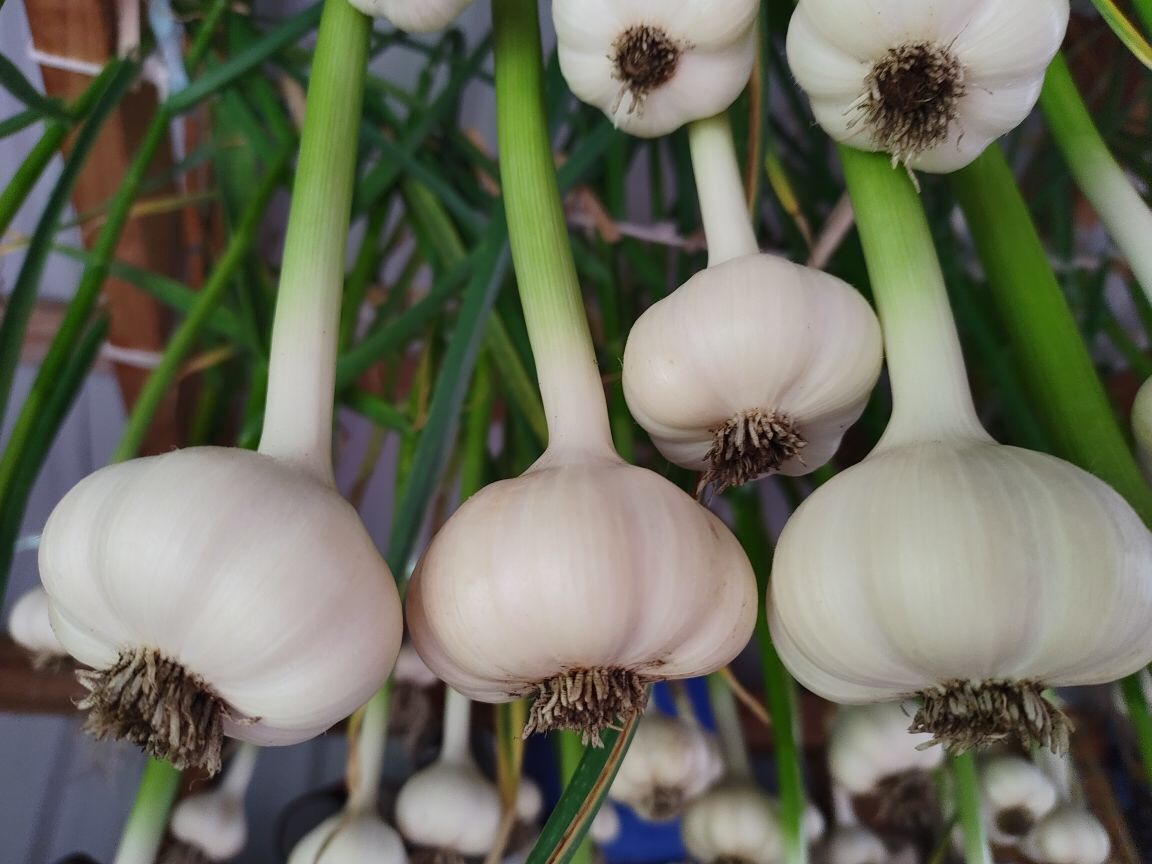
The garden continued to grow while we were consumed with party planning and even though we did our best to stay caught up, there were a few things that needed our fast attention once we were able to give it. Last summer we let our garlic stay in the ground a week or two longer than what was ideal and we didn’t want to let that happen again, so on Monday Dean pulled half of our bulbs and hung them from the rafters of the garage to cure.

Keeping the vampires away. Photo provided by Dean Sundmark

The strawberries I wrote about a couple of weeks ago are still at it, and we’re trying to pick a few whenever we get the chance. The black currants are just shy of being ripe and it’s the time of year when mushrooms start popping. There are herbs I want to gather and trees I’d like to transplant and about a million other things I’d like to do before it’s too late.

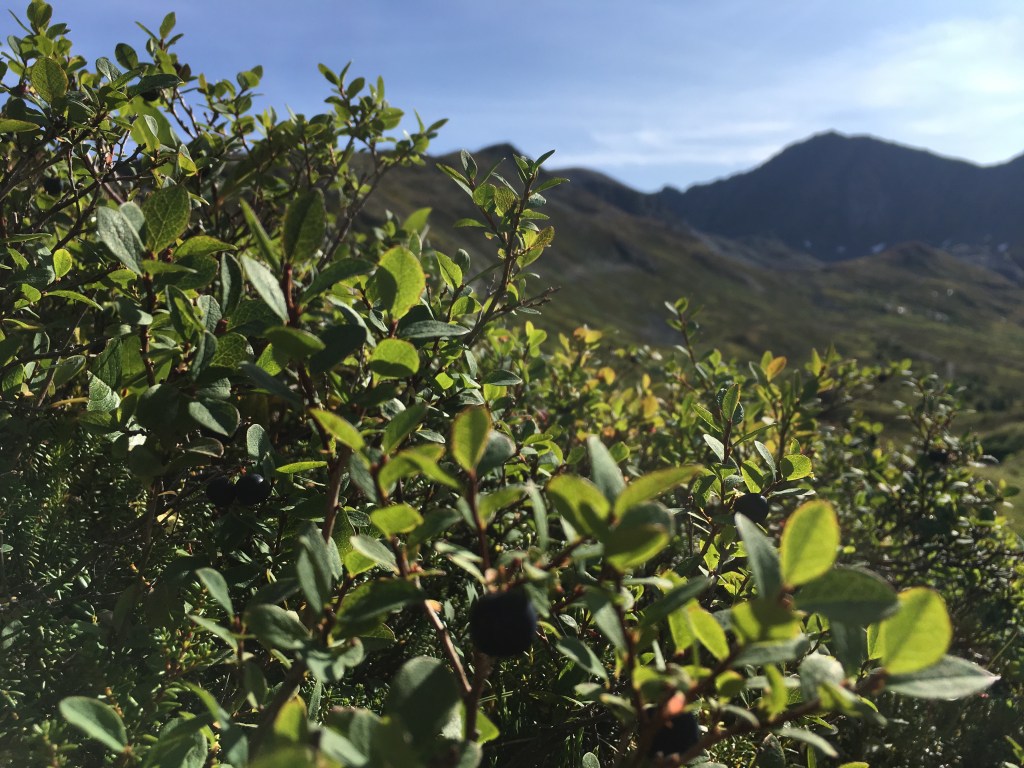
Even though the last several summers have extended well into September, August still feels like a race. There’s a short window of availability for certain things and if we miss that window like we did last year with the wild blueberries, we’ll have to wait for another year.

We don’t push ourselves all summer out of fear of not having enough or because we’re driven by the concept of self-sufficiency. Our reasons for doing what we do are a bit more fundamental. Each time we sit down to a meal that includes something we’ve grown or harvested, we have context to go along with what we’re eating. We remember the hope we felt when we planted the carrot seeds, the work it took to get them to germinate, and the excitement at seeing them finally sprout. We remember the baby magpie that hung out in the compost pile next to the potato bed and the squirrel family that raided our strawberry patch every morning around the same time we had our coffee. We remember feeling giddy at seeing those first purple nettle plants of the season and awe-struck by the sun filtering through the horsetail in the bog when we hunted for boletes.

We’re not pushing ourselves as much as we’re compelled by all of the possibilities of this place. We want to know the plants, the animals, the soil, and the patterns and cycles that make them all tick. And the more we learn, the more we see that there is sustenance here that goes beyond the physical level. It’s not unlike the feeling of being on the receiving end of a friend’s kindness.

The moon over Kachemak Bay on 8/18/2021

Five-Acre Almanac: Looking Out

Week 2

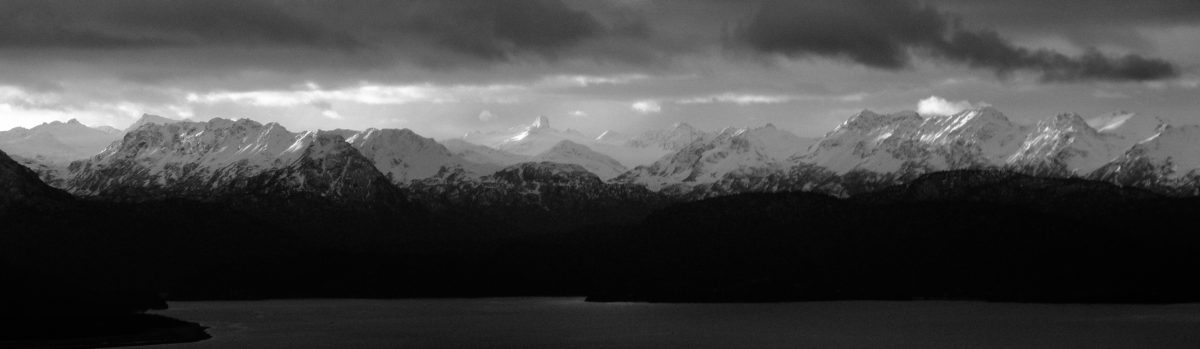
We have a big view from our property. When we stand on the edge of our meadow we can see nearly all of Kachemak Bay. We see mountains and ice fields and islands. We see where the river from the Grewingk Glacier spills into the ocean and when the sun is right we can see the way the silty water moves and disperses with the tides. The lights of the Homer Spit jut out into the bay, reminding us that in the distance there is a whole busy world of harbor life,restaurants, and gift shops.

When we moved here twenty-some years ago we could enjoy our big view from the picture window in our living room, but that’s changed. Nowadays most of what we see when we look out our south-facing window is green, at least this time of year.

A vegetable garden is directly in front of our house beside a small lawn, beyond that is a semi-wild area of raspberries, roses, and alders. Just to the south of all of that are several spruce trees that survived a bark beetle infestation that swept through the lower Kenai Peninsula in the mid 1990s. These days to fully appreciate our big view we have to go outside and take a short stroll down one of the paths we’ve carved out of the green zone that’s grown up between our house and the meadow below.

When the spruce bark beetles came through and killed all the mature spruce trees in their wake, we treasured the young trees that survived. Now those that were just a few feet tall back then have grown to create their own forest ecosystem, right in our view. The obstruction doesn’t bother me as much as it bothers other people, partly because I know that the panorama is just a few yards away, and partly because the forest gives us privacy and a protective barrier from noise and wind. And I won’t lie, I’ve become attached to a few of those trees, which I suppose is what happens when you watch a thing grow for a couple of decades.

Fire safety is on our minds though, and it demands that we start thinning some of our trees. Identifying the ones that need to go isn’t easy. How do we preserve the privacy and protection that the trees provide and still open it up enough to keep our house safe if a fire were to sweep through? Which of our favorites can we keep? The spruce bark beetles didn’t discriminate between the mature trees. They killed them all. I appreciate that I can be a bit more selective.

A few of the spruce have grown tall in precarious places. Removing them is going to require some fancy chain saw work and good planning so they won’t fall on our chicken coop or our garden. Most importantly I want to protect he grandmother birch tree that grows in the center of our five acres. I don’t know how old it is, but it was old when the original homesteader first got here. It’s the heart of this place, and my heart would break in two if a spruce tree fell on it.

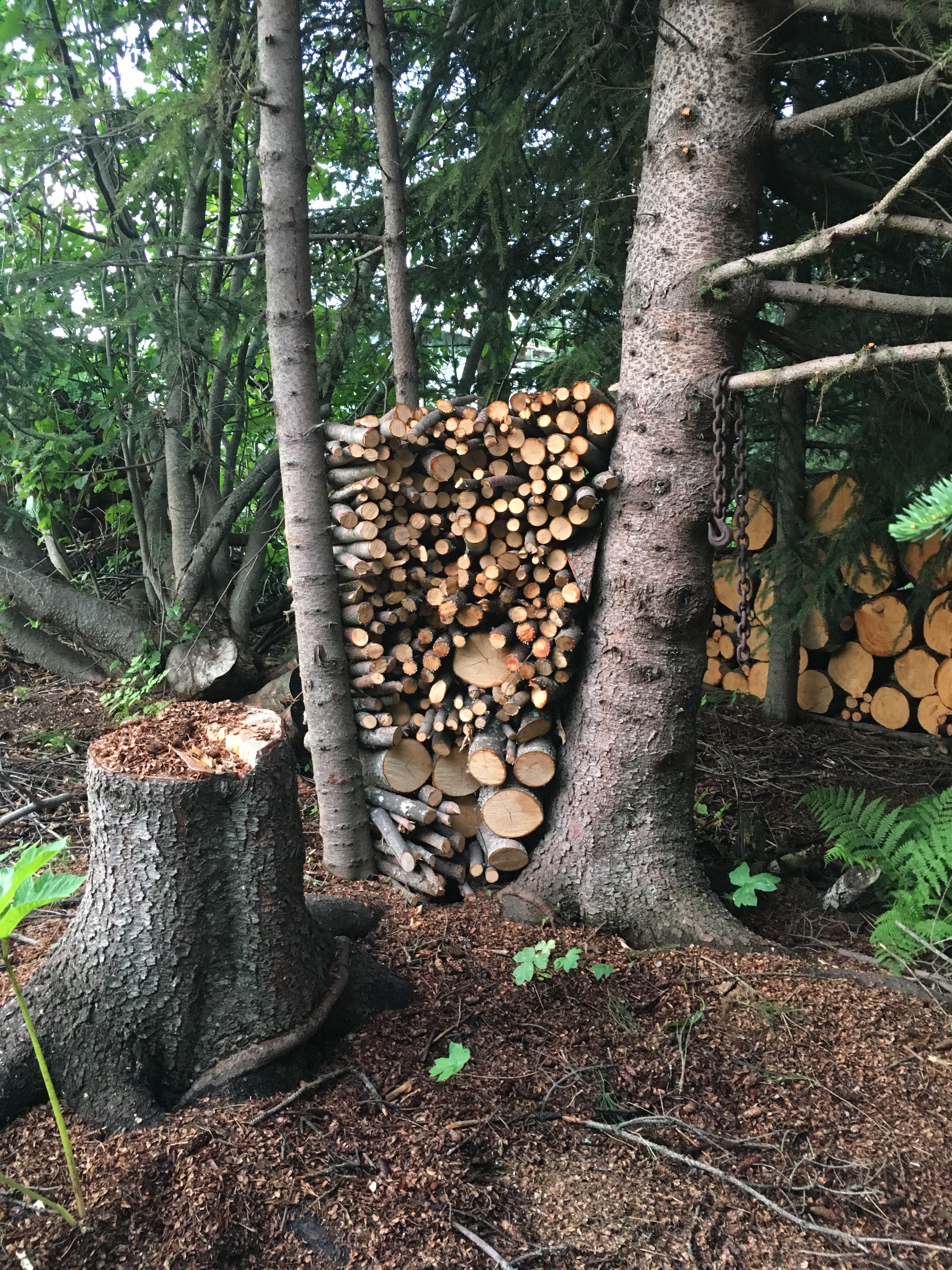
Last winter we dropped one of the more straight forward spruce trees, one that wouldn’t harm anything in its fall. Now it’s stacked and drying. Just that one tree going down made a difference in our view and the extra light from the cleared space is a noticeable change. More light is a good thing, for my psyche and for our gardens. I’m just hoping we can strike the right balance between open and protected.

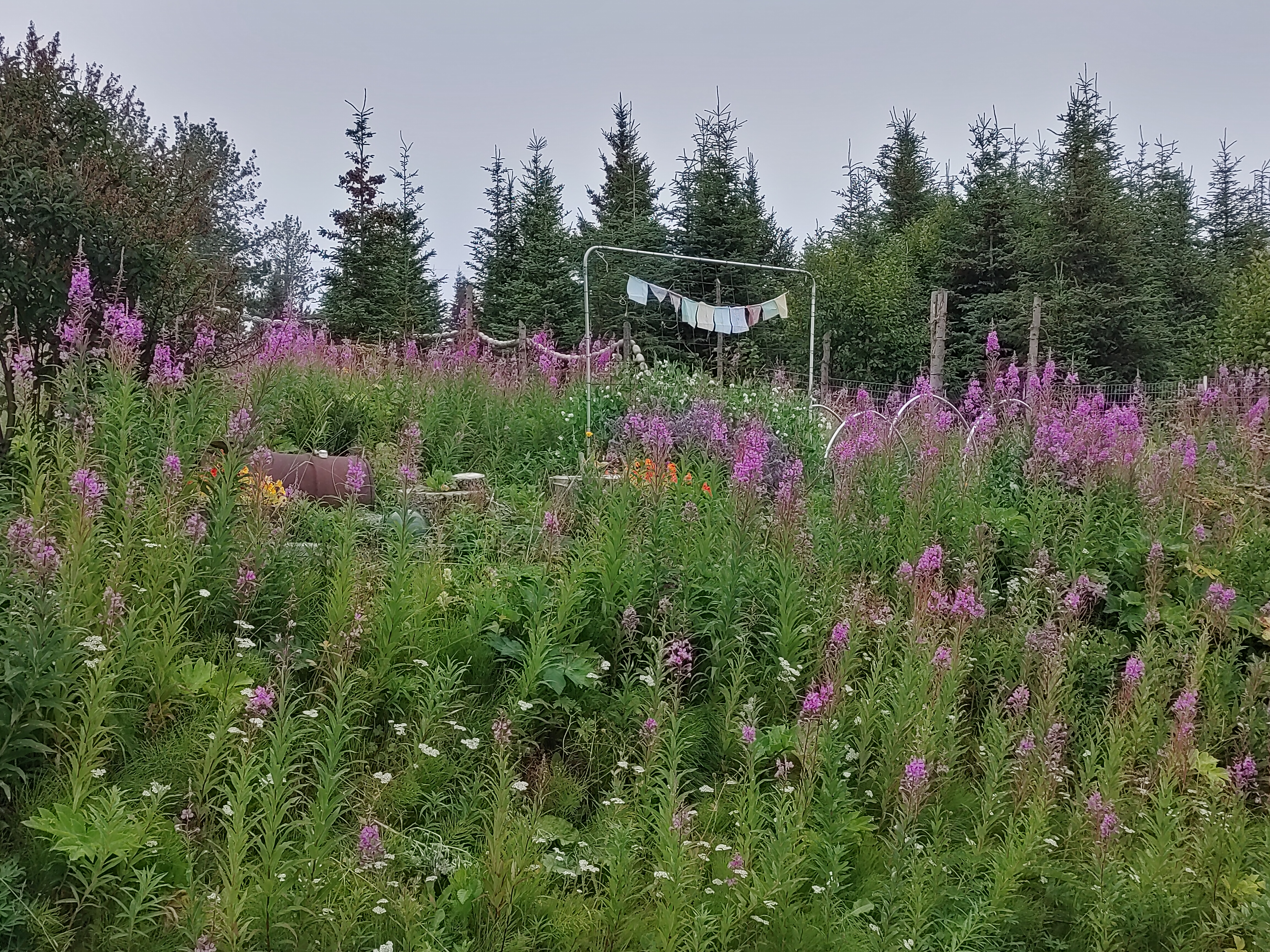
These days I gaze out the back window more often than the front window. There aren’t any bodies of water or mountains to look at in that direction, but there’s a stand of cottonwood trees in the distance where a family of bald eagles has built a nest, and right now the fireweed is blooming. The prayer flags we hung on our pea fence earlier in the spring have faded but everything else is brilliant. The orange nasturtiums against the fireweed against the bright white yarrow against a backdrop of green is like a magnet. My eyes are drawn to all that color. It feels nourishing the way sun on my skin feels nourishing in April. I’m taking it in while I can and trying not to mourn its absence before it’s even gone.

Five-Acre Almanac: Beginning

Right now seems an unlikely time to start a new writing project. It’s August in Alaska, which means that summer is speeding downhill. It’s time for berry picking and firewood stacking, time for cleaning out anything old in the freezer and filling it back up again with this year’s harvest. But I’m going to start it anyhow.

Earlier this year Dean and I acquired a business license and started Twin Fish Gardens. It’s a home-based endeavor and the idea of it came about in 2020 when all of our routines were disrupted and we had a bit of time to assess our lives. We asked ourselves questions. What brings us joy? What are we most grateful for? How do we want to spend our days? And we imagined creating something that would allow us to live in line with the answers to those questions. We don’t have a perfect plan in place and we expect there will be some trial an error along the way. But we knew it wouldn’t happen if we didn’t start somewhere.

This writing project is a part of Twin Fish Gardens. Each week I’m going to write an account of living here on this five acres of land. There’s faith and fear mixed into this commitment, but there’s also promise.

I’ll kick it off with strawberries.

1. Strawberries

I’m starting this at 10:00pm on the first Wednesday night in August, 2021 and outside there’s a thick fog. This afternoon we had an unexpected rain and it’s because of that rain that I’m inside writing instead of outside picking strawberries. The strawberries are only here for a time and the time is now.

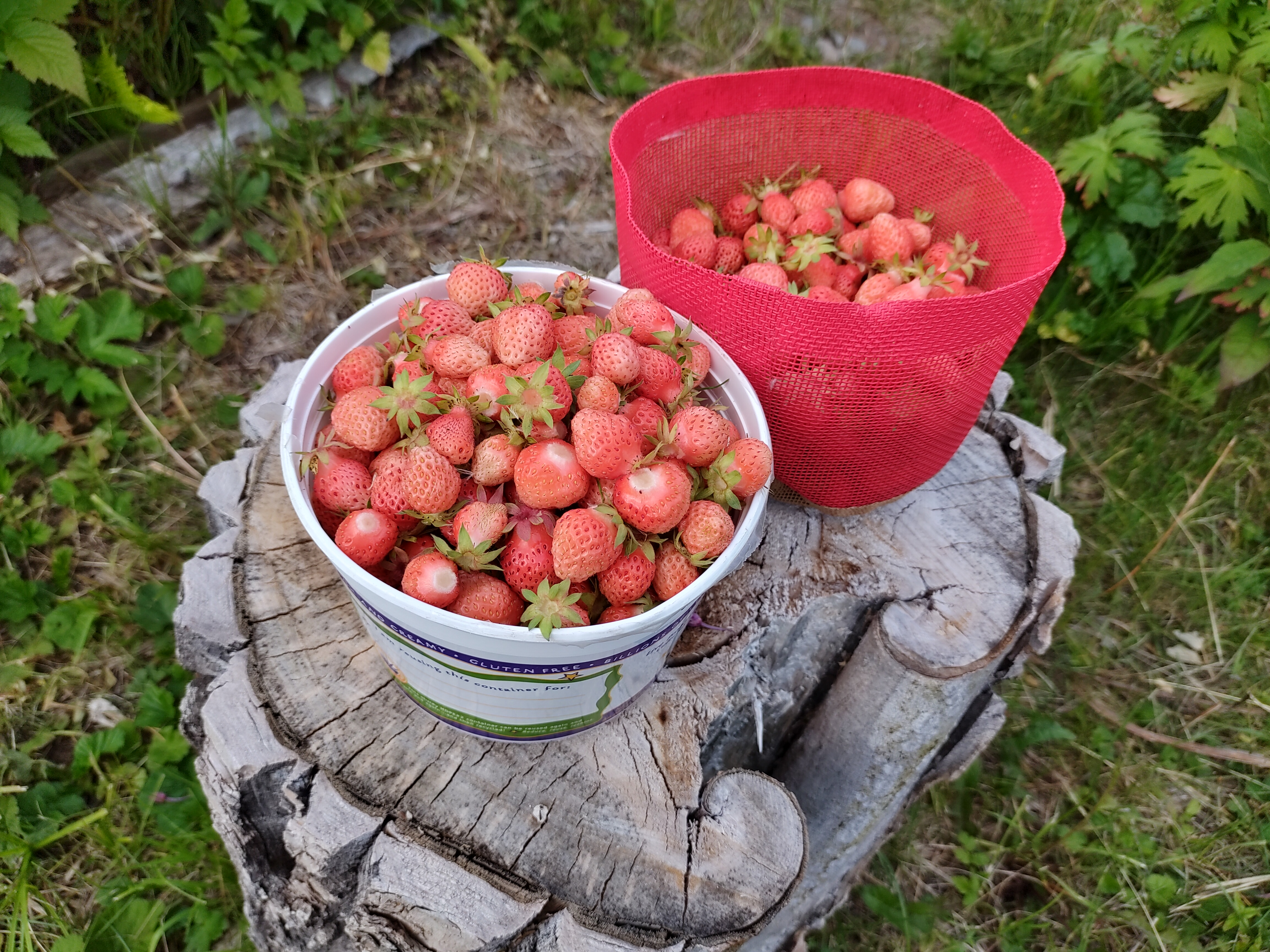
For the past two weeks we’ve picked twenty quarts of Sitka strawberries for our freezer and twelve pounds to trade. We’ve eaten them with abandon while picking and with a bit of sugar and cream when we’re settled back in the house before crashing into bed. We’ve shared with friends and we’ve turned a blind eye on our dogs sneaking into the patch and helping themselves. It seems like the more we pick the more they produce.

We’ve done nothing to deserve these strawberries. We’re just the recipients of a gift the previous owner planted nearly four decades ago. We don’t water them and we don’t weed them except for Dean’s occasional attempt to knock down the cow parsnip plants (locally known as pushki) so that we won’t be harmed by their photo-reactive juices when we’re down on our hands and knees, expedition style, in search of the soft pink fruits that are hiding among the horsetail and wild grasses.

We could spend our time weeding and keeping the strawberry beds orderly, but I don’t think we’d have more to show for our troubles. The way the plants are, free to do their natural berry thing in their natural berry way, seems to be working just fine. The horsetail between them offers visual protection from birds and provides them with an airy space in which to grow. The sprawling beds allow them to spread and put down roots in fresh places. They’d take over the whole place if we let them.

Strawberries are just one aspect of our garden. The snap peas are also coming on now, and after a slow start we’re finally eating broccoli and zucchini most days. The arnica Dean planted this spring has its first bloom and the wild plants we forage—fireweed, yarrow, pineapple weed, clover—are keeping our herb drying racks full. Slugs are also plentiful this year and one bed in particular has been hit hard. At this point we’ve sacrificed the kale plants around the edges in hopes that the slugs will be so enamored with them that they’ll stay away from the broccoli and cabbage.

There’s a lot we want to do around here and a limited amount of time, so we’re always looking for ways to be more efficient. The strawberries, along with the wild plants we forage, are a gift in that regard. They grow on their own and all we have to do is harvest. The same is not true for most garden vegetables. Most of the food we grow requires a lot more work and sometimes our efforts fail and our yield is much smaller than we’d hoped for.

How fortunate we are though, to live during a time when our survival doesn’t depend on whether we grow enough food. We can garden for the joy of it and if something doesn’t grow well for a season –and there’s always something that doesn’t grow well– we can either do without or buy it. This kind of freedom allows for creativity. We can try new varieties of vegetables. We can plant chamomile in between our garlic to see if it’s true that the two thrive next to each other. We can try different methods of gardening. Everything becomes an experiment and each season becomes a study. We plan for it over the winter, we plant it in the spring and then we watch and wait and learn. It requires patience and a willingness to get it wrong sometimes. But each year we do a little better. Each year we have a bit more to show for our effort.

Of course there’s more to summer than growing and foraging. We both hold full time jobs. In July we went to Georgia for our daughter’s wedding. This weekend we spent the bulk of two days at a music festival. Next week we’re hosting guests and throwing a party.

Extended, uninterrupted time for the things we love isn’t going to materialize out of nowhere. We have to do what we can and give up a few of the things that aren’t in line with the direction we want to go. Mostly we have to let go of perfection. I’ve written this post over a few days, between stints in the garden, in the mornings before work, fifteen minutes before bed. I’ve picked away at this the way I’m picking all those strawberries, a little at a time.

It’s more satisfying than television. It’s more uplifting than Twitter.

This place, these people.

         Image

          The temperature was dropping and a strong wind was blowing when I walked down the driveway after work on Thursday night. I am used to windstorms and cold, so I didn’t think much of it. But the gusts got louder and stronger through the night. Around 2:00am we heard one of the fiberglass panels from our greenhouse dislodge and it began to smack against the side of the house over and over again. An empty rain barrel crashed into the wall of our garage and then found its way from one side of our property to the other. It wasn’t a night for sleeping.

The next morning, the house was cold and outside the wind still blew–30mph sustained with gusts up to 60. We built a fire in the woodstove and when we opened the curtains we could see substantial sparks from the stovepipe flying through the air. The record breaking warm spell from January that had melted all of our snow was over, but the ground remained bare and vulnerable with dry grasses and brittle fireweed husks. Red flag fire warnings, standard fare for May or June, were issued in early February. Thankfully, the sparks fizzled out before they landed.

On my way to work Friday morning, gusts shook the car and blowing grit from early winter road sanding made for moments of no visibility. The pavement was littered with branches and debris. In three places I saw evidence of trees that had fallen and already been removed from the roadway. Halfway to town, a house with its roof torn and folded up on itself made my own sleepless night seem insignificant.

The wind didn’t let up all day.  In town, the library and the college lost power. Trees and power lines snapped. Roof shingles sailed through the air. Those of us who ventured out covered our heads to keep from getting dirt in our eyes and mouths. Everywhere it seemed people were on edge after having spent the night mentally holding down their homes and property.

Around noon, although it couldn’t be seen falling from the sky, cold, wispy, dry snow started to appear in the mix of blowing debris. After a few hours it began to accumulate unevenly—still bare ground in exposed places, but a few inches against buildings and in protected places. Finally, before we went to bed on Friday night, the wind stopped as abruptly as it had started the night before. I slept in the comfort of silence and a fresh blanket of snow.

***

             Everything that Friday was—violent, dusty, dark, edgy, uncertain—Saturday was not. The storm had passed, the skies were clear. The voice on the radio reminded me that we’re gaining five minutes of daylight a day.

I drank my coffee and had two productive hours of schoolwork in a sunlit room. Then I dug out my Mardi Gras beads and drove into town to watch the winter carnival parade. The parade doesn’t change much from year to year, but still I go. I love its silliness and its familiarity. It’s the town’s way of not taking itself too seriously. And yesterday, the day after the town felt like it was going to blow to pieces, everyone was relieved and festive and ready to have a good time.

Seeing friends at the parade led to an impromptu get-together of playing old-time fiddle tunes for a couple of hours in the afternoon. Later in the evening, we went to see the Irish band, Lunasa, at the high school. The place was packed and musicians played tirelessly and flawlessly for two solid hours.  After the show, we stopped at the Down East Saloon to enjoy Cajun music and one more showing of the Bossy Pants Brass Band that had marched in the parade. People were costumed and sparkly. The dance floor was sweaty and packed.

When we got home at midnight, I sat for a while and looked out the window at the stars. I thought about my day and how many friends I’d seen and caught up with. I thought about the way this town is molded by its crazy weather and its silly traditions. I thought about how I get weary of living here sometimes with the coastal climate, the distance from the rest of the world, the sameness, year after year. But then one sunny, musical day with a parade comes along and any bad thought that’s ever entered my mind about living here is gone as abruptly as the windstorm.

I went to bed with my mind still in motion. I could still see my friends’ children dancing to Lunasa’s hop jigs and reels. I could still hear the old time fiddle tunes I’d played in the cozy living room of my friend’s house. I could still see familiar faces parading through the middle of town—some on bikes, some on floats, some walking alongside their decorated farm animals.  I could still feel the rhythm of the Cajun two-step I’d danced with my husband and a hundred other friends.  When I finally fell asleep, I was thinking of all of us in this one place, all of us weathering every storm.

A Snapshot of Sadie

I wish I had a picture of Sadie. But even if I had a photo to go from I don’t think I’d be able to properly describe her. I remember a weatherworn face and a missing tooth. I remember her layers of clothes, faded and worn to a color similar to that of her skin. I remember the way her odor—distinct and offensive, but impossible to describe—lingered for a long time after she’d come inside to borrow our phone. And I remember her adamant warning that came every year in March:
“Beware the spring equinoxal,” she’d say.
***
Right now in Homer we’re gaining around five minutes of daylight a day. We’re looking at seed catalogs and planning our summer camping trips. The dirty snow berms on the side of the road are receding and the sun is high enough on the horizon to throw a little heat. Tasks that seemed overwhelming just a couple of months ago seem possible now.
And yet, suicide rates go up this time of year. The police blotter gets interesting and mental healthcare facilities fill to capacity. Couples who’ve held on through the winter give up and go their separate ways. It seems counterintuitive, but it’s true. This is a tricky time of year for lots of people.
When it comes to the spring equinox, Sadie was on to something.
***
I’ve been thinking about Sadie lately, wondering about her life, of which I knew very little. I was a teenager when Sadie used to make her way from the little shack across the alley to our house. But honestly, I never gave her much thought. To me she was just an eccentric old woman, living in a decrepit cabin. I knew she had a husband over there, a man called Monty, but I never really got a good look at him. They just existed there, on the edge of town. When I think about it, I’m not sure how.
I asked my mom about the old couple that used to live behind us, and she told me what she knew about Sadie and Monty Holbrook.
Monty kept to himself and Sadie came around to “borry” our phone now and then. She didn’t really offer much information about herself though, until one afternoon when my brother-in-law brought a horse he’d just acquired over to our place. In the driveway he tried repeatedly to get up on the horse, but every time he tried the horse would lie down. Sadie watched all of this from across the alley, then came over and asked if she could “have a turn at that horse.” She grabbed the reins, got the horse up on its feet and in a matter of moments had the horse “doing right.”
Sadie then told my mom that she’d grown up on a horse, had in fact ridden one from Canada to Mexico with an infant in front of her and a two-year-old behind her. “No horse would dared lay down or buck with me,” she said.
After the horse incident, Sadie talked more. She said she and Monty caught and broke wild Spanish mustangs for a living and trailed them to North Dakota. She also told my mom that Monty, who was ninety years old at the time, used to run with Butch Cassidy and The Wild Bunch. At one point a movie producer found him and wanted to interview him, but Monty chased him off with a gun and told him to “Git.” He was afraid that if people knew who he was he’d be arrested and hung.
***
One Easter Sunday morning, after I’d already moved out of the house, my mom and step-dad saw smoke billowing out of Sadie and Monty’s cabin and called the fire department. It was late in March. Medics came and took the two of them to the hospital. There they were treated for mild smoke inhalation, but other than that were found to be in good health. Monty put up quite a fight though, when the hospital staff tried to get him to bathe. He was of the belief that bathing too early in the year made one susceptible to pneumonia.
After their house fire, Sadie and Monty never returned to their home. They went to a nursing home in Fruita, Colorado to live near their daughter. My mom heard that Sadie was happy there—it must have been a huge step up in terms of ease of living—but Monty didn’t like it much. He died within the year.
* * *
Sometimes we wouldn’t see Sadie for several days, but then something would change and she’d come over several times a week. During the times when she’d visit frequently, she’d watch for us to come home. We couldn’t see her peering over, but moments after we pulled into our driveway we’d see her hunched figure making its way across the dusty alley and up the stairs to our back door.
I wish I had a picture of her now to remember her face, but more than a picture I wish I had a week of afternoons with Sadie. I’d ask her what it was like to break wild Spanish mustangs. I’d ask her what it was like to be married to an outlaw. And I’d ask her to tell me exactly why she was so wary of the spring equinox.
I’m guessing she had more stories to tell.

Wild, Wild Horses

Something to Say

You’d rather write about the charming side of your town, and for the most part you do.  But this week your town has shown its not-so-charming side.  Two brothers aged eighteen and twenty were arrested for sexual assault.  A number of other young people are afraid that they might be next because they were at the party where the alleged assault took place—with cameras in hand.  A young person was victimized; his life altered.  And so you want to write about your town and what it’s going through because people are shaken up about it.  But where do you start?   Your children are the same age as these children.  They’ve known some of them since preschool.

You want to write about the mother you spoke to today whose fourteen-year-old daughter was groped at her first high school dance, a place you’d expect her to be safe.  You want to write about how strange it is, adolescence.  How that window of time between trading Pokemon cards and being hormonally charged is so small, so small that you barely have time to catch your breath.  You want to talk about this terrible thing that happened in your town like it’s an isolated incident but this is nothing new and your town is not unique.  You write about your town and you write about every town and a culture that has allowed it to go on and on and on.  You write about how it was going on when you were in middle school and the boys chased you at recess and knocked you onto the grass and stuck their hands up your shirt and you write about it now because back then you didn’t tell anyone because you had it in your mind that it was just playful playground fun—even though it didn’t feel like fun to you.

You want to write about all of this and more, but putting it in words is difficult.  The thoughts are coming from so many different places and what you need to do is set the thoughts aside for a while and write from that place in your gut that’s holding it all in.  You want to write and you don’t want to write because it’s going to take you places you’ve been avoiding.  It’s going to take you places that you’ve held in secret for about thirty years and it’s going to make you feel vulnerable because somehow you still have it in your head that it was your fault, that you put yourself in a bad situation and so ultimately you are responsible.  You hate feeling vulnerable.

You’re going to say things about boys that have most likely grown in to decent human beings, stellar community members, charitable donors to their local nonprofits.  But you decide to write it now because it’s the only way you can express what’s going on inside of you when you hear about these two young men who have been arrested for sexual assault.

You knew boys like those boys in your school days.  They were the kids the teachers liked.   They were the kids you liked.  They played basketball and football.  They were witty and popular and you wanted their attention so badly.  And so when they gave it to you it felt like a privilege.  You with the crooked teeth, that lived on the wrong side of town, that had a step-father who wouldn’t talk to you and a father who never called wanted the attention of those boys and when they gave it you certainly didn’t want to tell them no.  And so they asked you to hang out with them after school one day and you said yes and it never occurred to you that you’d be the only girl.  And you went with them anyhow because you didn’t know not to trust them.  You went to one of the boys’ houses a few blocks from school.  His dad was home and so you went instead into their camp trailer that was parked in their front yard.  You don’t remember much about the camp trailer, just being shoved down on a little folding bed, and someone undoing your pants and another someone pulling them off your legs and there was laughing and you didn’t know you were crying until you felt the tears running down the side of your face and one of them put his head to your privates and said things and did things that in your naivety you never knew were things to do and the humiliation was more than you could bear and so when it was over you laughed along with them and pretended it was no big deal and then you walked home, alone and ashamed.  At home you ate dinner and watched Three’s Company with your mom and your little sister and your silent step-dad.  You talked on the phone with your friend for a while and you never said a word about what happened because you thought somehow you should have seen it coming.  You should have known not to go with them.  You should have been smarter.  You should have been prettier because the boys probably didn’t do that to the prettiest girls.  You should have, you should have, you should have and it never even occurred to you until several years later that the should-haves weren’t yours to own.

And so you want to write about your town and what it’s going through, because what your town is going through is a terrible thing.  But it’s been going on for ages.  The humiliating, the bullying, the assaulting, the tricking, the teasing, the hurting.  All of is has been going on in varying degrees in every town.  Your town is not unique.  The actions the two boys in your town have been accused of are not so uncommon.  What’s uncommon is their being called on it.  Victims blame themselves.  They try to protect their dignity and even their assailants with silence because the assailants are the good guys; they’re popular, the teachers like them, they make your town look good on the playing field.  But silence is more terrible than truth.   It perpetuates the belief that it’s okay.  It’s okay to rape a girl if she’s wearing a short skirt.  It’s okay to mess with the drunk kid.  It’s okay to tease the kid with a learning disability.  It’s okay to shame a girl for having sex.  It’s okay to shame a boy for not having sex.  It’s okay to beat up the gay kid.  It’s okay to pull the pants off the girl who was stupid enough to follow you into the camp trailer.

It has to end somewhere.  At some point you have to say enough.  It’s not okay.  And sure, what your town is going through is a difficult thing, but it’s necessary. It’s breaking the pattern of silence.

You write about it now, not because you want attention or sympathy.  You write about it now because there is this hope that by not brushing a society’s dark secrets aside, by saying something, by doing something, you’ll make a difference. You write about it now because when you were thirteen you couldn’t articulate the truth of the matter:  it’s not okay to hurt someone, grope someone, touch someone without consent even if they’re passed out drunk, even if they’ve flirted with you, even if they’ve wandered off with you.  You write because you hope for a future where open communication reigns and where victims don’t feel responsible for the actions perpetrated against them.  You write because there should be no excuses and no free passes when it comes to harming another human being.  You write, not because you have any answers, but because you have something to say.  You believe that when it comes to teaching respect and dignity we all have something to say.

Speaking of Chicken….

It seems that chicken is all over the news this week, and things are no different here at the Sundmark household.  Monday evening when we came home from work we discovered carnage in our yard.  The security of our chicken tractor—the one that got us through last summer with 25 healthy birds—had been breached.  Some kind of critter, most likely a dog, had broken the fiberglass greenhouse siding off of one side and proceeded to slaughter seven of our chicks.  The others went in to a state of shock and huddled together in a corner.  The ones on the bottom of the pile suffocated.  All together we lost fifteen of our chickens.

I know that eating local food isn’t going to save the world, but it’s a cause our family has decided to put some effort toward.  For us it means growing a garden or buying from local growers.  It means harvesting salmon, buying beef from our local cowboy, and raising our own chickens for both eggs and meat.  After the slaughter we found in our yard on Monday it looks like next winter we’ll have fewer chicken dinners.

There are plenty of foods I’m not willing to give up in order to eat a strictly local diet and so we spend a great deal of money on food that comes from places much warmer than Alaska.  I’m a big fan of apples, for example, and I have a weakness for the Rugged English Cheddar cheese that Save-U-More carries.  In fact Save-U-More is full of surprises, including an aisle of Trader Joe’s foods and an extensive organic produce section.  It’s a goofy grocery store with its bizarre layout and its incessant rearranging, but for the most part it keeps the foodies in Homer happy.

For the size of our town we have a good selection of restaurants and cafes as well.  Back in the day when we ran a bed and breakfast we had a guest one time that expressed surprise that a few of our nicer restaurants stayed open through the winter.  I tried to explain that in Homer people have priorities that might not be the same as in other parts of the country.  We may only buy a new pair of jeans every two or three years, and we may drive a Subaru that can only be entered through the passenger side door (true story) but we’ll spend good money on good food.  A few of our higher end restaurants have survived when Arby’s and Burger King couldn’t make a go of it.

And so it’s safe to say that after living in Homer for eighteen years I’m no expert on fast food.  I eat at the local Subway once every couple of years, and I haven’t stepped inside the local McDonalds since my niece worked there several years ago.  When I go to Anchorage there are so many great places to choose from that fast food doesn’t even cross my mind.  What all of this is getting at is that I’ve never eaten at a Chick-Fil-A, and I never will.  I wouldn’t have even if Dan Cathy had never made his statement in opposition to gay marriage, or if the company had never donated millions of dollars to organizations like the Family Research Council.

When I came home on Monday to find a bunch of dead chickens in my yard I had the realization that something I thought was secure was in fact very vulnerable.  I feel the same way today after seeing photos from around the country of crowds of people lining up to eat at Chick-Fil-A’s.  I thought we were moving beyond homophobia, but I see that we have a long way to go.  I believe that for some people eating at Chick-Fil-A this afternoon was a matter of showing support for our first amendment rights, but I don’t think that was the true motivation of most.

I’m in the fortunate position of having a diverse group of Facebook friends.  They cover most sides of any political issue and this whole Chick-Fil-A thing is no exception.  One of my friends stated in a thread that people were just taking a stand for Godly values by showing their support for Chick-Fil-A.   A couple of people on this thread even evoked the old saying, “hate the sin but love the sinner.”  It shows me that to them today’s turnout for chicken sandwiches wasn’t about first amendment rights.  It was about speaking out against homosexuality.  What I want to point out is that hating the “sin” in this case is synonymous with hating “the sinner,” because it’s not a matter of deciding to be gay; it’s a matter of being gay.  And that hatefulness, no matter how it’s framed, is disheartening.

A line from a John Gorka song comes to mind sometimes when I feel overwhelmed by the way humans build up walls and divisions between one another… We are here to love each other, that is all…

I know it’s only a line to a song and that it’s not realistic to think that this world will ever be a place where all people show love to one another all the time.  But the truth is that we all have the capacity for love on an individual level.  Every day lives are changed and attitudes are changed; every day individual worldviews are changed because one person somewhere decides to imagine the world from another person’s point of view.

We’re a diverse bunch, us humans.  Some of us will raise our chickens ourselves, some of us want ours served with a side of waffle fries.  Others of us would never think of eating a chicken.  The reality though is that we all get hungry.  Our differences are lower on the scale of importance than the things we have in common.  Let’s focus less on the ways we fill ourselves up, and more on the fact that we all need food.

Gradual Thaw

As many of you know, it’s been a big snow year in south central Alaska.  A few big storms left us buried early on, and due to the cold temperatures it never melted.  It just kept adding layers until finally, sometime around the spring equinox, we crossed over into the thawing stage.

It hasn’t been as messy a breakup as some years; we haven’t had much rain or a thin layer of volcanic ash on top of the snow like we had a few years ago when Mount Redoubt blew.  That year when the sun came out the snow melted so fast that the streets flooded.   Even the mountains across the bay lost their white cover in what seemed like a matter of days.

But this year the thaw is gradual.  Every few days we’ll discover something new in our yard that has been buried all winter—a missing shovel or the dogs’ Frisbee.  And the melting is uneven.  The snow drifts were highest on the west side of the house, which means that the crocuses are still under nearly three feet of snow.  In the front yard, where the sun blazes against the blue siding of the house, some nice heat is generated. There a few blades of grass are turning green and the chives are poking through, long enough already to add to the scrambled eggs.

*  *  *

      I think about my dad this time of year.  It was five years ago in April when we realized he was dying.   By the time they’d diagnosed him with Multiple Myeloma it was too late.  That year, in the time it took to go from winter to spring, I had to adjust to the idea of my father being gone forever.

One of the hardest things, one of the things I never admitted to him, was that I don’t believe in heaven.  When I said goodbye to him, it was really goodbye.  I didn’t have any notion of all of us someday feasting together at a common table situated somewhere on streets paved of gold in the sky.  It’s a lovely idea, a hopeful idea, but I can’t make myself believe it—even though I’ve tried.

Since my dad’s been gone I’ve been able to be more honest about my beliefs, or, as the case may be, my non-beliefs.  While he was still around I didn’t want to risk the possibility of  him thinking less of me.  And once he was gone it didn’t take long for me to find the courage to voice my opinions.  The year after he died I published my first piece of writing ever, and it had to do with the offense I felt at all of the hell-fire talk my family had to endure at the ceremony outside of Telluride when we scattered his ashes.  It was a traumatic event for me, but it was the beginning of my own gradual thaw.  Things I’d kept hidden away began to surface.  They’re still surfacing.

I’ll never know exactly how things would be if my dad were still here.  Would I have figured out a way to be honest with him about my beliefs?  Would I be as outspoken about my tendency toward agnosticism?  Sometimes it’s easier to hide the truth than it is to hurt the people we love.  I like to think that if we’d had more time we could have navigated our way through our differences.  My dad may not have understood me, or my way of thinking, but he loved me and I loved him.  And love has a way of superseding belief, if we let it.

49 degrees

It’s Thursday morning and I’m moving slowly.  If I’m lucky I won’t have to leave the house today.   It’s -3 degrees outside and our 1970s-built house is struggling to hold the heat.  Yesterday when I got home from work I discovered that I’d shut the woodstove down just a little too tightly and the fire had gone out.  The house was cold—a mere 49 degrees—and I had to devote my evening to warming the place up.  Today I have the luxury of staying home.  I’ll tend to the fire; cook something slow and savory.   I’ll have time to work on my story and go for a walk and read.

Funny how staying home feels luxurious these days.  When my children were small and I didn’t work away from home I was always looking for reasons to leave the house.  I needed to get out.  I rarely had time to read or write so I had to go searching for ways to stimulate my brain.  I needed to converse with other adults, go to performances and seek out activities that gave us a break from the routine of being home all the time.  I had to go away to find the space I needed in my life.

The other night I met with a group of writers at the library to discuss our projects and ambitions for the year.  My friend Bill, an elementary school teacher and poet, talked about how last year he had more time for creativity in his life with his middle child on foreign exchange and his older child at college.  He described it as having more “bandwidth.” I could relate.  I’m starting to feel the effects of more bandwidth in my own life.  Less than two weeks ago my son left for college and my sixteen-year-old daughter has taken a huge leap in self-sufficiency now that she has her driver’s license.

It’s a slow, gradual process, this gaining extra bandwidth.  It’s an hour of not driving to town and back.  It’s a night at home with my husband while Adella is gone on a DDF (drama, debate and forensics) tournament.  It’s more frequent evenings with no Netflix or television.  It’s a little less cooking, a little less cleaning.  It’s a lot less time spent waiting.

The extra bits of time are small, but they’re adding up.  There’s a part of me that feels I should be using this extra time to write more prolifically or get to work on our never-ending list of home projects that have been put on hold for the last several years, but so far that’s not what I’m doing.  So far with my extra time I’m doing a lot of wandering around, staring out the window, reading, thinking.

I have a suspicion that most people my age, especially parents, have a hard time allowing themselves much unqualified time.  I think about my friends around town.  Some of them homeschool their own children (which is a full time job with very few breaks and no pay) and yet they still manage to keep their families well fed and their houses in order.  One of them directs a nonprofit agency and spends her weekends shuffling her daughter around the state for hockey tournaments.  One wrote a book and earned an advanced degree while teaching school.  A co-worker of mine volunteers in her children’s classrooms on her days off and then at night, when the rest of her family is in bed she studies for a couple of hours.   It’s probably best if I don’t compare myself to these friends of mine who seem to use their time so efficiently. At least not right now.

In a society that measures productivity by the number of dollars earned or tasks completed, I’m falling terribly short.  I could be looking for ways to earn more money.  I could go back to yoga class or involve myself with one of the many nonprofit organizations that are doing great things for our community.  But for now, I just want to stay home.  I want the company of my dogs.  I want to walk around my property and notice all the things that go unnoticed in a hectic life.  I want to take naps and drink tea and sometimes play the same fiddle tune a hundred times until I get a certain part just right.

For now, the little bit of extra time and space in my life feels good—nourishing even, after many intense years of raising children.  Of course there are still bills to pay and debt and chores and work, but there is more space around each of those things as my children move on with their own lives.  So today my tasks are to play my fiddle, make dinner, keep a hot fire in the woodstove and finish this blog post.  Tonight I’ll spend the evening with my daughter before she heads off to Anchorage for another tournament this weekend.  I probably won’t set any productivity records or add anything of great value to this world, but for today it’s enough.  Sometimes in the middle of winter, in a poorly insulated house, it’s enough just to keep the temperature above 49 degrees.

 Image