Open Heart

I have spent the past week getting reacquainted with my heart. I’ve cried. I’ve played a few of my favorite songs over and over again. I’ve taken my fiddle out of its case and played the modal, soulful tunes that I love best.

All of this tending to my heart came about after I learned of a friend’s death last Wednesday. Trevor Stuart was a fiddle teacher of mine, and his passing was unexpected and sudden.

I wasn’t especially close to Trevor. Aside from his twin brother Travis, I’d never met his family. I hadn’t seen him for several years. I only knew a little of what was going on in his life by his occasional Facebook posts. And so this sorrow I feel over his death is something of a nostalgic sorrow. It’s not the true, deep sorrow that his family must be feeling. But it is sorrow nonetheless. He died too soon.

I met Trevor and Travis at Alaska Fiddle Camp almost a decade ago. They came from North Carolina to teach old time fiddle and banjo. I felt at home with them right away. They were funny, sincere, open and kind. Of all of those traits, it was their openness that stuck with me. They were open to friendship and they weren’t interested in proving that they were accomplished musicians or important in any way. They were just there to play music and have a good time. It was also apparent that they loved music, and not just the kind they were there to teach. When they had the time, they’d sit in on the Irish fiddle and bodhran classes. Late into the night they’d sing country songs, 80s pop songs, whatever. Music was more to them than a genre or a style. It was bigger than that.

One thing that always stood out about Trevor’s teaching style was that he taught tunes rather than technique. He seemed to know that the tunes would mean something different to every fiddle player, and so he didn’t try to get his students to play the tunes exactly as he played them. He didn’t insist on teaching them precisely the way he’d learned them from some old recording. He trusted that the tunes were living things and that variation, interpretation and evolution were part of the nature of old time music. He loved the music and what it could do. He trusted that the tunes would be just fine once he passed them along.

His own old time fiddle playing was as soulful as any that I’ve heard. He must have worked hard to master the technicalities of playing, and thank goodness he did, because his mastery allowed the heart of his playing to shine through.

And I suppose that is why I’ve been so deeply saddened by his passing. Trevor had heart. It came through in how he treated people and in how he played music. My own life was enhanced by the music he taught and played and by the kindness he and Travis brought with them from North Carolina to Alaska. I know I’m only one of hundreds who feel that way. And I, like so many others, assumed that we’d see him again someday.

As humans, our capacity to love is so great, but often we forget this. We squander our energy for love on things that matter so little.  We get caught up in sounding smart, in trying to be important, in trying to acquire status or material possessions. We forget that we are meant for so much more in this life.

Trevor’s unexpected passing won’t change the course of my life the way that it will his family’s. But it has done something. Over the past week I’ve felt my heart wedging open. It feels like it’s coming out of a deep, long sleep. It feels vulnerable and awake. It feels like it’s beating along to some tune that I haven’t yet learned how to play.


*Thank you to David Bragger for the wonderful recording of Trevor and Travis. David’s work is exceptional. To learn more about it go to The Old-Time Tiki Parlour.


Halibut and Cannabis Capital of the World

Here I go, writing about something I never imagined I would write about on this blog: the legalization of cannabis, marijuana, weed, pot. It’s something I haven’t cared much about in the past, but I care about it now for a number of reasons.

As I watched my home state of Colorado decide whether or not to legalize marijuana, I listened to the arguments both for and against. I began to educate myself both to the true nature of the plant and to reasons it was deemed illegal in the first place. Since its legalization, I’ve  asked a few family members who live in Colorado if they’ve witnessed any serious problems and the ones I surveyed said that they have not. This is coming from people who have no interest in partaking themselves. I do realize that there are plenty of others who may feel differently.

For me, the strongest argument for legalization has to do with justice. Too many people are spending time in jail for cannabis related crimes and more often than not it’s not the middle class or rich users that are getting caught, but the poor, the minorities, the ones who, for whatever reason, the police are watching closely. The more I read the more I realize that marijuana being classified as a Schedule 1 drug is completely misguided and wrong, and the more I learn about the drug war, the cartel, the criminal justice system, the more I realize that this legalization thing matters. It’s something wrong with our system that is worth correcting.

I was pleased when Colorado made marijuana legal and I was pleased when Alaska followed. That being said, I know that legalization is not an easy process. There are rules that need to be sorted out and there are long held misconceptions that need to be addressed. I also know that legalizing cannabis is not a comfortable notion for everyone. I respect that this is going to take some time.

Homer is in the smack dab middle of these legal cannabis growing pains and right now a great deal of time and energy is being spent on the decision of whether or not to allow commercial cannabis operations within city limits. I know it’s within the city’s rights to opt out, but personally I don’t see any advantage to doing so. Opting out would keep the city from gaining any tax revenue that might come from cannabis enterprises, but it would not keep cannabis out. To me, opting out is just a way for the city to take some imaginative moral stance.

I imagine a welcome sign on the edge of town, one that a visitor might see after stopping outside of city limits at a retail cannabis shop:

Welcome to the Halibut Capital of the World. We’ll gladly take your money for as much booze as you can buy, but we don’t want your pot dollars. We’re above all that.            

            Or:

Welcome to the Halibut Capital of the World. We used to have a well-funded fire department and library, but our superior morality prevents us from getting revenue from a regulated cannabis industry. Instead we are desperately looking for other ways to fleece you.

            Or:

Welcome to the Halibut Capital of the World. Here we will let you use as many plastic bags as you want because we believe in your freedom to use them, but we don’t believe in all freedom. Here we have decided for you what legal substances you may purchase.  (If you live in Homer, you know about the plastic bag ban controversy of a couple of years ago.) 

            I know I’m being sarcastic here, but honestly, what is it that people are afraid of when it comes to marijuana? Are they afraid that kids will have access to it? If that’s the case, then they must not realize just how readily available it already is. If anything, regulating it and having retail cannabis shops for those 21 years and older will make it more difficult for kids to get their hands on it. Have you heard what happens when adults get caught providing alcohol to kids? They get in serious trouble. Lessening the demand in the black market will likely make it more difficult for kids to buy and sell pot, but then again, maybe it won’t. It’s legal to grow marijuana, and kids who really want it will probably always be able to get it. It’s a fact, like it or not. Just the way that kids who want to have sex in their teens will likely go about their business whether we like it or not. What we can do is educate them, supervise them, and give them some decent alternatives as to how to spend their time.

Are people afraid that a few retail cannabis shops will attract a bad type of person to town? I suppose that requires defining a bad type of person. Homer has always been a place where young people come to live and work on the Spit for the summer and I am fairly certain that those who want it can find an ample supply of marijuana here. Having a legal way to purchase marijuana will mean that those young people who come to town are less likely to get in trouble, and if they aren’t getting in trouble then maybe they aren’t a bad type of person. See how that works?

I think that what the issue of cannabis in city limits comes down to is that there are still a number of people who are uncomfortable with the fact that it’s legal. I’m uncomfortable with the fact that MMA fighting is legal. I’m uncomfortable with a number of different religions. I’m uncomfortable with Hummers and Big Gulps and violent video games. But I recognize that these things are legal. I respect that individuals can make their own choices in regards to these legal entities and products. I am morally opposed to them and yet I realize that we live in place where people can make the choice to partake in things that I don’t necessarily approve of.

Mostly I’m afraid of the City of Homer taking a moral stand. It is not the place of a city to set moral standards. Let the churches set rules for their parishioners. Let parents set rules for their children. Let adults figure out where they stand on the use of marijuana and alcohol. I realize that the legality of marijuana is new and that means we are stepping into new territory. But it seems a shame to prevent a few rule-following entrepreneurs from running regulated cannabis businesses within city limits. If residents of the Lower Kenai Peninsula don’t want to support those establishments, they don’t have to. If there is no market for those legal cannabis businesses, then they’ll likely close down after a time. If however, there is a demand for their services and products, the City of Homer will gain some much needed tax revenue.

To end this discussion about the legality of cannabis in Homer, I want to suggest that the City of Homer has bigger problems to worry about than a few legal cannabis related businesses in town. We are a town in a state that is facing a huge budget crisis, a budget crisis so big that we can scarcely imagine what’s in store for us over the next several years. We need to think about diversifying our revenue sources. We need to become less reliant on the oil money that has sustained us for so many years. We need to think of ways to keep our police and fire departments well staffed and well funded. We need to keep the doors to our library open because as money gets tight for more families–and it will–people will need the resources it offers. In short, the City of Homer needs to make some money.

Marijuana is going to be a part of our culture whether we are morally in favor of it or opposed to it. The difference is not in whether or not cannabis is going to be here, the difference is that now the City of Homer has the opportunity to use its legality to its advantage.

My hope is that the city council can come to a decision to allow cannabis industries within the city limits without having to take this to a citywide vote. If they can’t, then I hope the city residents will vote to make it so.


Recovery

chicken in the house

I have a chicken in my house. She’s nestled in a straw-filled cardboard box in my daughter’s bedroom. Newspaper is spread over the floor and every few hours I go in and take her out of the box so she can walk around a bit, fluff out her feathers and spread her wings.

I probably should have taken a friend’s advice and offed her when she was a chick. I should have done the deed when it became apparent that she was weaker than the others in her flock. But I didn’t. So here I am with a chicken in my house.

While the other chicks put on weight and seemed to thrive, this one—a fluffy, feather-footed brahma—stayed significantly smaller. She had tremors from time to time and was always a step behind the others. But I didn’t kill her off. She didn’t seem to mind her status as the weakest of the flock and the others didn’t pick on her, so I held out hope that she’d catch up. But she never has.

For being with a rooster and six other hens that are much pushier than she is, it’s remarkable that she’s done as well as she has. She’s been able to sneak between the legs of the others to the food bin and she finds her way to the kitchen scraps that I offer. At one point in the summer, a neighbor dog came into the yard and attacked our chickens. When I assessed the damage, I found small pile of white feathers and figured she was toast, but later that evening she was back, no worse for all the excitement. Even in her weakened state, she escaped a dog. She had an instinct to live. After that, I figured she just might make it.

But last week I could see that something was wrong. The comb on top of her head was sickly pale, she was wobbly on her feet and she didn’t rush to greet me. At one point she was hunkered down outside of a laying box and another hen jumped on top of her and used her as a springboard. That’s when I decided to bring her inside.

“I’ll take care of her for you,” my husband said.

He wasn’t offering to care for her.

“Let’s give her a few days,” I said.

It’s been three days now. The comb on the top of her head is looking brighter. She’s getting steady on her feet. She seems downright excited when I go in to check on her. This is not surprising since she is in a heated room, does not have to compete for food and has been given hard-boiled eggs, lettuce, and sesame seeds to supplement her diet. Earlier this afternoon I took her out on the deck for some fresh air and she turned around and headed straight back to the front door. She may be the weakest of the bunch, but she’s no dummy.


I watched a documentary a while back and in it the filmmakers went to a chicken factory farm. It showed one of the workers walking through the place picking up corpses of chickens that had died in the night. He was talking to the camera and not fazed at all by his chore of throwing the dead into a big pile. To that worker, the chickens were something besides animals–they probably had to be in order for him to do that kind of job.

To be clear, I’m not such a terrible softy. In my years of raising chickens I have discovered a few of my own that have died in the night. I’ve disposed of their bodies without fanfare or undue emotion. I’ve even raised chickens for the purpose of eating them. I’ve helped with the butchering. I’ve dipped their dead bodies in boiling water, plucked them clean and wrapped them in butcher paper.

So why is it that I care about this weak little chicken so much? And while we’re talking about it, why is it that I am having a hard time imagining butchering the rooster that’s out there, bossing around the flock, crowing like a maniac during daylight hours and eating up more than his fair share of the expensive chicken food that I buy?

Maybe I am a terrible softy.

And I have to ask myself, what happens if this pretty little white tremor-prone chicken gets better? She’s never going to be as robust as the others. She’s never going to lay enough eggs to justify the cost of the feed it takes to keep her alive. And the rooster, he’s not giving anything back. He’s never going to earn his keep.

Maybe this is the crux of my dilemma: Killing these unproductive chickens makes sense if money is what’s most important. But I don’t see these animals as just a commodity. I realize that is something of a luxury since my family is not going hungry, since our survival does not depend on the maximum number of eggs, since a little extra money spent on chicken food is not going to leave us wanting.

But what to make of that little voice that says, “Just cull the flock of the weakling. Just butcher the damn rooster and have a nice chicken dinner.” Is it my own stubbornness that makes me want to ignore that voice?

I admit that part of my decision to tend the flock—weakling and rooster included—is an experiment. I want to see what happens when the chicken is given a little extra care. I want to know if there is intrinsic value in keeping these animals alive.

If I think about it too much (and I am) I have to ask myself if this is a selfish kind of kindness. Am I just making myself feel better by tending to this floundering chicken? Maybe, but it’s not as though I have a close relationship with this animal like I do my dogs. I haven’t named her. I’m not going to let her live in the house indefinitely.

I think it has more to do with what feels natural to me. Caring for this animal is not something I have to force myself to do. It’s easy. Sure it takes time and effort, but I don’t have to dig deep within myself to find the strength to do it. Killing it, on the other hand, would be a stretch—unless her suffering became too great.

Right now she seems to be okay with being alive. She stands up in her box when I enter the room. She’s eager to check out whatever morsel I have to offer. She’s making progress. So I’ll continue to root for this underdog. I’ll try to bring her back to health.

Her recovery will be a nice reminder of what is possible.

Maybe she’ll even get a name.


November Morning

OLYMPUS DIGITAL CAMERA
November Sunrise

Two summers ago when an old, dilapidated greenhouse on our property was torn down, the view behind our house opened up. For the first time since we moved here seventeen years ago we could see the cottonwood forest that sits above us on the neighboring property. I was happy to discover that every evening around sunset a pair of eagles found their way to one particular tree and perched there overnight. It was like clockwork—when the sun went down, they’d land on a sturdy, almost perfectly horizontal branch, and stay put until morning.

The sun dips below the horizon earlier every day now, and it’s the time of year when our small house starts to feel even smaller. As the darkness expands, our house seems to shrink. Nighttime encroaches on morning and evening. Incredible sunrises and sunsets  mark the transition. More than the darkness, it is the sameness that seems remarkable this time of year. I tend to sit in the same place every evening, drink the same tea. In general, I move into a routine that unintentionally becomes a bit rigid. I’m content here and I don’t have much desire to leave the house. When I do venture out, I daydream about coming back home, starting a fire, reading a book and writing.

A few weeks ago I was in Philadelphia and New York visiting our daughter during her fall break from school. It was my first time in either of those cities and being in such diverse and densely populated places was a feast for my senses. I’ve only lived in small, western towns where white is the predominant skin color, where at every place of business I’m bound to run into someone I know, where I rely on mountains to gauge direction, rather than the sun.

The way city dwellers need to get out into nature, I needed to spend some time in a city. I needed to see people different from myself. I needed to hear different languages and witness a way of life so very different from my own. I came home feeling more confident. I could get used to being in a city—could even live in one if circumstances took me there. This was good because growing up in rural places had me feeling wary of cities.

I’ve spent a lot of time in the kitchen lately. For the month of November we’re trying to eat only foods that we prepare—nothing from a box or a bag. It only works with planning and so I am in the kitchen a lot and when I’m not in the kitchen I’m thinking about food. What to make? What to add to the grocery list? How much time do I need to allow? This works only because of the sameness of November—no vacations this month, no company. In November we have more time in our lives without the garden to tend to, without the frequent outings of summer.

Our son is twenty-three and living at home for just a little while longer. Soon he’ll have a place of his own, a yurt he’s helping build. As his move out date approaches, he’s watching me cook and asking questions. “How long does it take to make rice?” “How long do you cook beans in the crock pot?”

Our daughter is nineteen and on the East Coast in her junior year of college. It’s been almost a year since she’s been home. As we walked around the streets of NYC and Philadelphia a few weeks ago, she talked about home cooked meals and our dogs. She misses fires in our wood stove and seeing mountains. In a month she’ll be home for winter break.

Early last summer, someone bought the land to the east of the eagle tree and almost immediately a new house started going up. As I expected, the eagles stopped perching in their usual cottonwood tree. I looked for them, but they had moved on, no doubt to a tree far from any construction zone.

Late Wednesday afternoon last week I was chopping potatoes and onions for a stew. Tears were streaming down my cheeks as I cut into the onion and I had to stop for a moment to keep from chopping my own fingers. Even before the onion, I’d been on the verge of tears for a few days after hearing about the death of a young man who’s the same age as my own son. I didn’t know him personally, but I know his dad. His mother and I once commiserated about the messiness of our son’s bedrooms. They are the second family I know who lost a child this year. While 2015 will be a year that will likely lose its significance for me over time, they will always remember this year as the year they lost their son.

I used a paper towel to dry my eyes and I took a moment to recover from the onion chopping. As I looked out my kitchen window an eagle swooped low in the cottonwood forest. It made a couple of passes before it landed on the tree with the perfectly horizontal branch. A few minutes later the second eagle landed beside it. They seemed unperturbed by the new three-story house just a few yards to the east of them.

I was unexpectedly thrilled to see the eagles return to their tree, as if they came back just for my benefit. I like to imagine that they searched the area for another that could serve their purposes, but all of the other trees fell short. None of them were the eagle’s equivalent of a comfy couch to settle in on for the evening.

The temperature is down in the 20s now. The night before last I had trouble sleeping because I was worried about my chickens out there in their uninsulated coop. The next day I installed a heat lamp and gave them a ton of fresh straw. Now as the cold wind rages, their space is rather comfy. Such an easy fix, straw and a heat lamp.

Today I’m reading the news of the Paris and Beirut terrorist attacks. I’m also making my grocery list and starting to clear out the things that have accumulated in my daughter’s bedroom while she’s been away. This afternoon we’re helping our son get the materials for his yurt deck. The sun has come up, finally, and I just fed my chickens and stoked the fire. Now I’m sitting on my couch with an old afghan draped across my lap, writing again, glad to have a moment to piece all of these unrelated things together.

Denali Story

photo by Dean Sundmark

Something I learned a long time ago about myself is that nature is my cathedral. It is where I am brought to my knees, where I am offered perspective.

Last Sunday I visited a vast cathedral: Denali National Park. The day’s sermon was on the subject of scale.

photo by Dean Sundmark

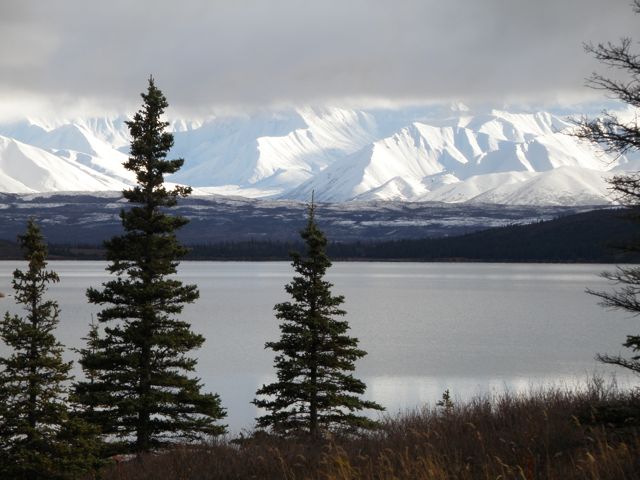
At the park entrance most of the foliage was gone from the shrubs and deciduous trees, the sky was gray and the air had a wool sweater edge to it. A short climb in elevation led us into snow flurries. A higher climb left us waiting to see if we could even make it to the end of the road for all the snow that had accumulated on the pass. Thankfully, the snowplows prevailed and we made it to Wonder Lake, where it felt less like winter and more like late autumn again.

photo by Dean Sundmark

Deep inside the park, the cranes were having their giant meet-up in the sky. Hundreds, possibly thousands of the birds gathered and one group would meet another group and they’d rise together and circle. Another bunch would join and in the distance a group five times the size of the smaller group circled and rose and their soaring bodies gave shape to the air currents.

Cranes

A thousand years earlier it must not have been so different. Gray sky, sun shining at a low angle through the clouds to the base of the lower mountains. Layers of riverbed, glacial moraine, cut valleys.

photo by Dean Sundmark

Alaska is huge. Denali National Park and the surrounding Preserve—not even the biggest National Park in the state—encompass more than six million acres. The 92.5-mile long road into the park allows casual visitors like myself just a glimpse of what is out there. Part of what I loved about going in the park was how little of it I could see.

Denali looking west

I grew up hearing a story of how the world came into being, and how it is that I am supposed to navigate through this world. The story shaped everything. I learned to pretend to ‘believe with conviction’ in the story I was taught, and I could fake it as long as my imagination was limited to just that one story—as long as I never left the one road.

Nature tells its own story. It’s less tidy. It involves a scale of time that the human brain cannot comprehend. It’s based on death and renewal and resilience. It’s based on birth and decay and physics and chemistry. Although it contains mysteries and induces wonder, it is not capable of lying.

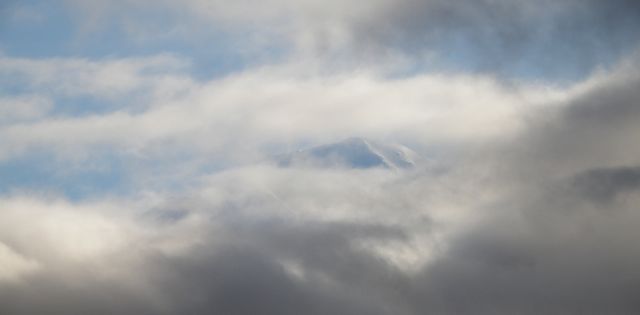
Near the end of the road, where the snow had gone and we found remnants of blueberries still hanging on their leafless branches and lingonberries bunched close to the ground, where the mountains made perfect reflections into the ponds and where overhead the cranes continued to call—the sun came out for a few minutes. The clouds gave way to bits of blue sky and for a moment the summit of Denali showed through. It didn’t last long.

I am always looking for a story. I continually narrate, create and assume. It was tempting to think that the clouds parted for my benefit.

Photo by Dean Sundmark
All photos by Dean Sundmark

Clear Skies

Clear skies

It’s September 1st and I’m sitting on my deck. It was cool enough for a fire this morning, but now it’s hot–so hot that I’m looking at the shade wondering if I should move my little writing operation over there. Of course I won’t because a) it would be too cool in the shade, and b) after living in Alaska for 24 years, I’m always fearful that each sunny day might be my last. There are certain things we don’t take for granted here in Alaska and sun is primary among those things.

President Obama is in Alaska for a few days and it’s a big deal. Some say he’s just using us as a prop to talk about climate change, and maybe that’s true. But I’m okay with that. I don’t think a person can be here on a crystal clear day like the one we’re having and leave without knowing that this is a pretty special place. And he’s going off the road system. He’s going to see parts of Alaska that most Alaskans don’t get to see. He’s going to learn a bit about this state whether that was his intention or not.

Of course I was a little disappointed that President Obama chose to go to Seward instead of Homer, but Seward does have the advantage of a retreating glacier that a person can walk up to. Oh well, instead of Black Hawk helicopters and Secret Service agents, we have our typical fleet of scuffed-up Subarus and fellas in Carhartts and Xtra-Tuffs. It’s fine that he chose Seward, I guess.

One thing that this presidential visit has me thinking about is how darn proud I am of this state. Just by its placement on this planet and its geology, it’s exceptional. And the people who live here, they’re a little different than the people who live in the lower 48. I’m not sure if that’s because it attracts people who think differently or if it’s because living here molds us into something different than we’d be if we lived in, say, Ohio or someplace like that. That is not to say that the people here are better than people anywhere else, but I would say that we have a higher per capita population of people who question societal norms. If nothing else, it makes us an interesting bunch. I hope the president will get just a little taste of that about Alaska while he’s here.

In other news, my mom and step-dad left this morning. Mom gave me the foliage-change report as they drove up the Kenai Peninsula, and the bore tide report as they drove by Turnagain Arm. She reported on the fresh snow just beyond the Matanuska Glacier. So much to beauty to behold as they’re driving away—I hope it lures them back.

These clear sky nights are bound to bring a frost in soon, so I suppose I should stop writing and harvest the peas from my garden. The tomatoes that did well outside for most of the summer have already been moved into our living room, and the carrots and beets and cabbage will only get better with the cool nights.

And speaking of cool nights, maybe President Obama will get to see the Northern Lights while he’s here. Dean noticed them around 2:00am the other night and we bundled up and sat on our front deck and turned our heads toward the heavens for about twenty minutes much to the consternation of our dogs, who possibly thought that their people had lost their minds. But we watched the Aurora and we witnessed a number of shooting stars. The air was calm and it was quiet—so quiet.

It’s possible, with these clear nights, that the President could see the Northern Lights through his window at the Hotel Captain Cook. It wouldn’t be the same as when we saw them the other night—in the comfort of our jammies, on our own front porch, without the interference of town lights—but it might be enough to give him pause. Alaska is amazing in a million different ways, but one of its best features is its ability to give pause.

An ode, of sorts, to this summer

Flower trail

Always, there is plenty to mourn in this world. Plenty to worry about. Plenty to try and change. But I don’t want to write about those things today.

Maybe it’s because this morning I went barefoot in the garden and picked snap peas for breakfast.

Maybe it’s the rare thunderstorm that rolled in last weekend and drenched us while we foraged in the blueberry bog.

Maybe it’s my chickens, weaving in and out of the nettles and wildflowers and pushki, clucking the way chickens cluck when they’re happy.

Maybe it’s that my mom is here for the summer and we can walk through the wooded trail to the bakery and there we can solve the world’s problems over a sandwich and a cup of soup.

Maybe it’s the freezer full of salmon and the sweet, sweet strawberries growing alongside the driveway.

Maybe it’s the higher than average number of coffee-on-the-deck mornings we’re having.

Maybe it’s this town, with its people who aren’t afraid to dance late into the night on a Tuesday.

Maybe it’s that I wake up every day with a dog tucked sweetly into the bend in my knees.

Maybe it’s sitting in the shade of an umbrella on a friend’s deck, drinking drinks and catching up while her golden retriever puppy nibbles at my toes.

Maybe it’s the evidence of sun on my skin, my flip-flop tan, the way we haven’t had to build a fire in the woodstove for days.

Maybe in this moment it’s the squirrel out there, taunting my dogs from the safety of a spruce tree. Or that raven that just flew past the open door, owning this meadow in a way I never will.

Maybe it’s the knowing that all of this, it has nothing to do with blessings or earning or deserving. It’s just that I’m lucky.

The weight of it all hits me hard some days.

Messages

OLYMPUS DIGITAL CAMERA

The other day at work my computer was out of service. It was the perfect time for me to tackle a few tasks that had been piling up. I did some filing. I made some phone calls. I did a little shelving. And then I listened to the fifty-two messages that were saved in my voicemail.

The messages went back as far as 2008, and listening to them has given me quite a lot to write about, but for this post I’ll stick to the ones that were left in response to two pieces of my writing.

Message #1:

“Hello Teresa, this is Rollie Campbell. I’m a relative of yours. I read your bit in the Telluride Newspaper and I have to say—way. to. go. Some of those things should have been said a long time ago. And here’s my number if you want to talk.”

This message, along with four email messages from strangers, were waiting for me at work on the Monday after Father’s Day, 2008. I had written a piece for the High Country News about my father’s memorial service held on a hillside near Wilson Mesa, just outside of Telluride Colorado. I wrote honestly about how I’d been hurt by the service being turned into a sermon. Instead of memorializing my father, the person holding the service felt compelled to preach about hell, and how those of us in attendance who weren’t saved would most certainly go there.

It was the first piece of my writing that had ever been published. It was personal and it was pointed and it was syndicated in newspapers around the West. Hundreds of people read the column in their Sunday newspapers. It was terrifying.

Now I can look at that essay as a turning point in my writing life. It was the beginning of me digging a little deeper, going closer to the core of what I care about most.

I called Rollie Campbell—this distant relative of mine who was in his 80s at the time. He lived on Wilson Mesa when he was a boy. He knew my dad and my aunts and uncles when they were young. We talked for about an hour. He told me stories and answered questions. After speaking with him, I knew a bit more about life on Wilson Mesa in the 1920s and 1930s. I had a few stories to put with the names of the people who came before me.

I did not erase the message he left in June 2008. I listen to it about once a year—usually when I need some kind of reassurance.

*

Message #s 28,29 & 31:

–“Teresa, call me. Here’s my number.”

–“Holy crap. Are you at work today? I need to buy you coffee.”

–“Hello. You don’t know me, but I want to tell you thank you. Something similar happened to me. I never told anyone.”

It was October 2012 and I wrote a blog post in response to a sexual assault that happened in Homer. I wrote it in a hurry and posted it in a hurry—before I could change my mind. Then I went into the bathroom and nearly threw up. Then I told my husband about it. I had never told him the story.

Unlike the message from Rollie Campbell, I’d forgotten about these messages. Hearing them again the other day brought me back to those first few days after I posted the essay on my blog. Lots of people were reading it, but worse, lots of people I knew were reading it. I felt more exposed than I’d ever felt in my life.

But an amazing thing happened. People responded. Men and women approached me at work, at coffee shops, in the grocery store. People sent me emails and private messages. While the feeling of being exposed never went away entirely, it was eased by the incredible sense of being supported by people who cared, people who had been through something similar, people who had a story of their own.

What I learned from that post is that courage begets courage. I only had the guts to write what I wrote because I’d read the work of others who had been brave. Then a few people had the courage to tell their stories because they’d read mine.

*

            Listening to those voicemail messages made me revisit those essays from years ago. If I had them to write over again, I would change things. They are imperfect and perhaps a little self-indulgent. Writing them was difficult. I might have been wise to use a bit more caution. But would cautious writing have prompted people to call and leave messages?

For me, writing is always finding the balance between restraint and indulgence. Too much of either one is a bad thing and whether it’s fiction or nonfiction it’s always a struggle to reach that sweet spot. But I know, and the messages on my voicemail reminded me, that people want to read work that originated close to the writer’s heart. They want to read what is real. They respond to stories that reveal some of the author’s uneasiness and dread. Maybe sharing something so intimate makes us all feel less alone.

Oxygen and Wishes

OLYMPUS DIGITAL CAMERA
Kachemak Bay in June

***

It’s raining today–a beautiful, windless, cool summer rain. It’s filling our rain barrels, settling the dust, watering our garden. Everything is green. Bright green. Alive green. New green. I open the front door. I inhale. I hold the air in my lungs for as long as I can. I let it out slowly.

I put on a rain jacket and pick greens from our garden. Every plant is growing at a miraculous rate. Each leaf is crisp and succulent. It is food and it is medicine and I want for everyone in the world to feel the satisfying crunch of this fresh bok choy, taste this raw spinach a second after it’s picked.  I want for everyone to hear the squirrels chattering in the spruce trees and the golden-crowned sparrows calling to one another in the open meadow. I want for everyone to breathe deeply of this morning’s air.

Right now, my mother in law is having a hard time. A few months ago she was diagnosed with pulmonary fibrosis, which is a hardening of the lung tissue. She needs supplemental oxygen–each day a little more than the last.

When I think of her, I find myself conscious of breath. I fill my lungs with a little more air than I normally would. I imagine oxygen finding it’s way to every part of my body.

***

This afternoon I am meeting friends and acquaintances, community members and strangers by the Seafarer’s Memorial on the Homer Spit. We’re going to make our wishes known and we’re hoping our pleas won’t fall on deaf ears.

Later this month, the United States Navy is planning to begin training exercises in the Gulf of Alaska. They have a permit to use live artillery and sonar to practice for war. The training is scheduled to happen for the next five summers during key breeding and migratory periods for marine life. By the Navy’s own estimation, the impact will be detrimental to as many as 182,000 marine mammals.

So we’re going with our homemade signs and our kayaks. We’re going with our bicycles and our skiffs. We’re asking the United States Navy to listen to us. We’re asking them to change their plans to accommodate the migratory animals. We’re hoping they’ll remember that the Gulf of Alaska is not a strategic military or political space but rather a life-giving body of water that is worthy of our protection.

***

Looking out my window, past the tomato plants on the sill, past the garden in my front yard, I see portions of Kachemak Bay and the Kenai Mountains. I think of my mother in law, fighting for every breath. I think of the ocean life, unaware and undeserving of the battle that’s about to be inflicted upon it. I am heavy with gratitude and sorrow and wishes.

I want a world where war games aren’t necessary. I want everyone to feel the sense of satisfaction I felt when I stepped into the cool rain this morning. I want the world to change. So I make my homemade signs and I pick a lunch salad from my garden. I write words on a page and I take one deep breath, and then another.

http://www.thenation.com/article/207881/here-are-navys-plans-bomb-arctic#

Mayday

OLYMPUS DIGITAL CAMERA

I thought we’d made it through another season. A snowless winter, early greening and the unseasonably warm wind in February and March fooled me. But April came and for a month the progression into summer was put on hold. The lengthening days and the birdsong reminded me that it wasn’t exactly winter, but it sure didn’t feel like spring. April was something all its own this year. Something to endure.

In April I thought a lot about racism. Not racism in the news but racism in my family. I thought about the hateful comments I heard from an uncle at my father’s funeral. I thought about the racial slurs I grew up with. I thought about the story of my dad and his brothers one time running off a Hispanic family enjoying a public park on a Sunday afternoon after church.

That was a long time ago. And the racism is no longer so blatant.

Now it’s a little more hidden. It’s got a new vocabulary—thugs, illegals, Islamists. And it’s got new targets—liberals, gays, atheists. It’s veiled by politics and end-times theology, the purpose of which is to keep humans categorized and separated into those who are worthy and those who are not. The way we look down on others has shifted over time, but I wouldn’t say that the problem is gone.

There is a deep shame for being born into racism. I once used racist terminology. I once told off-color jokes. I wish it weren’t true and that I could undo my past. I will always be trying to wash myself clean of it, but the memory of my ignorance still clings to me. All I can do is admit that I was a part of the problem, ask for forgiveness and try to make amends. Since I see the wrong ways of my past, am I somehow immune from divisive thinking? No, not now and not ever. No one is immune. We are all capable of great and terrible things.

The family I was born into is also a family of Pentecostals.

In April I read about William Seymour, the black, one-eyed son of slaves from Louisiana who led the Azusa Street Revival in Southern California and who was essentially responsible for spreading Pentecostalism around the globe. He believed in love and inclusiveness. He believed that God did not favor one gender over the other. He believed that God’s love revealed itself most powerfully when people from different races came together in worship. He did not exclude other religions from the spiritual movement that he led and he did not take credit for its growth or the way it transformed people. He believed that the Holy Spirit was moving and his job was to make sure that human designed divisions—race relations, gender hierarchies and economic standing—did not get in the way of God’s work.

I’d never heard of William Seymour until this month. I’d certainly never heard that the origins of the Pentecostal movement were so tied to the notion of equality. I think that somewhere in the line of my family’s Pentecostalism, something went terribly wrong.

While I was enduring April, while I was cursing the late-season snow and reading about religion and philosophy and contemplating my family’s history of racism, a friend across town lost her son. He was eighteen years old. The sad and shocking news pulled me right out of the heady place I’d been inhabiting and brought me back to the here and now.

Basically, I was hit with the most basic truth. We all love and we all feel pain. As long as we’re alive, there is no escaping these basic things. We can spend our lives constructing borders, terminology, political parties, religions, philosophies, economic divisions—every manner of barrier we can think of to keep us focused on our differences, but we’ll never be separate. We are bound by our human experience, which, when it comes down to it, is all we really know.

We love our children. We suffer excruciating pain when we lose them. Is there any category of people for whom this is not true? Was there ever a time in human history when this wasn’t the case? Will this ever change in the future? No. I don’t think it will.

I have spent most of my adult life trying to reconcile my religious upbringing with who I am now. I am left with more questions in regards to spirituality than answers. But I find solace in humanity. I know that sounds crazy, but it’s true.