Home, Again

    Image

  It’s fall equinox weekend, and suddenly everything points toward winter. Just a few weeks ago, everything was brilliant green—but now our yard is layered with gold, brown and maroon.  The color for today is orange:  flames in the wood stove, pumpkins from the farmer’s market on the kitchen table, my favorite wool sweater pulled out of the closet for another season.  Summer ends in a hurry here.  I know this by now, but every year it seems worthy of comment.

Just a little over a week ago I was in Colorado, sitting on my mom and step-dad’s deck, feeling the deep heat of the sun on my arms and legs for what I knew might be the last time in many months.  I closed my eyes and turned my face directly toward the sun and thought about how in February I will dream of a moment much like that one.  It was a good visit home.

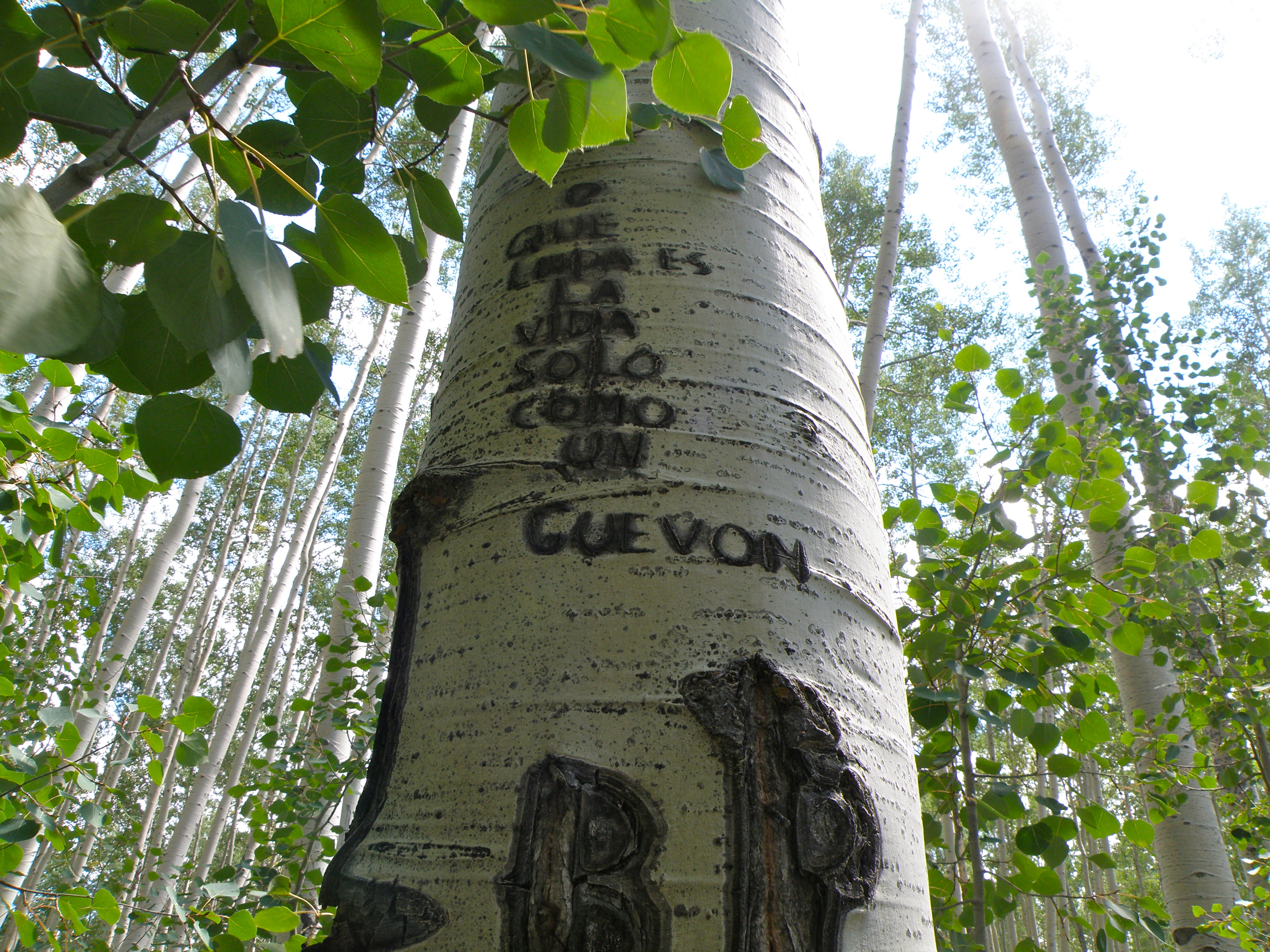
I went by myself on this trip, and my mom and Stanley were excellent tour guides.  I’d mention something I’d like to see and they’d make it happen.  We tromped through the remote territory above Steamboat Lake, near the Wyoming border, where my step-dad’s father lived as a young boy.  They drove me to Dinosaur National Monument where we viewed petroglyphs that looked like aliens and picked grapes that have gone wild at the old homestead site of Josie Bassett.  They took me to their cabin and pointed me in the direction of a trail that harbored messages engraved on aspen trees by lonely Peruvian sheepherders.

The whole time I was in Colorado ordinary things seemed extraordinary: The smell of ozone during a lightning storm.  That damp, earthy odor of beaver dams and aspen trees.  The way the wind kicks up dust in the evenings when a storm is blowing in.  Tumble weed, antelope, deer.  Mourning doves perched on power lines.  Fresh cut hay and sheep on a hillside.  Stars up close through a dry sky.  Ranch houses, cows, birds of prey.  Dinners of elk steak, sliced tomatoes, ripe peaches.  Rabbit brush in yellow, spindly juniper trees, sagebrush.  Grazing horses and sheep dogs keeping watch.  Back roads in all directions, blue heron fishing on bends in rivers.  And every once in a while, a cleansing shower that quells the dust.

One definition of nostalgia is the pleasure and sadness that is caused by remembering something from the past and wishing you could experience it again.  So even though the word ‘nostalgia’ kept going through my mind when I was back in Colorado, I suspect it was something different that I was experiencing.  Is there a word for appreciating things you couldn’t appreciate when you were younger?

I left Colorado for Montana when I was twenty-one years old.  Then I went back for seven months a couple years later, but that time it was with one foot already firmly out the door and headed toward my new life in Alaska.  I go back there now and I see things I’ve seen a hundred times, but it’s as though everything is in sharper focus.

And so now I’m back in Alaska and I’m thinking about the notion of home.  As is usually the case, I have more questions than I have answers.  What is it that makes a place a home, really?  Is it familiarity?  Is it where the jobs are or where the beauty takes your breath away?  Or is it simply where you put your energy into fostering love and comfort and friendship?  Does it change over a lifetime?  I’ve heard it said that home is where you make it, but then what do you call that place your senses yearn for?

For me, for now, I’m thinking of a place with plenty of open spaces and mountains, where summer afternoons are hot, but mornings and evenings are cool.  There, you might have winter days that dip below zero or storms that dump a lot of snow, but the sun, it still manages to shine most days, and it has the potential to warm your skin any time of the year—sometimes even in February.


Bravery Practice

It’s already well into August and I’m looking at the date of the last time I posted here. Where has my time gone?  In June it went to Montana for twelve days.  For a good portion of July it went to the University of Anchorage for my third MFA residency.  As it goes with employment, plenty of my summer time has been spent at the library.

Thankfully, some of my summer has involved soaking up much-needed sunshine and hanging out with friends and family.  Some of my time was even spent running, after a very long (read twenty-some years) hiatus.  Nearly all of my summer was spent mentally and emotionally preparing myself for my daughter’s departure to school on the East Coast.  And almost constantly, my time was spent thinking about writing, which is what I do when I’m not writing.

The high summer days are gone now and it’s time for me to get some words written down instead of letting them swim around in my brain.  It’s getting dark again at night and the rainy season is back.  Adella left a few days ago.  Time isn’t as elusive as it has been, and yet I’m finding it hard to know where to begin.

I’ll guess I’ll start with an admission:  I’ve spent a lot of time over the past few months questioning myself mercilessly about my reasons for continuing to write here on this blog.  I’ve thought about bringing it to an end.  I’ve wondered if I should change it up, make it into something more professional or more in tune with marketing myself, which seems to be the whole point of having a blog according to the million or so writers’ advice articles I’ve read on the subject.  I’ve fretted over what I named it, after all if a person doesn’t know the story behind the name, it does sound a little egotistical.  Worrying, fretting, second-guessing myself:  apparently I have those parts of being a writer figured out.

Then I thought about the things this blog has done for me since I started it nearly five years ago.  It may need some updating as far as formatting is concerned.  It may seem to have no identifiable theme, (which is another certain no-no in the blogging world.)  It may have no predictable schedule for new posts.  Clearly, it is an imperfect blog and being that I’m an MFA student entering my thesis year, I should spend my limited writing time working on my critical essay or on fiction.

But through questioning my motives and wondering if I should continue here, I’ve realized that this blog has been, and can continue to be, an important part of my becoming a writer.  It gives me a small but diverse audience.  It gives me a chance to write something besides fiction.  It challenges me to write with precision.  It does all of those things, but it does something even more important. Let me explain:

I think the best writers, whether they’re writing fiction or poetry or nonfiction, are those who are honest—honest with the story they are telling or poem they are creating, honest with those who will read their work, but most importantly, honest with themselves.  And honesty is hard.  It means putting yourself out there, opening up, making yourself vulnerable.  And could anything be scarier?

Last October, I posted a very personal story on this blog in reaction to something that happened in my town.  I had never told a soul that particular story and yet I wrote it on here for all to see.  I hit the publish button and started shaking.  I shook for almost a week afterwards as it was passed around the web through personal emails and Facebook.  I shook as friends and acquaintances stopped me in town to talk with me about it.  I took a huge risk.  It was terrifying.  But it ended up being a connecting experience.  People shared their own stories.  People expressed to me their gratitude for having spoken up.

It was hard to share that story and even as I was doing it I questioned my motives for doing so.  I wondered what it meant that I could tell such a secret publicly.  But then I remembered that I’m an aspiring writer and writers are supposed to tell stories.  We’re supposed to write about what it means to be alive even if it’s hard and, sometimes, even if it’s personal.  If nobody wrote the hard things, I think we’d all feel alone.

And so Lofty Minded in Alaska is not about marketing myself or about selling anything.  It’s not about perfection or keeping up with trends.  This blog is about connecting with other people.  As long as it seems to be doing that, I’ll keep at it.  Also, there are things I want to write about that are even harder than what I’ve written so far.  Some of it will best be written about in the form of fiction, but some of it needs to be the straight up truth.  And since I still hold back, I think I’ll keep this blog as a place to practice being brave.  If I’ve learned anything from keeping this blog it’s that writing fearlessly takes practice.

A Violent Wind

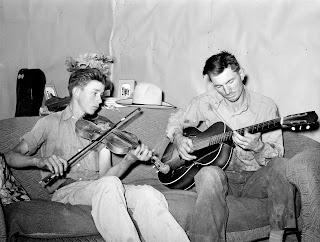
Farmer and his brother making music.
Farmer and his brother making music.  Russell Lee *


I heard my Granddad tell the story four separate times.

One evening when he was sixteen years old my Granddad, Clarence Acree, (nicknamed Sonny at the time) was at his Uncle Bill’s house in Sayre, Oklahoma.   It was late in the day, well after supper, and they were sitting in the main room playing fiddle and guitar.  Maybe it was the music that kept them from hearing the twister approach, or maybe the storm just moved so fast that they wouldn’t have heard it coming even if the house had been silent.  Either way, they had no warning.  In an instant it sounded like a freight train was upon them, and while they sat there, instruments in hand, the roof of the house was pulled clean away.  Just like that.

Everyone at Uncle Bill’s house was okay, but the storm moved on and they could hear its continued destruction.  After it passed they went out to assess the damage.

Here’s an article from the Sayre, Oklahoma Daily dated October 16th, 1933 about the incident:

AGED COUPLE AND LITTLE BOY DIE IN VIOLENT WIND

“A freak cyclone covering more than one mile in length approxamately 100 yards in width struck south and four miles east of the city after 10 ‘clock (pm) Saturday left death and destruction in its wake.  The dead are:

Frank Yandell 77, Mrs. Frank Yandell  72, Luther Lowrence 8 .

A fourth person Nadene Lowrence age 7, with the victims of the violent wind, escaped death.  Except for shock she is not thought to be seriously injured. The two youths are the great grandchildren of Mr and Mrs Yandell.  They were spending the night at the Yandell home. Mr and Mrs Lowrence live near the cyclone swept area.

Preceding a heavy rain, the storm swept down on the Willis Hawkins farm tearing the roof and porch off the Hawkins home and razzing a windmill.   The storm then gained in velocity and traveled in a northeasterly direction  hitting the Yandell farm and the spent itself as it the struck the John Edwards farm one mile away. The Yandell home and all the outbuildings were completely demolished.  A barn and garage at the John Edwards farm was leveled.

The bodies of the dead were found 175 yards from the wrecked home by Clarence Acree and Willis Hawkins, nearby neighbors.

Seeing the residence demolished they shouted but received no replies..  Checking with nearby neighbors 1/4 mile away they were assured the Landells or the Lowrence children had not escaped.

Walking back in the dark to the demolished residence the boys shouted again and the little girl called to them from a field.  An ambulance was summoned and the four were brought to Sayre.  The dead were taken to the local mortuary and the little girl was rushed to Tistial Hospital for treatment and examination.  She told them Mr Yandell and her brother had gone to bed and she and her great grandmother were getting ready to retire when the cyclone hit the house.  She could not remember anything after that.

The bodies of the deal were badly crushed and mutilated. And lacerated.  They appeared to have died instantly.”

* * *

It’s funny how we hear stories in the context of our own lives.  We grab hold of different parts.  We notice different things.

The first time I heard my granddad’s story, it was all about the violent storm, such force I could scarcely imagine.  He told about the bald chickens running around the farm the next day, the force of the wind had plucked them clean.  He said a nearby bridge had been impaled by a piece of straw.

The second time I heard the story, I thought more about the little girl.  My Granddad said they’d given up hope of finding anyone alive and were headed back to Uncle Bill’s house when they heard her.  She’d been carried nearly a hundred yards from her great-grandparent’s home, her nightgown had been pulled off in the storm, but she was uninjured.  I wondered, how was it to live a life as the one who had been spared?  Could she recall my grandfather finding her or was her shock too great to remember that detail?  Did she move away from tornado country the way my Granddad did?

The third time I heard the story I fixated on the time in history in which the storm took place.  A time when families sat down to play music together instead of huddling in front of a television, a time before tornado warnings and forecasts.  I thought about my own family history of fiddle players and Okies.  I tried to tie who I am today with the people I came from.

The last time my granddad told me the tornado story he was ninety-one years old.  I was back in Colorado for a visit and I asked him to tell me the tale one more time because I knew the time for hearing his stories was running out.  Always before when he’d told me the story, he was very matter-of-fact about it—first this and then that.  But this time it was different.  It was like he was there.  He was sixteen again, in rural Oklahoma, with his Uncle Bill.  He was walking through the rubble, trying to make sense of the destruction that came through in an instant and changed everything.  “We thought they were all dead,” he said.  “And then I heard her call out. ‘Sonny,’ she said. ‘What are you doing out here?’”   Then he couldn’t tell any more.  His blue eyes, still brilliant and as sharp as ever, watered up. He turned his head to the side.

That fourth time, the story was about my Granddad—about the man he was and the boy he’d carried around inside of him for all of those years.  It was about time and distance being erased for a while and being young and being old all at the same time.  It was about transcendence and remembering and living again and again.


*The vintage photo was taken by Russell Lee, you can learn more about him here.  (It’s not actually my granddad in the picture.)

                              ** Also, thanks to Helen McPherson for passing along the newspaper article and for reminding me of a few details of the story.

True Story

I was born to parents who were known to strike up a conversation with just about anyone.  In my family a typical exchange with the grocery store clerk might have gone something like this:

“I haven’t seen you here before.  Are you new to town?”

“Yeah, I’m from Helena.”

“Oh, you’re from Helena?  Well my cousin’s uncle is from a little town just outside of Helena, his name is Jimmy Jackson and his daughter is probably close to your age.  Her name is Mindy.”

“Oh, I went to school with Mindy Jackson.  She dated my older brother for a little while but they broke up when my brother joined the service.”

“Oh your brother’s in the military!  Where’s he stationed?”

“Germany.”

“Oh, my neighbor’s son and his wife are at the base in Germany right now.  As a matter of fact, my neighbors are going to go there next month for a visit.”

This was how I was raised—and still I find it hard to refrain from asking questions when I meet someone new.  “Where are you from?”  And their answer—no matter where they’re from—typically causes my brain to do the mental equivalent of spinning through a Rolodex looking for some way to make a connection—even when it seems fairly absurd.   “Oh you’re from Hong Kong?  My husband’s cousin once visited Hong Kong.  Kolkata?  My daughter’s boyfriend’s dad lived there for a while and I’ve always wanted to visit.”


In Anchorage on Thursday evening I was wheeling my small suitcase down a sidewalk toward two taxicabs parked in front of the Hilton Hotel.  The drivers, both men with olive skin and thick dark hair, were engaged in an animated conversation with each other and neither seemed to notice me.  When I got so close that they could no longer ignore me, the one driver who looked to be a few years older than the other nudged the younger one my direction, giving up his chance for some business.  Then they embraced.  When the younger man turned around his eyes were watery.

“I have not seen him in ten years.  The last time was in Albania,” he said as he was loading my bag into the trunk of the car.  “I did not recognize him, but he recognized me.”

There was my opening to chat.  I asked him what it’s like in Albania.  “Beautiful,” he said.  “We lived very near the beach.  But there I worked eighty hours a week and even with that many hours I could not make the rent.”

I asked him more questions and he proceeded to tell me that he’d only been driving a cab for two days and he was still learning his way around Anchorage–but he was happy to have a third job.  Before he landed the cab-driving job he worked at two different restaurants. “I was working fifty hours a week, and this job will add twenty more and it is above minimum wage.”  He was responsible for paying the rent on a two bedroom apartment he shared with his mother and he was sending money back to Albania in hopes of bringing his brother and sister, still in their teens, to the US.

I asked him if he’d had the chance to get out of Anchorage yet.  “Oh no,” he said.  “Maybe in the summer I will take a day and drive down the Turnagain Highway.”

He was quiet for a few blocks and it crossed my mind that he might be making this story up about working three jobs and sending money to his siblings in Albania.  It would be a good story for a cab driver to tell in order to get a bigger tip.

But then we drove past the bowling alley on the corner of Minnesota and Spenard and the young man shook his head and looked directly at me through the rear-view mirror.  His dark lashes were damp again.  “How is it possible that I found an old friend on the streets of Anchorage?”

For the whole ride I’d been asking him questions and he’d been answering, telling me about his life since leaving Albania, his time in Chicago, his learning to drive on icy roads.  He told me about his family spread around various European countries and the United States, about his trying to make ends meet.  All across town I was doing my part to connect with my Albanian cabdriver, but between the street in front of the Anchorage Hilton and the intersection of Spenard and Minnesota he’d been to Albania and back again.

It’s a long way to travel in such a short time.

A Snapshot of Sadie

I wish I had a picture of Sadie. But even if I had a photo to go from I don’t think I’d be able to properly describe her. I remember a weatherworn face and a missing tooth. I remember her layers of clothes, faded and worn to a color similar to that of her skin. I remember the way her odor—distinct and offensive, but impossible to describe—lingered for a long time after she’d come inside to borrow our phone. And I remember her adamant warning that came every year in March:
“Beware the spring equinoxal,” she’d say.
***
Right now in Homer we’re gaining around five minutes of daylight a day. We’re looking at seed catalogs and planning our summer camping trips. The dirty snow berms on the side of the road are receding and the sun is high enough on the horizon to throw a little heat. Tasks that seemed overwhelming just a couple of months ago seem possible now.
And yet, suicide rates go up this time of year. The police blotter gets interesting and mental healthcare facilities fill to capacity. Couples who’ve held on through the winter give up and go their separate ways. It seems counterintuitive, but it’s true. This is a tricky time of year for lots of people.
When it comes to the spring equinox, Sadie was on to something.
***
I’ve been thinking about Sadie lately, wondering about her life, of which I knew very little. I was a teenager when Sadie used to make her way from the little shack across the alley to our house. But honestly, I never gave her much thought. To me she was just an eccentric old woman, living in a decrepit cabin. I knew she had a husband over there, a man called Monty, but I never really got a good look at him. They just existed there, on the edge of town. When I think about it, I’m not sure how.
I asked my mom about the old couple that used to live behind us, and she told me what she knew about Sadie and Monty Holbrook.
Monty kept to himself and Sadie came around to “borry” our phone now and then. She didn’t really offer much information about herself though, until one afternoon when my brother-in-law brought a horse he’d just acquired over to our place. In the driveway he tried repeatedly to get up on the horse, but every time he tried the horse would lie down. Sadie watched all of this from across the alley, then came over and asked if she could “have a turn at that horse.” She grabbed the reins, got the horse up on its feet and in a matter of moments had the horse “doing right.”
Sadie then told my mom that she’d grown up on a horse, had in fact ridden one from Canada to Mexico with an infant in front of her and a two-year-old behind her. “No horse would dared lay down or buck with me,” she said.
After the horse incident, Sadie talked more. She said she and Monty caught and broke wild Spanish mustangs for a living and trailed them to North Dakota. She also told my mom that Monty, who was ninety years old at the time, used to run with Butch Cassidy and The Wild Bunch. At one point a movie producer found him and wanted to interview him, but Monty chased him off with a gun and told him to “Git.” He was afraid that if people knew who he was he’d be arrested and hung.
***
One Easter Sunday morning, after I’d already moved out of the house, my mom and step-dad saw smoke billowing out of Sadie and Monty’s cabin and called the fire department. It was late in March. Medics came and took the two of them to the hospital. There they were treated for mild smoke inhalation, but other than that were found to be in good health. Monty put up quite a fight though, when the hospital staff tried to get him to bathe. He was of the belief that bathing too early in the year made one susceptible to pneumonia.
After their house fire, Sadie and Monty never returned to their home. They went to a nursing home in Fruita, Colorado to live near their daughter. My mom heard that Sadie was happy there—it must have been a huge step up in terms of ease of living—but Monty didn’t like it much. He died within the year.
* * *
Sometimes we wouldn’t see Sadie for several days, but then something would change and she’d come over several times a week. During the times when she’d visit frequently, she’d watch for us to come home. We couldn’t see her peering over, but moments after we pulled into our driveway we’d see her hunched figure making its way across the dusty alley and up the stairs to our back door.
I wish I had a picture of her now to remember her face, but more than a picture I wish I had a week of afternoons with Sadie. I’d ask her what it was like to break wild Spanish mustangs. I’d ask her what it was like to be married to an outlaw. And I’d ask her to tell me exactly why she was so wary of the spring equinox.
I’m guessing she had more stories to tell.

Wild, Wild Horses

Life Expectancy

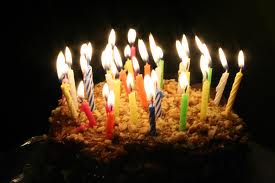
birthday cake

Just twenty years before my Grandma Ross was born, the average life expectancy for a woman in the United States was 45 years.  Coming across this bit of trivia this morning—this day of my forty-fifth birthday—makes complaining about getting older seem ridiculous and downright ungrateful.

Statistically speaking, there’s a good chance that I’ll have at least another thirty-five years or so on this amazing planet, and that’s something that women in their forties couldn’t say in 1879.  Seriously, I could spend this birthday pining for the days when my hair was more brown than gray, or for a time when I could fit into size seven jeans, but I’m thinking that since this is the beginning of those extra years that modern life has potentially granted me, I ought not to squander this day on pining.  Instead I’ll make a list of positive things about turning forty-five:

  • My hair started turning gray about ten years ago and I’ve spent a lot of the past decade self-consciously feeling older than I am.  But now that I’m in my mid-forties, a few of my same-age friends are beginning to sprout a few gray hairs of their own, and while I wish I didn’t care about such trivial things, there is something nice about no longer being alone in this particular category.
  • I will never make it into one of those 45-Brilliant-Writers-Under-45 anthologies, so that’s one less thing I need to worry about.
  • When I was thirty-five and my hair was turning gray and my children were ten and seven years old, I sometimes questioned my decision to have children before establishing a career or traveling the world.  Now that I’m 45 and my children are nearly grown, I can see the advantages of having had kids early in life.  If I am indeed granted an extra thirty-five years or so, then I’ll get to enjoy my children as adults for a much longer time than if I had waited to have them.  And after I get done paying off the debt I’ve accrued in raising them, I may still have time to travel the world.
  • My life so far has been divided into lots of parts, but the most defining of them have been 1) my own childhood and 2) the raising of my children.  Right now I’m on the cusp of the Next Big Part and it’s exciting to consider the possibilities.
  • At forty-five I’ve already done so many of the things I’d hoped to do when I was just starting out.  Now I have this distinct feeling that the future is less about serving my own needs and more about finding a way to be of service to others, it’s humbling and hopeful all at the same time.
  • And on a lighter note, hitting the quintessential birthday that marks the potential halfway point of life left me feeling completely justified in buying myself a new pair of gorgeous leather boots, and in that way turning forty-five hasn’t been all that different from turning twenty.

Slow Soup

     What fools call “wasting time” is most often the best investment. — Nassim Nicholas Taleb

Image

     This week I’ll be facilitating my first Creative Writers’ Roundtable discussion at the Kachemak Bay Campus.  The topic for the first of the three-week series will be on developing a writing practice.  It’s a funny subject, developing a writing practice, because what works for one person doesn’t necessarily work for another.  And a routine that works beautifully for a certain period of time doesn’t always continue to work as life circumstances change or as the writing itself evolves.

When I first decided to pursue an MFA in Creative Writing I imagined that I’d make a peaceful corner in my house that would be solely devoted to my writing.  I thought I’d carve out a very specific schedule for myself: two hours before work every Tuesday morning, three hours on Thursdays, another big chunk of time on Saturday afternoons… you get the picture.  But the reality of my writing practice is something much more chaotic than this.  The truth is that I don’t have a quiet corner in my small house.  Oftentimes family obligations get in the way of the time I’ve set aside for my writing.  How is it, then, that I continue to get things done?  How do I meet my deadlines?  This is the stuff I hope to talk about at the Creative Writers’ Roundtable.

* * *

I’m lucky enough to live with a man who, in an effort to keep our family eating nutritious meals in the midst of a busy workweek, has taken it upon himself to make a big pot of soup or stew every Sunday afternoon.  It’s usually a long, slow affair.  He spends a good amount of time looking through recipes, making a grocery list, shopping, soaking, chopping, sautéing, simmering. And then there’s the clean up.

Slow Soup

Some might say that Dean’s Sunday soup productions are a waste of time, and it’s true that if time were the only consideration we’d be better off buying a case of Campbell’s Soup at Safeway.  But with the extra attention Dean gives to the food he prepares, we get so much more than canned soup.  We have more time in our week because we don’t have to scramble through the kitchen on weekday mornings to make ourselves lunch before we leave the house. We don’t have to drive across town during our mid-day breaks in hopes of finding something satisfying to eat.  And ultimately we have delicious, sustaining food that gets more flavorful as the week progresses.

* * *

Writing is more than time spent in front of a computer or a notebook.  Like the making of a slow soup, writing requires assembling the right ingredients, processing, organizing, simmering, filtering and cleaning up.  Some of those things can be done even when I’m not in front of my computer.  In fact, many of my problems in regards to a story or a plotline are solved when I’m doing the dishes or going for a walk.  Important revelations have come to me when I’ve been playing my banjo or been in the middle of a yoga session.  And so for me developing a writing practice is about practicing to be a writer—all the time.  It’s about never turning it off.   This is not to say that every moment of my time is organized, in fact it’s just the opposite.   My best writing is done when I’ve had a fair amount of time to dawdle.  If I don’t take the time to stir my ideas around and let them settle, my writing sounds canned, like it was pulled from a shelf.  It’s a little too bland or salty. It lacks originality and flavor.

So I guess part of developing a writing practice, at least for me, is learning to embrace the slowness of the process, the thoughtful moments that can’t necessarily be accounted for.  Part of it is letting go of the false belief that productive writing can be  measured with something as simple as a word count.


Confession Time:

“I mean I truly believe there exists some combination of words—there must exist certain words in a specific order that would explain all of this…”  – Walter White,  from Breaking Bad

Here’s my confession:  I have an MFA packet due on Tuesday and I’m not even close to having it done.  This packet is to include one new short story, one revised short story, four pages of transcription, three reader’s response papers and forty pages of freewriting.  So one would think that the logical thing to do would be to set aside this blog for a while and get to work on the required writing, but doing things in their logical order isn’t necessarily my strong suit, and so here I am, composing a blog post in hopes that by getting this out of the way I’ll be able to focus on the tasks I need to complete by Tuesday.

I’m not going to tell you what parts of my packet I have done and what parts need to happen between now and January 15th, all I will say is that I need to put on my superhero cape or my bionic woman costume and get on with it because I’ve waited for the damn stuff to write itself and clearly that has not been my best tactic.

You see, I’ve had a hard time writing fiction lately and I’m not entirely sure why.  I’d rather write poetry or essays or memoirs or songs.  I’d rather write letters to friends or make lists.  Right now nothing sounds more daunting than sitting down in front of blank page on my computer screen and creating a story out of thin air about people who aren’t real.

When I was accepted to the MFA program two years ago I had to pick a genre for my course of study.  I could have gone in any direction:  poetry, fiction or nonfiction.  At the time I had this grandiose idea that I should choose the genre that I’d find most challenging and so I chose fiction.  That didn’t seem to be so much of a problem last year, but this year something has changed.  This year I have a bad case of fiction fatigue.

I’ve been trying to figure out what is causing this little fiction problem I seem to be having.  I think it has to do with the gap that lies between being able to recognize good fiction and being able to write it myself.  I’ve experienced similar gaps with fiddle playing.  Sometimes I can recognize when something I’m playing doesn’t sound right, but I don’t yet know what I need to do to fix the problem.  Then there is another gap that comes when I know how to fix the problem but I don’t yet have the skills to make it happen, for example my fingers might not be trained to reach so far, or the bowing technique is something I haven’t yet learned.

So I suppose my job for this second year of my MFA is to work on bridging that gap between where I’m at with my writing and where I want to be.  I have to keep on writing marginal fiction and trust that I’ll recognize when something in it doesn’t seem right.  Then I have to figure out what to nix or change or tweak in order to make it better.  And I have to keep reading great fiction and thinking about what makes it great in the first place.  It’s like putting together a complicated puzzle, but with pieces I have to hand craft myself.

Someday I’ll be glad I set myself up for this challenge, but between now and Tuesday night it’s going to hurt.

Low Pressure

The ceilings have been lowered and the walls are pushing in.   Even if the winds weren’t howling, if sprays of rain weren’t pelting the side of the house, even if I were warm and dry inside a silent house with no access to the weather forecast, I would feel this storm.  It’s all pressure.  It’s a dull headache and achy joints.  It’s slowing me down.

Outside everything is accelerated:  Gusts to 55mph.   Three feet of snow from Tuesday now condensed to a waterlogged foot and a half.  The driveway, meticulously plowed a few days ago to allow us access to the world, has become a southern sloping waterway; its riverbed made of ice.  Inside we sip coffee, read books.  We think of the things we’ll bake—assuming the electricity stays.  We watch water pour off the roof, wonder when the snow will reach its saturation point.  Dinner with friends across town is cancelled.

The forecasters have used the word cyclone to describe this storm.  The satellite image is reminiscent of hurricanes and typhoons.  The startling terminology aside, this kind of weather system is not uncommon here and it poses no danger to our house.  We aren’t in a flood zone.  No trees will blow over onto our roof.  We might lose our power and we might be cut off from getting to town for a few days, but even those things are unlikely.  All we really have to do is keep a fire burning in the wood stove and wait for things to get back to normal.

Several years ago a relative asked me, “What’s so special about Alaska?”  Her accusing tone made me defensive and I talked about the mountains and the ocean and the extreme weather.  I talked about the long hours of daylight in the summer, the darkness in the winter.  I mentioned the northern lights and grizzly bears.  Everything I said was true, but she wasn’t convinced.  And to be honest, neither was I—every place has something to make it special. But her pointed question and my inadequate answers have stayed with me.

And today there is no place I have to be, no thing I have to do, which allows me to enjoy this storm and whatever it might bring.  Outside, the world is a giant swirl of wind and rain and snow and muck, and as I’m writing this I can see a bald eagle from the window beside my kitchen table.  Its wings are spread. It’s coasting on the currents of this storm—rising and falling—giving in to the push and pull of the wind.  I watch it and wonder, what’s so special about children? Or coffee, or flowers or chocolate, for that matter.  What’s the big deal about the sky or stars or fire?  Why spend an hour writing about a storm or watching an eagle play in the winds of a cyclone?

No reason.  No reason at all.

Layers Upon Layers of Normal

Floating

I would have been comfortable
floating somewhere near medium
in the realm of muted colors, suburban
yards and lite-rock.
But with you it’s AC DC,
1975 green shag
and weeds so tall
it’d take a machete to cut a trail
back to normal.

* * *

It seems appropriate—in a full-circle kind of way—that I’m going to Montana next week.  That’s where a lot of things started for me nearly twenty-three years ago.  As a twenty-year-old I moved to Missoula “to go to school,” but the real reason was to be nearer a guy that I’d met while fighting fires in New Mexico.  He lived in a small town not too far away in Idaho and the University of Montana was the closest place where I could continue my education.

The guy from Idaho was the wrong guy—that’s something I knew even before I went there—but it turns out that everything else about moving to Montana was right.  I didn’t know a soul in Missoula and so it worked out to be the place where I started to figure a few things out for myself.

It’s where I began to pay attention to nature.  It sounds silly because I grew up in Western Colorado, one of the most amazingly beautiful places I’ve ever been, but the landscape was different in Montana, so I began to see things I’d failed to notice as a kid.

It’s where I started to question religion and where I began to appreciate literature.  It’s where I first had the idea to start writing.  And it’s where I eventually met Dean.  Three years later we were on our way to Alaska and our first child, Dillon, was on the way.  He turns twenty on Sunday.

Nothing about our journey from there to here has been what I would have predicted.  As a child I imagined a much more mainstream way of living.  But we haven’t taken the normal route:  We got married young.  We had kids young.  And since then it’s been a flurry of school and summer camp and trips across the bay (when the motor doesn’t peter out) and jobs and struggling to pay the bills and homeschool and taking classes to finish the degree and gardens and neighborhood get-togethers and dogs and chickens and bears in the yard and dipnetting for salmon and old time fiddle tunes and accidents on icy roads and gun-yielding neighbors on one side and nudist neighbors on the other and all of it has been a mix of love and heartbreak and fun and frustration—and it’s been twenty years.  And now our youngest child is leaving for Montana.

Adella was born in Alaska and has been anxious to go someplace new for a few years now and so she’s going to Missoula to live with friends for her senior year of high school. And I get to go down there with her to get her registered for school and spend a week in the place where so many things began for me.  Montana seemed pretty extreme when I moved there from Colorado all those years ago.  It will be interesting to see how I perceive it after having lived in Alaska for twenty years.

(The poem at the top was in the Winter Solstice 2011 Issue of Cirque Literary Journal.)