Illuminate: A ten-day journal series

I count myself lucky to work in a place that’s a three minute drive to the beach. Often on my lunch break I pull on the mud boots I stash under my desk, grab my sack lunch, and head down to the shore. Most days I eat in the car and then head out walking. As soon as my feet hit the sand I feel like I’ve entered a different realm.

A person might go to the beach for any number of reasons. Sometimes after a big storm people drive out and fill their truck beds with coal for burning. Between September and April people might show up with buckets to collect seaweed for their garden beds. Friends of mine go to the beach once a month to plunge into the cold ocean. I say I want to join them, but haven’t mustered up the will quite yet. I usually go to the beach just to wander, and see what I might find.

Each beach excursion is different. There might be a calm drizzle or a raging wind, brilliant sun reflecting off the water or dense fog. The tide is either high or low or somewhere in the middle. Some days I might only have a few minutes, other days I might have a good long time. One day the beach will be crowded with people and dogs, other times it’s nearly empty.

It’s often cool and breezy and I find it tempting to stay in the car to keep myself separate from the elements, but always, even on the rough weather days, once I’m out there I don’t regret my choice to feel the ocean’s influence on my body and soul, even if it’s only for a moment. That’s because the beach is a place for receiving gifts. Some of them are physical, but more often I come away with something that’s much more difficult to articulate. How do you describe the effect of fresh salt air, the sound of waves on rocks, the company of birds, the long expanses, the being near something so vast and alive as the ocean?

When I go back to work after spending time at the beach, I’ve brought some of its offerings with me. I breathe easier. I’m better able to focus. I have fresh ideas and a new perspective. I’ve got color in my cheeks and a sense of calm and connection.

What do I feel connected to? Myself, I suppose, but also something beyond myself. I’m not just a person who goes here and there and exists on the planet alongside everyone else, I’m a part of the whole big system, and for me, puzzling about the whole big system—what it is and what my role in it might be—is the stuff that makes life interesting. It’s the driving force behind my writing.

And that brings me to my journal.

I do a lot of writing, and I share a small percentage of it here, but I consider the writing I do in my journal as the real writing. It’s the place where the inner work is done. It’s where I suss out questions and consider multiple answers. It’s where I question my beliefs and test the soundness of my opinions. It’s where I vent my frustrations and scheme about new ideas and imagine a brighter future. It’s where I give myself pep-talks and muster up the courage to do the things that are required to live the kind of life I want to live. It’s where I toss around new business ideas and evaluate their pros and cons. It’s where I’ve found empathy and ultimately forgiveness for the people I’ve needed to forgive, including myself.

On the pages of my journals are prayers for the people I know and love. Prayers for the whole of humanity, for the state of the world and for the planet that supports our existence. There are to-do lists, recipes I don’t want to forget, and anecdotes and snippets of conversations I’ve overheard. There are poorly written song lyrics and descriptions of places I wish I could teleport back to. On the pages of my journal I’ve imagined conversations with my dad and my grandparents who’ve been gone from my life now for a good many years. These conversations are made up, but often they bring back memories that are real, the sound of a voice, a specific gesture, a funny trait, a remembrance of what it felt like to be in their presence.

What I’ve discovered is that the way I feel after writing in my journal isn’t so different than the way I feel after I’ve spent some time at the beach. Each day the writing is different, but always when I’m done I feel a sense of calm. I feel connected. And often I’ve been given a memory or an idea or a vision of the future that feels very much like a gift. Where does that gift come from? What is it I feel connected to? Well, those are the kinds of questions I love asking on the pages of my journal.

For me journal writing has become a practice, and without hesitation I can say that it’s made my life better. I could continue to go on about it, but what I really want is for you to try it for yourself, or maybe get back into the habit. I want you to experience the way writing can change the way you see the world, the way it can open your heart and inspire your attention, even if you never share a word of it with anyone else.

I’d like to invite you to join me for ten days of journal writing, starting on the first day of November. Early each day I’ll send an email that will include some writing prompts along with a bit of encouragement, and then you’ll take it from there. That’s all there is to it.

If you’d like to participate in this ten day journaling series, let me know you’re interested by sending an email to tsundmark@protonmail.com and I’ll add your name to the list and send you a quick confirmation. Then you’ll hear from me again just before we get started. It’s free to join and there are no strings attached. At the end of the series there will an opportunity to offer a gift payment if you’ve found the experience meaningful, but absolutely nothing is required. For me this is about connection, and I’d love to have you join me.

Pointing Toward Winter

It’s fall equinox this weekend and this morning a light frost had settled outside, giving a gray hue to the kale and cabbage that’s still in the garden. This week we’ve draped row covers over the peas and chamomile each evening as the forecast calls for the temperatures to dip down to freezing, hoping to buy them a little more time. There’s a lot to do in the garden this time of year with harvesting and processing, planting next year’s garlic, and tucking in all the garden beds for winter. It’s a bit of a push when our energy is waning and our pull is toward slowing down and settling in.

I’m staring out at the landscape a lot these days, and in particular I find myself gazing out the window at our back garden. The fireweed back there didn’t bloom spectacularly this year like it normally does, but now it’s a mix of maroon and orange and red. The cottonwood and birch have turned yellow. The cow parsnip is fading and the alders are browning. A few of our flowers are hanging on, blue borage, purple comfrey, gold and yellow calendula, a couple of deep red poppies for punctuation. I’m enthralled with the colors themselves, but also with the depth of perspective they provide. Suddenly with a change in color it’s as if I can see more. More plants, more variety, more contours, more perspective.

A couple years ago I watched a video of a young man with colorblindness putting on a pair of glasses that allowed him to see colors he’d never seen before. I expected him to be wowed to see certain colors for the first time, and happy to have the visual experience most everyone else has. His reaction though, was one of overwhelm. He immediately burst into tears because it was all so much. He physically didn’t know how to respond to the sensory input he was suddenly tasked with processing.

I’ve also heard stories about people seeing colors they’ve never seen before while on psychedelics or during near death experiences. After the experience is over it’s impossible for them to describe the new colors because there are no words in our shared language for such things, but they have a memory, and an understanding that there’s more out there beyond our perception.

There is a book called Old Ireland in Colour by John Breslin and Sarah-Anne Buckley that features colorized versions of historical black-and-white photos. The book is beautiful and it became a bestseller in Ireland in 2020. But would the book have been a bestseller if it had just featured the black-and-white photos? Or was it hugely popular because of the added color? Does the addition of color allow people to feel a connection to the subjects of the photos – the children, the elders, the landscapes – that’s more profound?

What is it about color that changes our emotional response to a thing? How is it that we’re wired to respond to a smattering of wildflowers against a meadow of green, to alpenglow, to a sunrise? Why do these autumn colors compel me to think deep thoughts and ask so many questions?

Last week sandhill cranes flew overhead in huge noisy flocks, heading east over Kachemak Bay to begin their journey south for the winter. Now the squirrels are dropping spruce cones from the tops of trees in an effort to build their middens. Even my parents who spend their summers in Homer are starting their long drive back to Colorado on Monday morning.

Once again, like every year, everything is pointing toward winter. While I’d like to sit and write all day, the garden and all the bounty it’s offered us still need my attention. There are roots and herbs to dry, cabbage to ferment, and even a few berries still to pick. I know there will be time for more writing and reading soon enough.

While I’m out there I’ll take in all the colors and I’ll breathe in the cool fall air. I’ll work with my hands and let my mind roam free. I’ll feel the changing season and let myself change with it. I’ll feel the longing that seems to go hand in hand with the fall equinox. I’ll keep working, knowing that I’ll never really be done with all the tasks at hand, and I’ll keep coming up with questions I may never be able to answer. By the end of the day I’ll have added a few new things to my to-do list, and technically I won’t be any further ahead than when I started out, but I’ll be glad for how I passed my time.

***

On a different but not entirely unrelated note, three years ago, starting on the Autumn Equinox, I offered a twelve day journaling challenge. I invited people to sign up to receive an email a day for twelve consecutive days with a few prompts to get them going with their own writing. I put the idea out there without knowing what to expect but with hopes that people would discover a few things about journaling that I’ve discovered over the years, which is that it’s an amazing tool that lends itself to self-discovery and personal growth. It’s fun. It’s a way to jump-start a writing project or any creative endeavor. It can help a person work through a few things in their life that might need some attention and it almost always uncovers surprising insights and ideas.

Here’s the invitation I sent out three years ago: https://loftyminded.com/2020/09/16/lost-words-found-meaning-and-an-autumn-equinox-journal-series/

Around forty people signed up and for twelve days we journaled together. Many of the participants let me know that it was a mix of challenging, meaningful, fun, and inspiring. For me personally, it was the highlight of my year. I loved everything about it and I’ve been excited to do it again.

Finally I’ve settled on a start date for my next one. This time the start date will be November 1, 2023 and it will go for ten days.

I’ll send out a more formal invitation as Nov. 1 approaches, but I want to start getting the word out so that everyone who wishes to participate can start thinking about it and looking for that perfect journal. Please send me an email at tsundmark@protonmail.com if you’d like to sign up or if you have any questions, and I’d love it if you spread the word to anyone else you think might be interested.

Like last time, I’ll be offering this as a gift because I want to make it available to everyone who’d like to participate regardless of their financial situation. When it’s all said and done if anyone wants to and is able to offer a gift payment in exchange for participation in the series, there will be a way to do so. It’s 100% free to sign up and participate though, and I hope you will!

Five-Acre Almanac: Eastering

Week 37

I don’t think about it much anymore, but when we bought this property we were recovering from a bad decision. Without going into too much detail I will just say that before we landed here we had a bed and breakfast in town. It all looked good on paper when we bought it and we did our best to run it for a couple of years, but we were young, we were in over our heads, and the stress of trying to maintain it and keep up with the demands of guests and two small children nearly tore us apart. We reached a point where we had to make a choice between getting a return on our financial investment by sticking it out, or count our losses before we lost more than just money.

Our daughter was born at our bed and breakfast home on Thanksgiving. It was a fast and easy birth and after our midwife and doula left, Dean and I found ourselves sitting on the couch with a newborn and a toddler and it was there in the dark hours of that early Thanksgiving morning that we decided we had to make a change. It took a while to extricate ourselves from that house and business, but when we finally did we were nothing but relieved.

When we saw this simple house on five acres of land it seemed like a place where we could begin again, and thankfully we still had enough money left to make a down payment.

There’s a lot of shame involved in losing money and it’s not something we’ve talked much about with other people. But as the story goes, we had a chunk of money from an inheritance and then we lost most of it and then we spent a lot of years of our lives beating ourselves up over those losses.

Once I took a writing workshop from Luis Alberto Urrea and he said that forgiving our former selves is one of life’s most difficult tasks, and I’m not sure if I’ve ever heard truer words. But I can say that it’s worth the effort it takes to do so.

Now our lives seem so sane. Our children are grown. We have steady jobs and enough time to pursue the things we love. The dreams we had when we bought this piece of property have been slow to come, but they are coming. I say all of this because sometimes the way it’s all working out still surprises me. Our grown children still seem to love us despite our imperfect parenting. While money is not growing on any of the trees we’ve got around here, we can pay our bills and afford the inevitable car repairs and winter tires. We’ve got steady jobs and friends and family members who’ve got our backs. We’ve still got each other too, which wasn’t always a given.

One of my favorite novels from the last couple of years is This is Happiness by Niall Williams. Besides being exquisitely written, it’s an homage to a simple life. It takes place in Ireland and it’s told from the perspective of a young man living with his grandparents in a small village during the time when electric lines were making their way to the rural parts of the country. There is a custom in the springtime of the year in which all of the villagers’ household belongings are taken outside and set in the yard for a good airing out in the sun. Then the empty houses are scrubbed clean. The cleaning and airing out is to prepare for the Easter holiday and the custom itself is called Eastering.

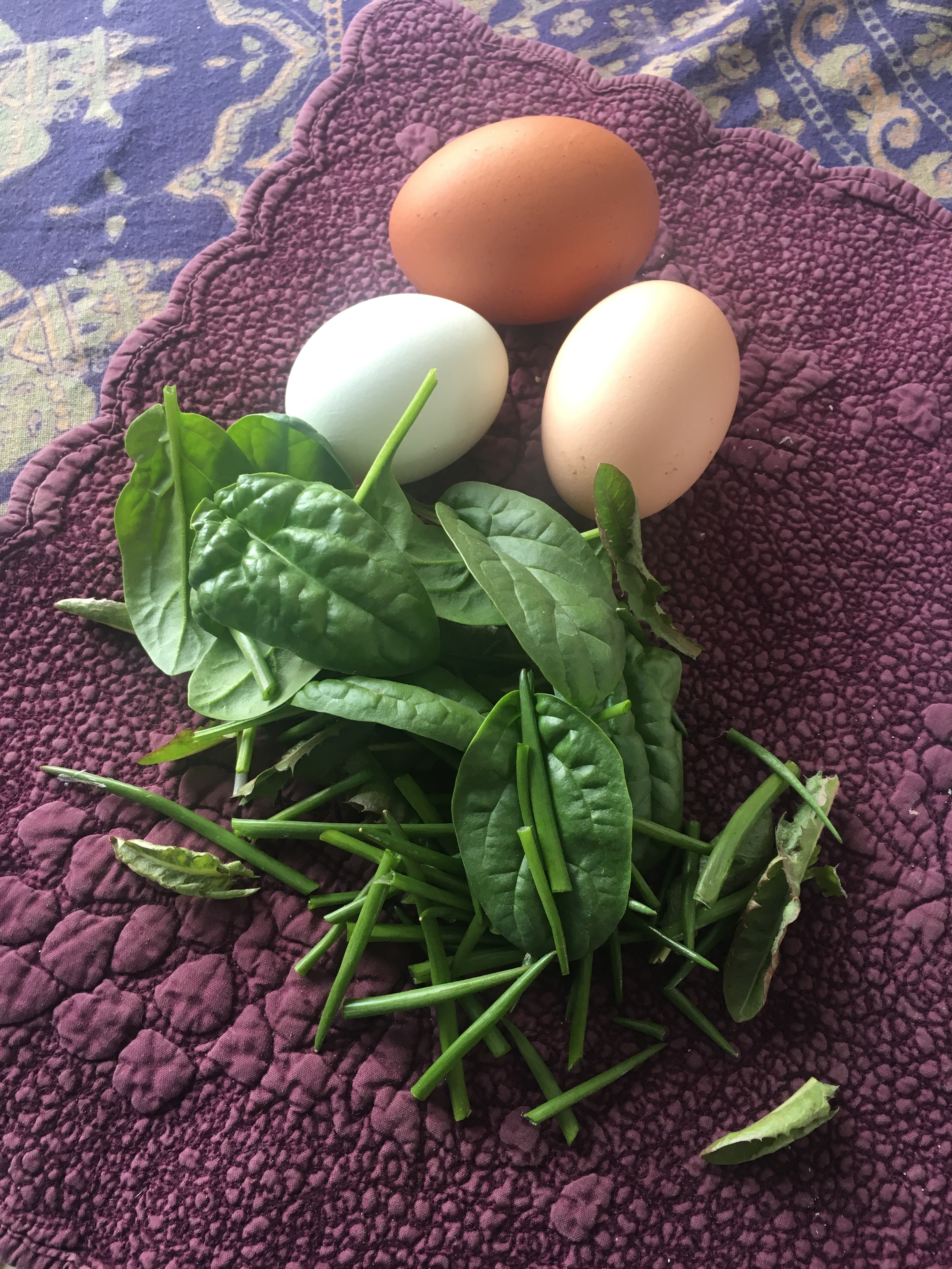
First fresh greens of 2022

We’re not quite at that stage of the game here. Our yard still has too much snow and where the snow has melted the ground is mushy. But the scene from that book stays with me. I imagine the house would smell like freshly laundered sheets and sunshine after that kind of a cleaning. And I try to imagine a life so unencumbered by stuff that it would be an easy enough task to haul all of our belongings out into the yard in an afternoon. Mostly I love the idea of letting air and sunshine work their way through all the indoor things that are prone to dust and darkness.

Retreating snow from the back garden

Journaling for me is a form of Eastering. With each entry I haul out something from inside myself that could use a little fresh air and sunlight. When it’s laid out on the page I can see the dings and the dust. More importantly I can see how small it is when it’s juxtaposed against a larger landscape. Once it’s no longer cluttered inside the shadowland of my interior self, there’s space for me to do some cleaning. Or forgiving, as the case may be.

Then, once I’ve looked at whatever it is in a different light and from a few different angles I can decide what to do with it next. I might choose to let it go or I might decide to hold onto it differently. I might file it into a new category or I might connect it to things that at one time seemed unrelated. But after each airing out I’m ready to begin again, which is what we all do. We begin, and then we begin again, and hopefully as we look at the pieces of our lives that brought us to where we are now, we’re able to offer ourselves and each other some grace.

**

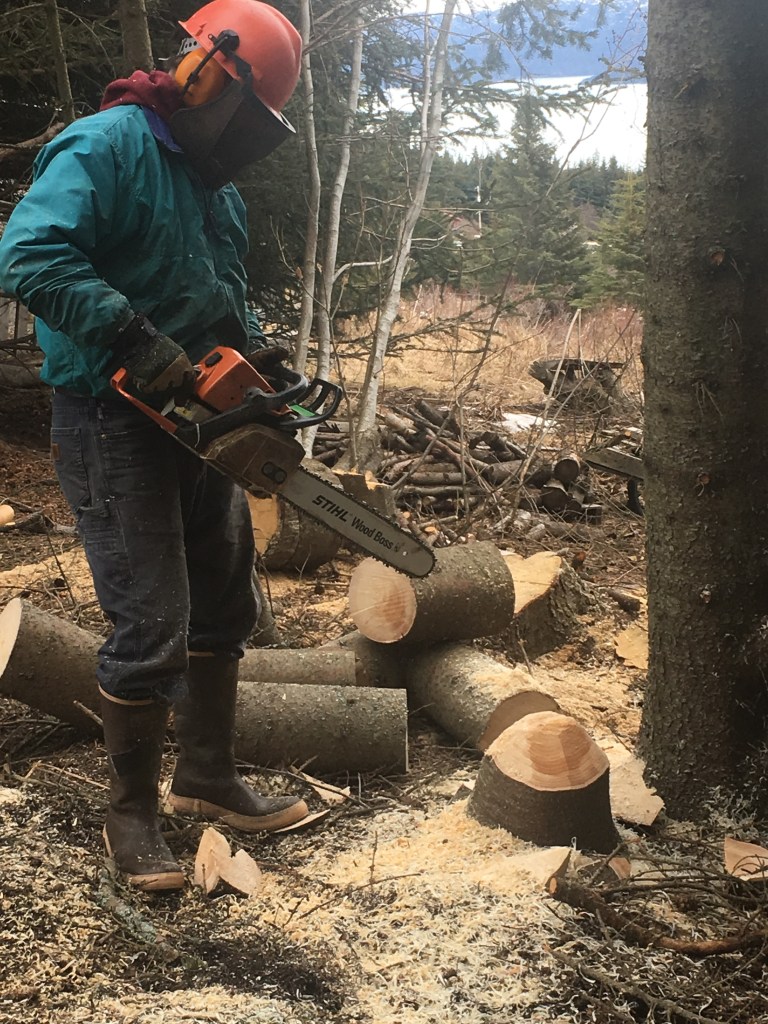
Fire safety/improved view/next winter’s heat all wrapped into one job.

Lost Words, Found Meaning, and an Autumn Equinox Journal Series

A few months ago, in a moment of mindlessness, I left my 2020 journal on the side of the road. On my way to work one morning I stopped to take a photo of something. I was already running late, and in my hurried state I grabbed my pack from the back seat of my car and set it outside on the ground so I could dig out my phone. I snapped the photo I was hoping to get and jumped back in my car and drove away without remembering my pack sitting there. It had my lunch in it, a pair of reading glasses, and my journal. 

I’ve lost a good number of things in my life, but never anything as personal as my journal. For a few weeks I obsessed over it. In my mind I replayed the whole scenario as if I could undo what I’d done. I scanned the side of the road each time I drove to and from town and I put the word out about my lost pack on social media and the local radio station, and contacted the police department in hopes that it would return to me. 

Journaling is a private affair, and so my first thought was one of deep embarrassment. Who had my journal and what must they think of me after reading my writing? I wracked my brain trying to remember all the things I’d written about, and goodness knows I’d written about all kinds of things, the most significant among them being my attempt to figure out what I’m capable of doing in a world that’s in need of so much healing. The thought of those words being out there, at large, outside of my control, kept gnawing at me.   

Over time I took comfort in imagining a few different things that might have happened, the first one being that the person who found my backpack needed a good meal, ate my lunch and then tossed the remaining contents of my pack into a dumpster somewhere. The next scenario involved the person reading my journal and laughing maniacally over all of the weird, esoteric ramblings that it contained. After a while I imagined a person reading my writing and finding some bit of comfort or insight in it. In reality, I’ll probably never know who found my journal or whether or not they bothered reading its contents. All I know is that it’s gone. The physical manifestation of all the hours of writing, exploring, and digging deeper into my own thoughts and questions is out of my hands. Still though, I like to imagine that in some kind of miraculous way it will find its way back to me. 

But because I am a person who tries to make meaning out of things, and because I believe there is always something to be learned from the things that happen in my life, I have decided to use the lost journal incident as something of a turning point in my writing life. I’m still trying to sort out exactly what I’m turning toward, but I’ve identified a few important truths that are helping me move forward. 

The first and most important truth is that in my life the act of journaling matters more than the physical journal. Yes, my physical journal is gone, but the hours I spent in the creative, contemplative space of filling the empty pages have served me well. I know myself and my convictions more completely because I have taken the time and made the space for journaling in my life. I continue to grow as a critical thinker, as a more compassionate human, and as a person who’s engaged with living because I question and examine my thoughts through journaling. This is true even if the words that I write are not available for me to read again. My old journals can serve as a record of my personal evolution, but the evolution has taken place, even if the journal is gone. 

The next thing I gleaned from the incident is that while journaling is useful, it can be limiting if its only purpose is to serve as a repository for ideas, dreams, and desires that are never acted upon. As I mourned the loss of my journal and all that it contained, I sensed that I was being challenged to do something, to start something, to create something. This is how the Autumn Equinox Journal Series came into existence.

The invitation that follows is a melding of my belief in journaling as a transformational activity and my determination to do something with it beyond myself. It’s an idea that grew into being on the pages of my lost journal, and by offering it now, I’m answering a calling I felt to do something rather than just write about it. 

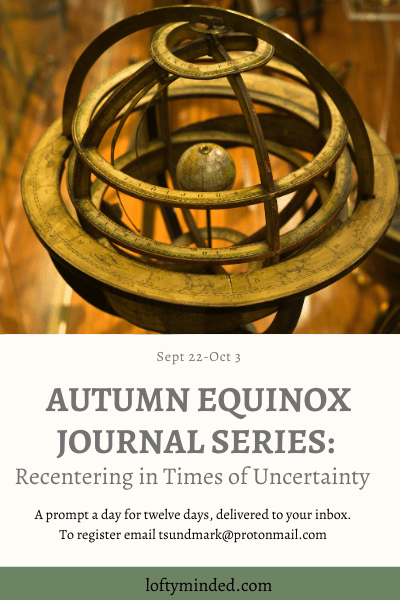
So, I’d like to formally invite you to sign up for the Autumn Equionox Journal Series: Recentering in Times of Uncertainty. It will start on the fall equinox, which is  Tuesday, Sept. 22, and run through Saturday, Oct. 3.

Everyone is welcome to participate, but when designing the prompts I made them specifically for people who are feeling the need to garner some strength as we move toward winter during these eventful and uncertain times. All of them are written as an invitation to examine your life from a slightly different perspective, to go a bit deeper than what our day-to-day lives typically allow for, and to engage the imagination.  

While the act of journaling is private and potentially impactful on an interpersonal level, my hope is that a community of journal writers engaging together for twelve days will have meaning that reaches beyond the personal. 

If you have questions or would like to sign up to receive the prompts, send me an email at tsundmark@protonmail.com. I’ll add you to the list and send an introductory email in return.

There is no cost for participation, but there will be an opportunity to offer a gift payment if you feel so inclined. I encourage you to join, regardless of whether or not you feel you can afford to offer a monetary gift. 

I hope you’ll consider journaling alongside me for twelve days and sharing this post in order to help me spread the word to a wider community of people. Together we can center ourselves and support each other as we navigate the months ahead. 

Thank you,

Teresa Sundmark