Saturated (part 1)

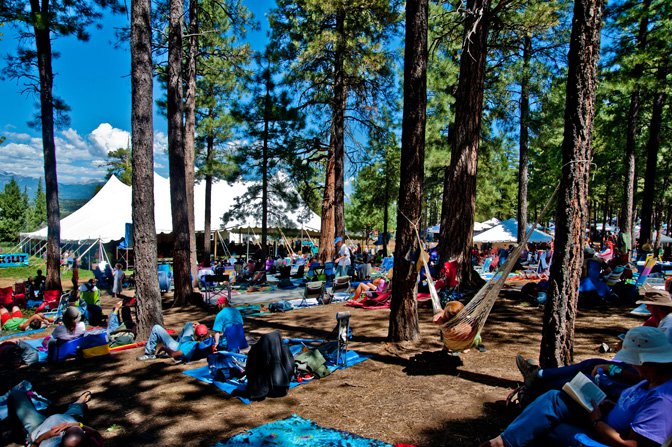
Sometimes a person reaches a saturation point.  The dampness of this coastal Alaskan summer was beginning to take its toll on my mood.  My imagination was stuck on replaying a scene that involved waking up in the morning and seeing blue sky and a yard that could be navigated without getting soaked.  I needed some sun and I wasn’t going to get it in Homer.  A field trip was in order, so my sister Marla and my friend Kate and I headed north, to the Anderson Bluegrass Festival.

There were no guarantees that the weather would be nice in Anderson, but whenever people gather to play music there is different kind of warmth that is created, a kind of heat that is a close second to that which comes from the sun, and I needed some of that as well.  Lucky for me the weekend did not disappoint on either front.

We left on Thursday afternoon and headed toward Anchorage to stay one night with our friends Jay and Sigrid, host and hostess extraordinaire.  They have an enviable way of making people feel right at home the moment you enter their presence (not just their home.)  Sigrid attended the play of one of her nieces that evening so we didn’t get to see much of her, but Jay whisked us away to a birthday party of a fellow musician and fiddle player, Peter.

Several friends that I’ve made over the past five years of attending Alaska Fiddle Camp were there, and it was great to get to see them, especially since there will be no camp this year.  After visiting for a while we found our way to the dining room that had been cleared out to make room for the purpose of playing music.  My brain was dull after the drive, and I could feel the beginnings of a headache (I should have known better than to substitute dinner with a mocha,) but thankfully my friend Sherry, another fiddle player, was there with her plethora of tunes, and between her and Peter and George, I enjoyed the luxury of just playing along without having to think too hard.  We played until just after midnight (in order to usher Peter into his 40’s) and ended the evening by passing around a gallon of raspberries that George had picked from his yard and given to Peter as a birthday gift.

It was raining again as we left the party but it didn’t really matter.  I felt content, and warm, and glad to be in Alaska among my friends.

Halfway through summer

Somewhere in the early days of this blog I think I wrote something about trying to post something at least twice a week.  In retrospect it may have been a little too lofty a goal.  I seem to be doing well to get something out twice a month at this point.

There is always the hope that somewhere in my future I will find more time for writing and reading.  Realistically the six to seven months of winter we get here could work to my advantage.   During the long season I go to bed early and therefore find it relatively easy to get up at 5:30am and take advantage of a quiet house.   Summer in Alaska is a different story.  There is this climate-imposed pressure to fit as much into three months as others in a more southern locale could spread out over as many as six to eight months.   The garden needs tending, firewood needs stacking.  There are fish to catch, berries to pick and recreation to be had, all in addition to the regular household chores and my job.    I’ve heard people talk about “lazy summer days” but honestly I haven’t experienced many of them in the 18 years I’ve lived here.   Perhaps we’re programmed to keep moving until darkness settles in, which this time of year is around midnight. It’s a rather manic existence and I can sustain it for a while, but just lately I’ve reached the part of the summer where my concentration is low and my attention span is short.

Lately I’ve been craving some serious couch time.  The other day I found myself fantasizing about catching a summer cold that would force (allow?) me to sit still for a while with my books and my laptop.  When my reading and writing habits become mucked up in the long daylight portion of summer, I feel a little out of balance.  A sort of literary mania comes over me.  The problem is compounded by the fact that I work in a library.

It starts with me checking out more books and magazines than I could ever possibly find the time to read.  Then, when I start feeling bad about taking so many items out of circulation for the public use I begin digging through the book donation boxes in the back room.   My stack keeps getting higher and in my attempt to make up for all the years I spent reading Glamour magazine and listening to 80’s pop music when I should have been reading the classics I start having thoughts like, “How can I possibly be a good writer if I’ve never read Moby Dick, or anything by Steinbeck?  I must remedy this situation right now.”   The guilt I inflict upon myself is emotionally exhausting and by the time I actually have time to sit down on my couch with my oversized stack, (usually around 11:30 pm) I’m overwhelmed by the choices.   I do a lot of page flipping and a little reading (remember the short attention span I mentioned earlier) before I find myself too tired to think straight.  Then I fall into a hard sleep for about six hours.

Coherence returns, for a while at least, after a good sleep, so that’s when I try to write, even if it only amounts to a page or two in my notebook.   Some would say that journaling is a waste of time but I find that it’s a valuable tool for helping me keep my wits intact.   A while back it led me to a most obvious solution to my reading and writing problem of late:  short stories.  I’m working on a short story of my own, and what better way to learn the workings of the genre than to read a bunch of them?    And beautifully, I can manage complete works of fiction that are only 5-12 pages long, even during this crazy time of year when daylight lasts much longer than my brain’s ability to stay fully engaged.

And as for this blog, I still aspire to post more often, and maybe even liven it up with pictures once in a while.    In the meantime I’ll do what I can, and continue to enjoy the process.  I think I’ll also try to slow down a little and savor some of what summer has to offer.

Thanks everyone for reading.  I can’t tell you how much I appreciate your support!

Two ends of the driving spectrum

Getting your driver’s license on your sixteenth birthday was a rite of passage when I was a teenager.   I’m sure it still is for most of the United States, especially in rural towns where public transportation isn’t an option, but here in Homer it’s not uncommon for kids to wait a while before they get their license.  Some of them don’t bother until they’re about to graduate from high school and they realize they won’t always have their parents to drive them around.

My son waited until he was seventeen before he got his driver’s permit, which meant he had to wait another six months to get his license.  And here in Alaska we have “provisional” licenses, (thank God!) which means that kids can’t drive their friends around until they’ve been licensed for six months.

We were a three car family for a while.  Dean and I each have one that gets decent gas mileage, and then we had a Toyota 4-runner that we use for things like hauling the boat and getting firewood etc.  When our son got his driver’s license we let him use the 4-runner.   We thought it would be a good first vehicle for him; it’s pretty much bomb proof and it guzzles gas like you wouldn’t believe, which we thought would teach him about conservation.  Our idea was that if you can only afford to fill it up once a month or so, you learn to carpool and not partake in lots of frivolous driving around.  Our plan was working pretty well until the 4-runner died a couple of weeks ago.

It’s been a bit of a transition going backwards like that.  Our son, who finally got a job in order to support his driving habit, was loving his freedom, even if he did have to parcel it out.   And we were getting pretty fond of it as well.  When we no longer had to chauffer him around we found extra hours in our week.  With offers to pitch in a few bucks for gas we’d send him on errands to pick up his sister or a few groceries.  We no longer had to make late night runs to town to retrieve him from his girlfriend’s house.  It was nice while it lasted.

When you’re a driving adult it’s easy to take the freedom it brings for granted.  I certainly appreciate not having to ask for a ride every time I want to go somewhere.  Our son has adjusted pretty well to this step backwards, partly because it’s summer and he can bike a little, and partly because we let him borrow one of our other cars now and then.  And he knows it’s a temporary thing.  He’s young and can save his money for a car and soon enough he’ll be back in wheels of his own.

On the other end of the driving spectrum is my Granddad.   I don’t know how old he was when he first got his driver’s license, but last week at age 93 he finally had to give it up.  I saw him about a month ago and the thought of him driving was pretty terrifying.  He had trouble staying awake for very long and he moved very slowly.  Just getting up from his chair in the living room and walking the 15 feet to the kitchen table seemed to take an eternity and it looked like he could topple over at any moment.

His driving had been a concern of ours, especially my mother’s, for the past couple of years.  She and my step-dad have been the ones who have checked in on my grandparents, (who at 90 and 93 years old still live on their own), every chance they get, and have constantly tried to assess where and when to assert their help.  Respecting their desire to remain independent has not been easy.  They have ever so slowly slipped into that stage of their lives where independence isn’t always the safest option.  For example, on January 1st my granddad took my grandmother to her weekly hair appointment, dropped her off and drove back home, never realizing that the hair salon was closed for the New Year’s holiday.  My grandmother had to teeter across a busy intersection to get to a grocery store where she called home and asked my granddad to come pick her up.  When he answered the phone he couldn’t hear anything, so he hung up.  Eventually she got a ride with a cab, but when she returned home my granddad had no recollection of ever dropping her off in the first place.   Worrisome stuff, to put it mildly.

Well last Sunday when my granddad was driving home from church he rear-ended someone.  I don’t know the details of the accident but I do know that nobody was injured.   I can only imagine the scene with my very old, very slow-moving grandfather getting out of the car to assess the damage.  He used to be a great auto-body repairman and I would bet that before he realized that the accident would end his driving career he was thinking about how to make the cars look new again.

I haven’t heard how my granddad is dealing with the fact that he can no longer drive.   Even though the roads are safer without him behind the steering wheel, it must be a frustrating loss of freedom.   The good news is that he’s forgetful, so maybe he won’t remember how he lost his driver’s license.  Maybe his short-term memory will fail him in a beneficial way and the after-church, rear-ending incident will fade away leaving space for the memories of all the road trips of his past.  And my mom must be relieved.  There are plenty of things for her to worry about with her aged parents, but at least Granddad driving is no longer one of them.

The Low Down on the Kachemak Bay Writers’ Conference (so far)…

The Kachemak Bay Writers’ Conference is underway, and I’m feeling lucky that such an event happens right here in my home town.  World class authors come here, to me, making it just so easy (and affordable) to learn from them.  I get in my car, drive about fifteen miles, make myself comfortable in the conference room at Land’s End Resort, and people like Michael Cunningham, Dinty Moore, Bill Roorbach, Peggy Shumaker, Sherry Simpson, Nancy Lord and Rich Chiappone (to name just a few) offer workshops, answers to writing questions and expert advice.   It’s pretty cool.

Although I’ve been dabbling in writing for several years, I’m a newbie to the writing world.   The KBWC is a good way to get a sampling of what it’s all about.  Jennifer Pooley, a senior editor from HarperCollins imprint William Morrow is here, as is agent April Eberhardt.  It’s been nice to meet both of these very approachable women because they remind me that agents and editors are real people; something I’m guessing that most of you already knew.

Here are a few morsels I’ve gleaned from the offerings so far:

  • I use the word “I” way to much in my writing and I think I’m going to have to start looking for alternative ways to talk about myself so as to not bore the poor readers or sound like a narcissist.
  • Bill Roorbach says to call writing “work” and not “writing,” because the guilt-ridden side of us won’t let us skip out on work and it’s easy to decline social engagements when you say, “Sorry, I have to work.”
  • Dinty Moore’s workshop on miniature nonfiction validated my love for keeping things short and gave me some great ideas for future projects.
  • Michael Cunningham says it’s important to stay engaged with a piece of writing by visiting it every day, even if you don’t have much time.  He also says to “write smarter than you are.”
  • Listening to Peggy Shumaker read from her new book, “Gnawed Bones” reminded me that I love poetry, especially when it’s as accessible and beautiful as hers.
  • And Bill Roorbach says that gardening is writing.  I love that.

A Break

My last blog post was on April 22nd, two days after the oil platform Deepwater Horizon exploded in the Gulf of Mexico.  At that point I was writing one or two essays a week for the History of Psychology class I was taking, and that particular blog post was a way for me to escape the pressures of my class for a couple of hours. I noticed the headline about the oil platform sinking and eleven crewmen missing on that day as I was researching school lunches but honestly my mind was on other things and I didn’t give it much thought.

I took a break from journaling and blogging late in the semester in order to finish the term paper for my class. And in my attempt to stay focused on the task at hand I didn’t pay much attention to the news, but on May 6th, the day I submitted my final project, I heard that the oil leak in the Gulf was spewing close to 25,000 barrels a day, a much bigger number than the 1000 barrels it had been estimated at in the beginning.  The burden of a semester’s worth of deadlines was gone and I could finally think about the trip to Colorado I was leaving for the next day, but that number, twenty-five thousand, stayed with me.

My sister and I flew out of Anchorage on Saturday, May 8th.   The route took us over Prince William Sound where twenty-one years before, the Exxon Valdez spilled 257,000 barrels of crude oil.   When that spill occurred I was three years out of high school, at a time in my life when keeping up with current events was the last thing on my mind.  But I had this dream of moving to Alaska and I watched the spill unfold on television with a heavy heart.  What I didn’t understand at the time was that the images of oiled sea birds and otters were only a small part of the story; the lost livelihoods, the damaged ecosystems, the profound hopelessness experienced by those affected, those are the stories that aren’t as easy to cover in a headline, or with a picture.

I spent my first day in Colorado, Mother’s Day, at my step-mom’s house.  Three of my five sisters were there along with four nieces and a nephew.  She prepared for us a delicious meal of shrimp scampi and just before we sat down to dinner we checked CNN and found out that BP’s first attempt to cap the spewing oil with a containment dome the day before had failed.  If I’ve done my math right, the Deepwater Horizon had already surpassed the Exxon Valdez in the number of barrels of oil leaked by Mother’s Day.  But unlike an oil tanker with a finite capacity, nobody knows how much oil can escape from a hole that is drilled 18,000 feet into the ocean floor.   Nobody knows how many fishing families will be put out of business, or how the Gulf of Mexico’s sustainable shrimp industry will fare, but it doesn’t look promising.

I didn’t follow the news much for the next ten days or so.  I knew the oil was still flowing into the ocean but thinking about it couldn’t change a thing, so I went about enjoying my time with my mom and my sisters.   It’s a powerless feeling to care about something and really not be able to do anything tangible to remedy the situation.

I returned from Colorado a little over three weeks ago.  Since then I’ve resumed my normal life, which is mellower in the summertime.   With the kids out of school I’m able to sleep a little later, and the extra daylight after I get off of work allows me to get outside and work in the garden in the evenings.  The peas and beets are beginning to sprout already, and potatoes and carrots will soon follow.  So far all of the green vegetables that we transplanted seem to be surviving, so maybe this will be a good gardening year.  Hopefully by the time I’m harvesting vegetables this fall the technology to stop the flow of oil into the Gulf of Mexico will have been found and put into use.

I still check the headlines every day to see if there is any good news at all in the Gulf of Mexico.   I haven’t heard any yet and it’s been about fifty days since the initial explosion.  It’s a sobering thing to know that we can cause so much harm; that the advantages of our technology can at times be outweighed by the damage it can unleash.  I feel it’s a problem that must be recognized and considered with each advance that is made, but out of self-preservation I can’t let myself get overwhelmed by things that go so far beyond my own control.  I can’t stop the flow of oil into the Gulf of Mexico but I can tend my garden, my family and my soul.  I can get back to writing and I guess that’s better than doing nothing.

Singing the lunchtime blues

I think about food a lot.  It seems like I’m constantly going over grocery lists in my head and thinking about what to prepare for dinner.  I have to say it’s a lot of work to feed a family well, both from a time standpoint and from a money standpoint.  My family, like so many others, has fallen into the trap of creating hectic lives for ourselves by trying to do so many things.  We work long days. Then in the evenings we take classes, drive kids around to their various activities and generally keep ourselves busy.  While none of these things are bad, they don’t always leave us with much time to do the things that are required for eating well, like planning meals, shopping, cooking, and my least favorite food related activity, washing dishes.

I know that when my life gets busy I’m less inclined to make a salad to go with dinner and I’m more inclined to reach for things like frozen pizza. After all, frozen pizza is cheap, easy and it doesn’t mess up the kitchen.  I joke that it fills all of the food groups (even though I know better) with tomato sauce as the vegetable, white crust as the carbohydrate, and pepperoni and cheese as the protein.  If I start doing this too often though, it doesn’t take long for me to start feeling the effects of such a diet.  I’ve figured out the correlation between the crappy food that I eat and the crappy way I feel the next day, so that keeps me from going overboard with the junk food.

This week a teacher at one of the local schools posted on his facebook page pictures he’s been taking of junk food.  Most of the meat was nearly unidentifiable and it was always served with something starchy, like white bread, mashed potatoes or French fries.    I know for a fact that with my metabolism, if I were to eat those meals, or meals like them several times a week I would weigh at least twenty pounds more than I do now.  I would also feel like I lived in a constant state of hangover.  The “meals” he photographed weren’t from a gas station or from a fast food franchise as it looked like they might have been, but from the public school lunch program.

It seems like the USDA has prioritized convenience over nutrition as a policy.   As long as it’s cheap, easy and doesn’t mess up the kitchen, the USDA will approve it and the schools have no choice but to serve it.   This may seem a lot like my reaching for the frozen pizzas when I’m pressed for time and money but there is one important difference; I recognize that frozen pizza is junk food, and even though I joke about it meeting the nutritional needs of my family, I know for a fact that it does not.  It might taste alright, and it might fill everyone’s bellies, but I know I can’t serve it all the time.  Unfortunately the USDA has twisted the rules around and has tried to convince us that they’re meeting the nutritional needs of schoolchildren.  They fumble their way around the requirements by saying that French fries and apple juice count as fruits and vegetables.  They serve junk food every day of the week, only they call it “well-balanced” and “nutritious.”

A healthy, well-balanced USDA approved lunch

Unlike the kids who depend on public school lunches five days a week, I have choices.  I don’t have to eat frozen pizza or mystery meat on a daily basis.  Most of the time I have the ability to  figure out meals that are inexpensive, relatively quick to prepare and healthy for my family; and as a parent it’s my obligation.  Come to think of it, I imagine that the folks in charge of making the policies regarding school lunches are pretty smart as well. I know they’re probably busy and feeling over-extended just like the rest of us, but feeding kids real food should be one of their top priorities.  It’s what they signed up for.  Have they forgotten?

Thinking about freedom

I have less than one month to finish my History of Psychology class and I should be studying instead of writing for fun.  I’m justifying my actions by convincing myself that I’ll be more productive after a break.  In reality I’ll probably just feel more tired.  I’m actually enjoying this class, although I’ll be relieved when it’s completed.  For now though, it’s giving me the opportunity to use my brain in ways it hasn’t been used in a long time.  There’s a good chance that a couple months from now I won’t remember most of the things that I’ve read, but for now it feels good to be learning.

Here is a sampling of some of this week’s deep thoughts:

Karl Marx thought that human behavior was controlled by society.  Sigmund Freud thought that human behavior was controlled by biology.  Erich Fromm considered the possibility that human behavior wasn’t completely determined by either society or biology.  He believed that humans have the potential to make free choices.  Here in America, in the land of the free, it’s easy to forget that the concept of individuality hasn’t always been a given, and in some cultures it’s still a pipe dream.   For example, if I had been born a peasant in the Middle Ages, then I would have stayed a peasant.  My life would have been predetermined by my birth.  But nowadays, at least in America, one can conceivably be born poor and grow up to be rich.  One can choose to get an education or maybe move across the country if they feel so inclined.

I imagine that being a peasant probably wasn’t much fun, but at least it wasn’t complicated.  Very few choices had to be made.  Life had structure.  If you think about it, it’s unlikely that peasants experienced mid-life crises.   Freedom, you see, comes with a downside according to Fromm.  He said things like loneliness, confusion and alienation are byproducts of freedom.  He went on to say that we do things to “escape from freedom” in order to avoid the discomfort that it causes.

He said we either a) submit to an authoritarian figure, or become one, b) become destructive to ourselves or others, or c) hide ourselves within the culture at large, making ourselves as inconspicuous as possible.

Each person, at least within our own culture, has to choose how to cope with freedom.  For most of us it isn’t all or nothing.  We experience it in varying degrees.  We try to find that balance of how much freedom we can tolerate, and then adjust our lives accordingly.

All of this has me questioning where I fit into the spectrum of freedom.  Do I try to avoid it or do I embrace it?  I guess it depends on the circumstances.  I do however feel thankful to live where I live, during the time when I live.  At least I have the freedom to consider all of these complicated issues.

Lunch Break Pilgrimage

To outsiders 39 degrees doesn’t sound very warm, but in Homer, in the middle of March, when there is no wind and the sun is shining, it feels downright toasty, especially if you’re wearing your favorite wool sweater.  Yesterday, St. Patrick’s Day, was one of those days.  Unfortunately I had to work, but I did manage to get outside over my lunch break.

First, I left the library and waded through several inches of slush in the parking lot to find my way to the walking trail that leads through the woods.  The trail hasn’t been cleared since last week’s storm, but a narrow path of packed down snow made it passable.  I could have followed the road, but I would have been sprayed and subsequently soaked if a car had driven past.  On the trail I met a young guy whose mother is a friend of mine.  When he stepped aside to let me pass he sunk about two feet into the soft, melting snow.  It was very chivalrous of him considering the fact that he was wearing sneakers and I had my snow boots.

At the end of the trail I turned south on Poopdeck Street.  At this point I had to shade my eyes with my hands.  The sun, the snow, the water; well it was all a little overwhelming for my pupils.  The sidewalk was also icy which made for some interesting maneuvering.  I walked and slid my way downhill to the highway, without crashing I might add, with one hand above my eyes and the other out in front of me for balance.

I crossed the highway at the crosswalk and cut through the Islands and Ocean Visitors Center parking lot to meet the next trail.  It cuts down through the spruce and alder forest and leads to one of my favorite destinations in Homer; Two Sisters Bakery.  But yesterday it was too nice outside, and I needed the sun more than I needed a chocolate bread roll, so I walked past the bakery and headed toward Bishop’s Beach.

The parking area was crowded.  Dogs and children were milling about.  A black lab and a German shepherd, free from their owners, ran up to greet me.  It turns out that I knew both of the dogs and when I called out their names, Osa and Caspian, they were beside themselves. They proceeded to swarm around me in a flurry of leaping and hopping and wagging tails.  When the boys who belonged to the dogs caught up they seemed equally as excited as the dogs at having found someone they know at the beach. Sometimes there’s nothing like a good greeting.

After a short chat in the parking lot I walked through the soft sand at the top of the beach and over the rocky stretch about half way down before I reached the final stretch of my journey.  Still wet from the receding tide and littered with clumps of seaweed, driftwood and clam shells, the expanse of dark sand just before the water is one of my favorite places.  Sometimes I walk long distances along the water’s edge, taking advantage of the firm surface, but yesterday my time was limited so instead of walking parallel to the water I went straight toward it.

I  knew I didn’t have long, that I’d have to turn back in order to get back to work on time, but I stood for a while with the water inching in and out around the soles of my boots.  I listened to the waves. I turned my head toward the sun and soaked in its heat for a few moments.  Then I did something that I hadn’t planned on doing; I took off my gloves and plunged my hands in the ocean.   For some reason it just seemed like the right thing to do.

Jury duty/Time management

On Monday morning I woke up at 3:45am feeling anxious about how busy my life has become.   Finally at 5:00 I got out of bed, made coffee and wrote in my journal for a while.  I find that journaling helps me narrow down solutions to some of the bigger problems I have to face and on that morning I wrote about needing to manage all of the different things I have going on right now.

When I enrolled in two classes in January I knew I was going to have a full schedule until the end of the semester, but a few unexpected things have come up that had I known about may have convinced me to hold off for a while on the classes.  Since the beginning of February we’ve decided to explore the idea of putting our house on the market, our son’s schooling situation has changed and I’ve had to increase my hours at work by six hours a week in order to keep some important benefits.

So how am I finding the time to write something other than essays for my class right now?  Well back in December when I received my summons to jury duty in the mail I thought I was being clever by deferring it to February and for the past two days I’ve been sitting on uncomfortable benches in the hallway of the courthouse.  Thankfully I had been warned about the jury selection process requiring an awful lot of waiting around, so I brought along lots of stuff to keep my busy.

A lot of folks here are complaining about all of this down time but I’ve decided to welcome this unexpected reprieve.   Yesterday I got caught up on some reading for one of my classes, and today I’m getting the opportunity to write for my much-neglected blog.  I’ve also had time to reread the journal I’ve been keeping for the past few months which reminded me that problems I’ve been overwhelmed by in the past have come and gone.  It helped me relax a little and realize that I can do this; I can finish these classes, be a good parent and systematically work toward putting our house up for sale.

Who knows, if they keep me here a while longer I may even have time to finish Pride and Prejudice.  I started it in December when I thought I’d have plenty of time to plow through my booklist.  This jury selection process really isn’t so bad but if I am actually chosen to serve for this trial, which is expected to go for two to three weeks, I may find myself bursting into tears in front of the attorneys and the judge.  Either way, I guess I’d be off the hook.  I’m pretty sure they’d let me go at that point.

The chicken before the egg


One of my chickens is dying.  On Monday morning when I went to give my small flock of seven some food and water she had that look that I’ve come to recognize as the dying chicken look.  She was huddled on the ground instead of perched up high on the branches I’ve arranged inside the henhouse and she didn’t show any interest in what I was bringing.  I thought she’d be dead by the end of the day, but she’s been hanging in there all week.

This isn’t anything new.  I’ve been keeping chickens for quite a few years now and we’ve watched many of them grow old and die.  Some people are very systematic about culling their chickens in order to keep their egg yield high, but I don’t have it in me to kill something just because its productivity isn’t optimal.  I did banish one from the coop once when she wouldn’t stop eating eggs and I found a pile of feathers a few days later.

I first started raising chickens when my children were little and I didn’t work away from home.  It was always exciting to get the baby chicks in the spring.  We’d go to the feed store and each kid would choose one that they could call their own.  Adella usually chose a Buff Orpington.  Dillon was partial to the black and white spotted Barred Rocks.  We raised them in cardboard boxes in the house for a few weeks before we introduced them to the older hens in the coop.   My kids were proud of their chickens and loved showing them off to their neighbor friends.

Times have changed though.  Now that my kids are teenagers they show no interest whatsoever in anything farm or garden related and I spend big chunks of my time away from home.  I’m pretty sure it no longer makes sense to keep chickens.  I should probably make my life easier by buying eggs at the store like most reasonable people, but I guess my chickens aren’t just about the eggs.

I love to watch them in the spring after the soil thaws; manic in their search for worms after a long winter.  I love that to them, nothing is more luxurious than a dust bath.  They remind me that a good life isn’t always about high productivity.  It’s more about enjoying the life we’ve been given.