Extreme Measures

Image


Stories in the news this week:  A young man kills a group of people, but before doing so he leaves a misogyny-laden Youtube video explaining why he’s going to do what he does.  A forest fire burns 183,000 acres on the Kenai Peninsula.  And Maya Angelou dies, leaving me to ponder her fearlessly lived life.

These things are unrelated, but I’m a writer and what that means is that these things are winding through my brain, and I’m trying to order them up, make some sort of sense and connection out of them.  And ultimately they’re all converging into a story I’ve been meaning to tell, and waiting for the right time to tell it.

***

A regular hangout space that students of the UAA MFA creative writing program frequent during our summer residency in Anchorage is the Blue Fox Lounge. It’s within walking distance from the dorms and it’s a great place to unwind after long days of literary talks, workshops and readings. On this particular night, a band was playing—a band we’ve made a point of going out for over the last few years. I sat with my friends right in the front, just feet from the trumpet and trombone. The music was fantastic and I was fully enjoying the break from my day-to-day life of working in the library, household responsibilities and going to bed by 10:30pm. For a couple of hours I laughed with my friends, enjoyed a couple of beers and lost myself in the music.  A rare, memorable night.

Then, after the band finished playing, we decided to go out for breakfast. In front of the bar while we waited for a cab, we made small talk with the band members as they smoked and packed up their gear. We made a point of thanking them for the music, and for maintaining such a high energy level for so many hours.  At that point, the keyboard player, the one who kept the witty banter going throughout the night, asked me my name.  Teresa, I told him.

“You know what you are, Teresa?” He said.  “You’re a cougar.”

 ***

The smoke from the Funny River Horse Trail Fire was dark brown and snaking its way from somewhere up the peninsula down to the head of Kachemak Bay where it hovered over the water and moved toward town last week. As is the case with every fire, it started small. But an unconventionally long stretch of dry weather, a beetle-killed spruce forest, dry grasses and wind conspired to allow one spark to grow and consume a total of 183,000 acres over the next several days. Over the Memorial Day weekend, a fire ban was put in place, which meant no outdoor fires were allowed.  No campfires, no cooking fires, no burn barrels.  Not even on the beach, not even with a bucket of water and a shovel nearby.  Families closer to the fire spent their weekend cutting down trees, making defensible space around their homes.

 ***

As a writer, words are my job.  I realize they have power.  I try to choose them carefully.  I want to understand their connotations.

Cougar.

I wasn’t sure how to take that at first. Mostly I was stunned. I mean, who was this guy, and what was he saying about me?  As is often the case in uncomfortable situations, I laughed it off.  But it didn’t take long for me to start adding up the number of things he was saying about me with that one word.

Cougar.

Before the word was directed toward me that evening last summer, I was hardly aware of the ages of my friends.  They were my MFA buddies, people who had read my writing, critiqued it and understood it in a way that few other people had.  And I’d read their work. One great thing that happens when you share your work with people is that you connect with them on a deeper lever.  Suddenly with this word, I was aware of my age, and of theirs. This one word, at least for a moment, lessened the real relationship I have with my MFA friends, a few of whom are men younger than me.

Before the word was directed toward me, I didn’t feel self-conscious.  But in an instant these thoughts went through my head:  Should I color my gray hair? Do I look like I’m out to hook up with someone? Should I have gone home early? Maybe I shouldn’t have gone out at all.  Eventually, I rationalized my way through these thoughts, but that one word made me doubt myself for a moment.

And then there were the inconsistencies.  A few members of the group were women who are younger than me, and men who are older than me.  But the keyboard player didn’t feel inclined to shame the older men for hanging out with younger women. And while calling me a cougar was hardly a crime, it was an insult, an insult that was gender specific. What are the insults directed toward women that don’t have a male equivalent?  Old maid, hag, slut, whore, tease… cougar.  I could make the list longer, I’m sure.

Most baffling of all to me was this: what gave that man the sense that he had to right to define me with that term? He’s a total stranger.  All he saw of me that night was that I was out late, I was laughing, I was enjoying a beer or two with my friends, I was tapping my foot to the music.  That’s it.  And yet he felt entitled—compelled somehow—to belittle my existence in that space in time.  I’m sure had he been in line in front of me at the grocery store or had I met him in a more formal setting, he would have made polite conversation. But being out, late at night, with people not my age, gave him license to call me a derogatory name.

And people think that women are too sensitive—that we are uptight about language and names and subtle jokes about our sexuality.  But those words are like sparks.  They have potential to grow into full-blown misogyny.  They have to be extinguished and called out and we have to make people understand their power.  It’s not just about being politically correct, it’s about taking preventative action.  When we point out an inconsistency or a sexist remark, we’re making defensible space.  We’re making sure you understand that we’re not going to allow you to burn us. When we don’t tolerate names or insults at all—even in the context of a joke—we’re banning those campfires, those cooking fires, those burn barrels.  It may seem like an extreme measure, but all it takes is reading the news to see that extreme measures are in order. And wouldn’t it be nice if we could move beyond making defensible space? Wouldn’t it be nice to somehow send everyone the message that power and oppression are not mutually exclusive? The band that night had power over its audience in a good way.  Everyone in the Blue Fox was smitten with their sound. Too bad the keyboard player didn’t feel that that was enough.


A Calm Presence

Image
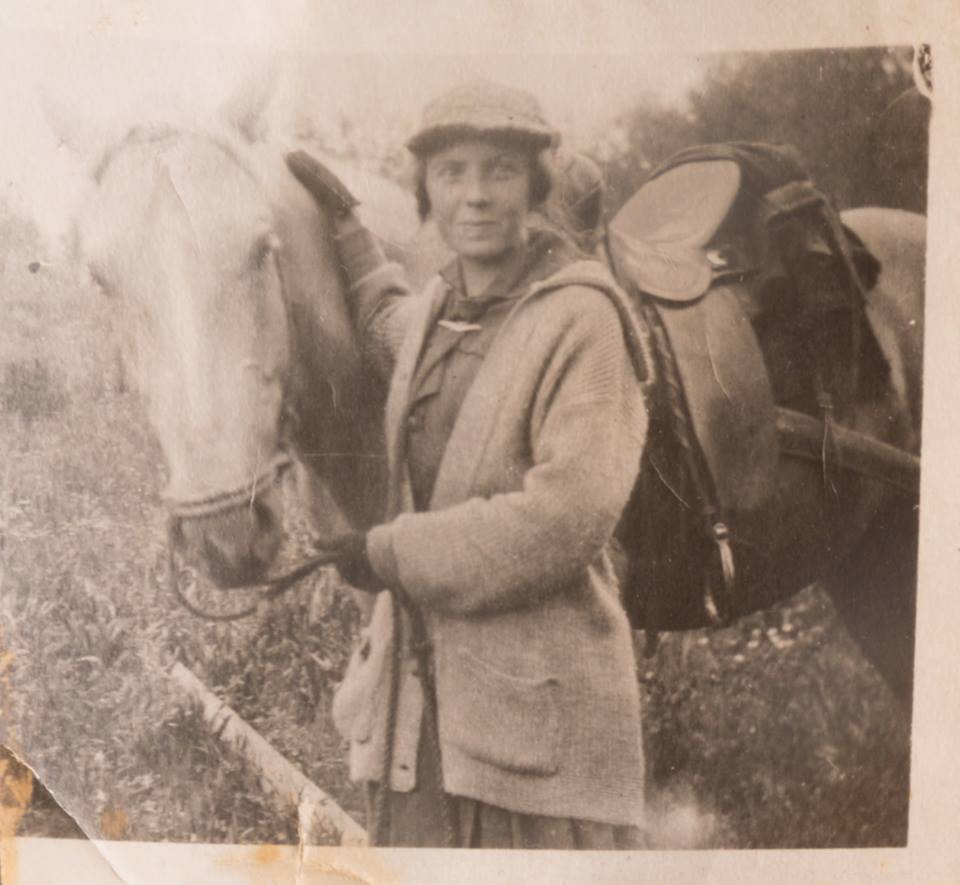
Edith Campbell Ross


When I was in kindergarten, I’d spend afternoons at my Grandma’s house. She’d sit at her kitchen table with me and together we’d drink tea—with lots of sugar—and eat slices of her homemade bread.

She was sixty-nine years old when I was born and had lived a long life before I was ever in the picture, but of course when I was young I didn’t think about the life she’d lived before I was in this world. I didn’t even wonder how she spent her days before I walked through her door every afternoon.

As a young woman, she raised her family in remote country, high up in the hills outside of Telluride, Colorado. She no doubt worked harder in one day than I do in month. But by the time I was in kindergarten she was beyond all of that. When I knew her she had the modern conveniences of indoor plumbing, centralized heat and television. By the time I came along she could do her dishes without having to haul water or boil it first. If she felt chilly, all she had to do was turn up the thermostat. And so when I sat at her table after school on those weekday afternoons, she had time to sit there with me. If she talked about her life at all it was in the form of stories about her and her sister Bessie playing together when they were little girls, and the trouble their very naughty brother Jesse always seemed to bestow on them.

Those afternoons were about tea and bread and childhood stories. She didn’t burden me with anything about the adult world.

If I could sit down with her now, I’d probably ask her too many questions. I’d want to know what it was like to raise a slew of children in a small cabin high up in the mountains. I’d ask about her parents, her brothers and sisters, her marriage to my grandfather. I’d want to know what brought her the most joy and what brought her the most sorrow.

As it is, all I can do is imagine what her life must have been like before I knew her. I can take the experiences of my own life and project what I know about love and hard work and responsibility onto her life as a young wife and mother. But all of that is speculation.  What is real and what I don’t have to imagine is the memory of my grandmother’s calm presence. Time with her was soothing to my young soul. It was not about the future or the past. It was just about sitting together in the afternoon sun, drinking sweet hot tea and eating bread still warm from the oven.

This place, these people.

         Image

          The temperature was dropping and a strong wind was blowing when I walked down the driveway after work on Thursday night. I am used to windstorms and cold, so I didn’t think much of it. But the gusts got louder and stronger through the night. Around 2:00am we heard one of the fiberglass panels from our greenhouse dislodge and it began to smack against the side of the house over and over again. An empty rain barrel crashed into the wall of our garage and then found its way from one side of our property to the other. It wasn’t a night for sleeping.

The next morning, the house was cold and outside the wind still blew–30mph sustained with gusts up to 60. We built a fire in the woodstove and when we opened the curtains we could see substantial sparks from the stovepipe flying through the air. The record breaking warm spell from January that had melted all of our snow was over, but the ground remained bare and vulnerable with dry grasses and brittle fireweed husks. Red flag fire warnings, standard fare for May or June, were issued in early February. Thankfully, the sparks fizzled out before they landed.

On my way to work Friday morning, gusts shook the car and blowing grit from early winter road sanding made for moments of no visibility. The pavement was littered with branches and debris. In three places I saw evidence of trees that had fallen and already been removed from the roadway. Halfway to town, a house with its roof torn and folded up on itself made my own sleepless night seem insignificant.

The wind didn’t let up all day.  In town, the library and the college lost power. Trees and power lines snapped. Roof shingles sailed through the air. Those of us who ventured out covered our heads to keep from getting dirt in our eyes and mouths. Everywhere it seemed people were on edge after having spent the night mentally holding down their homes and property.

Around noon, although it couldn’t be seen falling from the sky, cold, wispy, dry snow started to appear in the mix of blowing debris. After a few hours it began to accumulate unevenly—still bare ground in exposed places, but a few inches against buildings and in protected places. Finally, before we went to bed on Friday night, the wind stopped as abruptly as it had started the night before. I slept in the comfort of silence and a fresh blanket of snow.

***

             Everything that Friday was—violent, dusty, dark, edgy, uncertain—Saturday was not. The storm had passed, the skies were clear. The voice on the radio reminded me that we’re gaining five minutes of daylight a day.

I drank my coffee and had two productive hours of schoolwork in a sunlit room. Then I dug out my Mardi Gras beads and drove into town to watch the winter carnival parade. The parade doesn’t change much from year to year, but still I go. I love its silliness and its familiarity. It’s the town’s way of not taking itself too seriously. And yesterday, the day after the town felt like it was going to blow to pieces, everyone was relieved and festive and ready to have a good time.

Seeing friends at the parade led to an impromptu get-together of playing old-time fiddle tunes for a couple of hours in the afternoon. Later in the evening, we went to see the Irish band, Lunasa, at the high school. The place was packed and musicians played tirelessly and flawlessly for two solid hours.  After the show, we stopped at the Down East Saloon to enjoy Cajun music and one more showing of the Bossy Pants Brass Band that had marched in the parade. People were costumed and sparkly. The dance floor was sweaty and packed.

When we got home at midnight, I sat for a while and looked out the window at the stars. I thought about my day and how many friends I’d seen and caught up with. I thought about the way this town is molded by its crazy weather and its silly traditions. I thought about how I get weary of living here sometimes with the coastal climate, the distance from the rest of the world, the sameness, year after year. But then one sunny, musical day with a parade comes along and any bad thought that’s ever entered my mind about living here is gone as abruptly as the windstorm.

I went to bed with my mind still in motion. I could still see my friends’ children dancing to Lunasa’s hop jigs and reels. I could still hear the old time fiddle tunes I’d played in the cozy living room of my friend’s house. I could still see familiar faces parading through the middle of town—some on bikes, some on floats, some walking alongside their decorated farm animals.  I could still feel the rhythm of the Cajun two-step I’d danced with my husband and a hundred other friends.  When I finally fell asleep, I was thinking of all of us in this one place, all of us weathering every storm.

Falling into a Global Warming Facebook Vortex

A week ago, I did something my better judgment told me I shouldn’t do.  I engaged in a Facebook discussion about global warming.  A cousin of mine posted this statement on his Facebook page: “OK, somebody much smarter than me is going to have to explain why this record cold weather is caused by man-caused global warming. It was explained to me once but I forgot.”

The statement was loaded for a number of reasons.  First of all, it was coming from a person who doubts that anthropogenic climate change is a thing.  I suspected that his asking for an explanation was less a cry for understanding and more a way to get a larger discussion started. Currently the thread has 172 comments, so if that was indeed his motive, it’s safe to say he was successful.

Also loading the question was the way it appropriated one event—the polar vortex that chilled much of the lower 48 last week—to the overall trend of global warming.  We all know that there were probably such strange weather events long before humans started burning fossil fuels, but the wording of his question wanted proof that one thing led directly to the other.  Unfortunately though, one wicked cold snap cannot prove or disprove climate change.

The other part of my cousin’s statement that made it feel loaded were these words: “somebody much smarter than me is going to have to explain.”  By trying to answer, there was an insinuation that I was saying that I’m smarter than him, and goodness knows I am not.  I have come to different conclusions than he has come to on the topic of climate change, but I am not smarter than him.

 ***

     I was the first to respond to his Facebook post, and I gave him a couple of links from the Union of Concerned Scientists webpage. This one, that explains how scientists have linked global warming to human activity and this one, that explains how the polar vortex can be destabilized. From there, the posts went in a few different directions.

There were plenty of people who fell into the “God is in Control” category with their posts:

-“No such thing as global warming it’s all in God’s hands simple as that”

-“God is in control. Simple as that. Who on earth thinks they’re smart enough to control the weather. Warming , colding, rain, shine. Who would even dare to say they can control it. Not me….”

-“The Bible says in Genesis 8:22 while the earth remaineth, seed-time and harvest,and cold and heat,and summer and winter, and day and night shall not cease. That tells me that God is still in control and that we will always have hot and cold weather. from the beginning time till now, it has been this way, and will continue to be so.”

And there were those that took a more conspiratorial tone:

-“Now that it’s no longer getting warmer, they changed it to “Climate Change.” The climate has been changing since the beginning of time, but somehow these libs think they can stop it from ever changing again. And, best of all, no matter what happens (hotter or colder, more hurricanes or fewer) they can blame it on climate change. How conveeeeeeenient!”

-“I wonder if Al Gore’s net worth has had anything to do with GW? What a great investment. Influence an army of idealist college students and send me out to become global warming evangelists…”

Interspersed throughout all of this there were was one young man who kept speaking his mind, saying over and over again that scientific data shows that humans are causing the earth to warm.  He became exasperated.  Insults were tossed his way.  Some were direct, such as this one:

-“Not all of us believe we are gods and not all of us believe we have the power to shape something we have no idea how to control (climate superstorms etc.). But now we know you think fairly highly of yourself and the power you wield. Be careful with that power – sometimes the only one you can fool is yourself.”

And some were more passive aggressive:

-“I find it interesting that, when young, a great many people tend to be more idealistic, liberal and non-religious. As they age and face the reality of living with the taxes associated with their young idealism, they tend to become more realistic and conservative. As they age more and face their own mortality, if they have not already realized the “truth” in what God says, they tend to turn toward Him as they realize that there just might be an afterlife after all. The old saying “There are no atheists in foxholes,” tends to be true. Science is not absolute truth. God’s Word is!”

Throughout the comments there were plenty of charts and graphs and websites that were mentioned, as well as a recommendation to watch Al Gore’s An Inconvenient Truth and another movie called The Great Global Warming Swindle.  Regardless of which side of the debate these posts fell on, these ones tried to keep the discussion within the realm of science.

Of the 172 posts, two touched on the philosophical/practical:

-“‘Yesterday I was clever, so I wanted to change the world. Today I am wise, so I am changing myself.’ ― Rumi”

-“It’s all too overwhelming. Remember think globally, act locally.”

***

     After watching this discussion unfold, and minimally participating in it, I am left with so many questions.  First of all, does a discussion like this do anything to change anyone’s mind?  That remains to be seen, but it’s doubtful. Still, my personal opinion is that it’s better to talk about it than to not talk about it.

Certain people believe history is directed by God and since He is in control of all that happens it’s not so much a question of whether climate change is real or not real, human-caused or caused by non-anthropogenic forces.  To them, climate change is irrelevant and governments spending resources to address it is a waste of time and energy.  Scientific findings are unlikely to change their fundamental beliefs.

Those who are climate change skeptics may be more inclined to change their positions if they are open to changing their minds.  But our tendency as humans is to pick and choose information from sources that confirm our own biases.  Most of us are not climate scientists or statisticians and we have to rely on experts to interpret all of the data that’s out there.  In this article from The Telegraph, Tom Chivers explains his approach to choosing what to believe:  “I’ve decided who to trust, and it’s mainstream scientific opinion: the Royal Society, the Royal Institution, Nasa, the US National Academy of Sciences, the US Geological Survey, the IPCC, the national science bodies of 30 or so other countries. And that gives me a possible route out of the confirmation-bias trap: I have, in advance, outsourced my judgment to expert bodies. If several of them changed their position, I would change mine. It’s far from perfect, but short of becoming a climate scientist myself, it’s the only option I have; otherwise my reasonable belief that the climate is changing due to human behaviour becomes an article of faith. As it is, although it is mediated through authority, it’s still, I hope, based on empirical data, on the scientific method.”

So what am I taking away from this Facebook discussion on climate change and the subsequent reading I did on the subject?  There are too many points to address in one blog post, but here are just a few:

-All the good science in the world will not change some people’s minds.

-Insults won’t change minds.

-The idea of human-caused climate change is not just overwhelming to some people; for some it does not fit with their faith in God so they will not allow themselves to consider the possibility.

-Anything to support any position on climate change can be found on the Internet and it will have charts and graphs and renowned scientists to back it up.

Mostly, my cousins Facebook statement and subsequent discussion left me wondering if caring about something as big as climate change is worth the effort. If climate change is indeed caused by human activity, and I believe it is, then what can I possibly do to address it?  It is so big and I am so small. From a moral standpoint, is the magnitude of the issue a good enough excuse to do nothing?

A Short Assessment

I’m thankful for food in the pantry, stacked firewood in the garage and for my little house with a big view.  I’m thankful for a loving husband and two healthy and delightful children who are really no longer children.  I’m thankful to work in a beautiful library where I’m surrounded by great co-workers and thousands of books.  I’m thankful for studded tires, ice cleats and plow trucks, also my Colorado family, whom I love and miss every single day.  I’m thankful for my Alaskan friends who make living here a blessing and an adventure.

I’m thankful for the opportunity to write and for the people who believe it’s a worthwhile endeavor.  I’m thankful for the education my daughter is able to pursue, and for the Swarthmore endowment that makes it possible.  I’m thankful for my fiddle and that it found its way through the Sundmark family and landed at my doorstep at a time in my life when it made all the difference. I’m thankful for my banjo, although I’m not sure my family feels the same affection for it that I feel.  I’m also thankful for muscle memory—that my fingers know what to do when I retrieve my instruments from their cases after weeks or months of neglect.

I’m thankful for my dogs.  They entertain and warm my heart in a predictable and unconditional way.  I’m thankful for cars that run, for good coffee and chocolate—obviously.  I’m thankful for down comforters, clear skies and the moon, especially when it reflects on Kachemak Bay.  I’m thankful for the Internet and for word-processors.  At the same time, I’m thankful for sharp pencils and notebooks.

I’m thankful for science and poetry, and that between the two there will always be new discoveries.  I’m thankful for aging, and for the perspective I gain each year.

Gratitude is everywhere I look for it, and I could go all day.  But I’ll stop for now.

Mostly I want to say thank you, wherever you are, for being a part of what makes my life my life.

Dark and Stormy

     Image

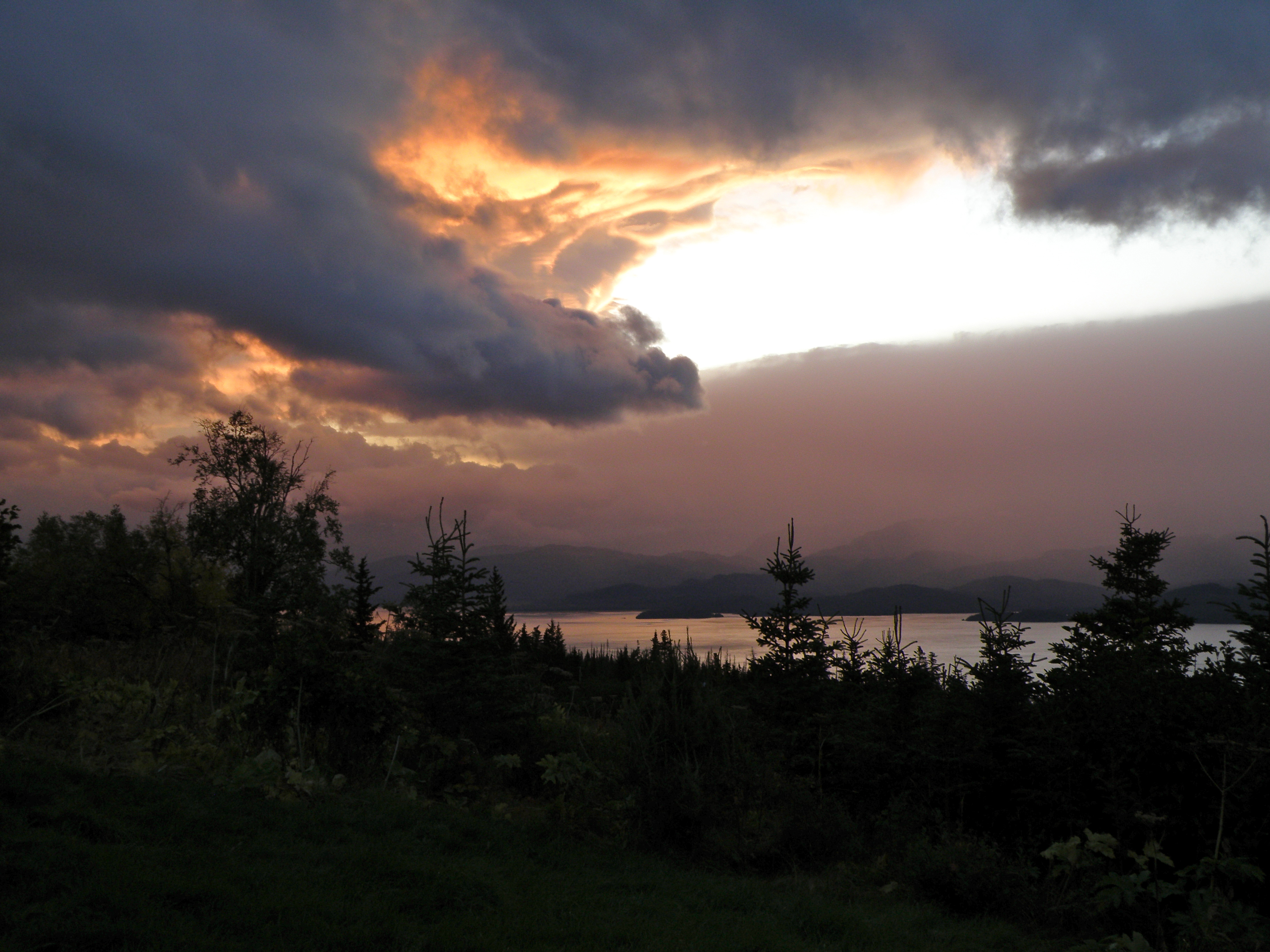
     It’s a dark and stormy day…  Outside the wind is howling.   (A perfectly true cliché on this October day!)  A constant rain is pouring from the sky and on occasion is sounds like someone is tossing buckets of water at our windows.  I’m sitting down to rewrite one of the stories that will be part of my thesis.  It’s a hard story.  I’ve been thinking about how to proceed with it for days.  And the word I keep coming back to when I don’t know what to write is “honesty.”

     This particular story (the one I’m just about to get to, when I’m done here) is personal.  In it I’m exploring the myriad of emotions I’ve felt and situations I’ve encountered over the years as my spiritual beliefs have changed away from those of my family of origin.  It’s a topic I’ve thought about for more hours than I can count.  The potential for misunderstanding is great.

My hope with this personal story, though, is not to tell my own story.  My hope is to transcend my own story.  My story is small.  In a world of billions, it is a speck in time and history.  But the truth I’m trying to get at is relevant, and will be for as long as people exist.  My challenge is to get out of my own way, to move beyond my own experience, to reach beyond my own hang-ups and fears.

Early in 2012, I wrote a blog post in which I was fretting about whether I should be writing fiction or nonfiction.  (It’s about scary stuff, which seems relevant this week since it’s Halloween and I’m writing about religion.) At the time, fiction seemed terrifying.  Now I believe that the idea of choosing one genre over another is kind of a silly notion.  My job as a writer is to explore the human experience and I’d be limiting myself if I allowed myself just one avenue for exploration.  My constant work, my never-ending hope as a writer, is to find the best way possible to tell a story or articulate an idea, an emotion or an experience.

In the case of this story I’m rewriting, fiction is the tool that’s helping me get the job done.  It’s the tool that allows me to wedge in, from a safe distance, to one of the most consuming topics of my own life.  With this tool I can pluck out morsels of truth from my own history and plop those truths down into the lives of characters that are nothing like me, who may behave very differently than me.  With its help I can dig deeper into those hidden corners of my own understanding and pull out surprises that I didn’t know were lurking in the background—like my own biases and my own tendency toward intolerance.

In this way, I suppose writing fiction is something to be feared.  Not because it’s impossible (although it does feel that way sometimes), but because it can lead you to dark places within yourself.  And when you see those less than flattering things that live inside your heart you have to make a decision.  In my case, it’s do I acknowledge my biases and try to overcome them, or do I ignore them.

And isn’t that just like writing to go full circle on a topic?  You sit down to explore religion and its role in your life, and you find that the writing itself is a lot like religion.  It’s a way toward empathy and truth.  It challenges me to be a better person.

State of Uncertainty

   Image

    Books can make you love a place, or at the least the spirit of a place.  Lately I’ve been missing the part of the country where I grew up, and so I’ve sought out books that take me there.  This week I read, Where Rivers Change Direction, by Mark Spragg.  I used his stories, his experience, his adept configuration of words, to take me back to the Rocky Mountains.  His love for the ranch in Wyoming where he was raised came through and I could hear the elk bugling, and the coyotes calling and the sound of water running over a rocky streambed.  The way his characters talked—their concerns, their desires, the hardships some of them had to endure—they were familiar, like people I’ve known, or at least like people my people have known.

It’s a hard thing for me to admit, but I’ve been disillusioned with Alaska lately.  Or maybe a better way to say it is that I’ve been disillusioned with my experience of living in Alaska. When we moved here looking for adventure nearly twenty-two years ago, we thought we had an idea of what living in Alaska would be like.  No doubt about it, we were naïve.  We thought that it would be just like Montana, but bigger.  We also had no concept of the realities of full-time employment or of the way our lives would change once we had children and a mortgage.  We never anticipated how difficult it would be to access so many of the wild places we hoped to explore or that getting to them would require more money, time and work than we could manage. We imagined a life in Alaska that was somehow like the books we had read:  Margaret Murie’s Two in the Far North, Nick Jans’ The Last Light Breaking, Edges of the Earth, by Richard Leo, Shadows on the Koyukuk by Sidney Huntington and Jim Rearden, and Nancy Lord’s collection of short stories, Survival.  Those books made me infatuated with this place.  They gave me an idea of what I thought it meant to be an Alaskan.

When we planned our move north, I imagined us rafting interior rivers, flying into the remote Brooks Range and hiking for days.  I imagined long winters with deep snow and of spending those dark, cold days tending a fire and writing, cooking, snow-shoeing to a neighbor’s house for a visit and a cup of tea.  But even here, in this place that blows my mind with its beauty, a hectic life seems to have worked its way into the forefront of our existence.  We go to jobs five days a week.  We stress about paying the bills.  We spend our weekends doing house chores and recovering from the workweek.  When we have extended breaks we tend to fly south to visit family.  And the Alaskan life we read about all those years ago in anticipation of living here goes largely unrealized.

I’m not meaning to whine here.  I’m just trying to think this through.  I’m trying to discern whether it’s a lifestyle I’m longing for, or a place.  The two might be connected.  The lifestyle I crave might be better found where the cost of living isn’t so high, where public land and diverse landscapes can be more easily accessed.  I’m wondering if we should stay here longer and give ourselves some post-raising-children time to enjoy this incredible state, or if we should go be closer to extended family or to the part of the country I think of when I think about home.

And what does it mean that I still call someplace else home?  It might mean more than all of the ways I try to rationalize, it might mean more than all of the books I read or sentences I write.

The discussion of whether to stay or go has been constant for a while now, so much so that I’m starting to get used to this state of uncertainty.  But until we’re able to make a decision, or a change, I’ll continue to walk out my door every day and feel glacier-cooled air on my skin.  I’ll watch the way the wind plays on the surface of the bay, turning it different shades of green and brown and gray.  I’ll marvel at how the light and shadows settle and spill across the mountains.  I’ll stand on this shelf of land where I live and look east toward the Fox River Flats and west to Cook Inlet and beyond.  I’ll be humbled and inspired and overwhelmed by the bigness of it all.

My own story about living in Alaska is still unfolding.  It may have more to do with exploring ideas of home and belonging than it has to do with climbing mountains or fording raging rivers.  It may be that my story of living in Alaska is simply about uncertainty, and all of the ways this place has taught me to embrace it.

Home, Again

    Image

  It’s fall equinox weekend, and suddenly everything points toward winter. Just a few weeks ago, everything was brilliant green—but now our yard is layered with gold, brown and maroon.  The color for today is orange:  flames in the wood stove, pumpkins from the farmer’s market on the kitchen table, my favorite wool sweater pulled out of the closet for another season.  Summer ends in a hurry here.  I know this by now, but every year it seems worthy of comment.

Just a little over a week ago I was in Colorado, sitting on my mom and step-dad’s deck, feeling the deep heat of the sun on my arms and legs for what I knew might be the last time in many months.  I closed my eyes and turned my face directly toward the sun and thought about how in February I will dream of a moment much like that one.  It was a good visit home.

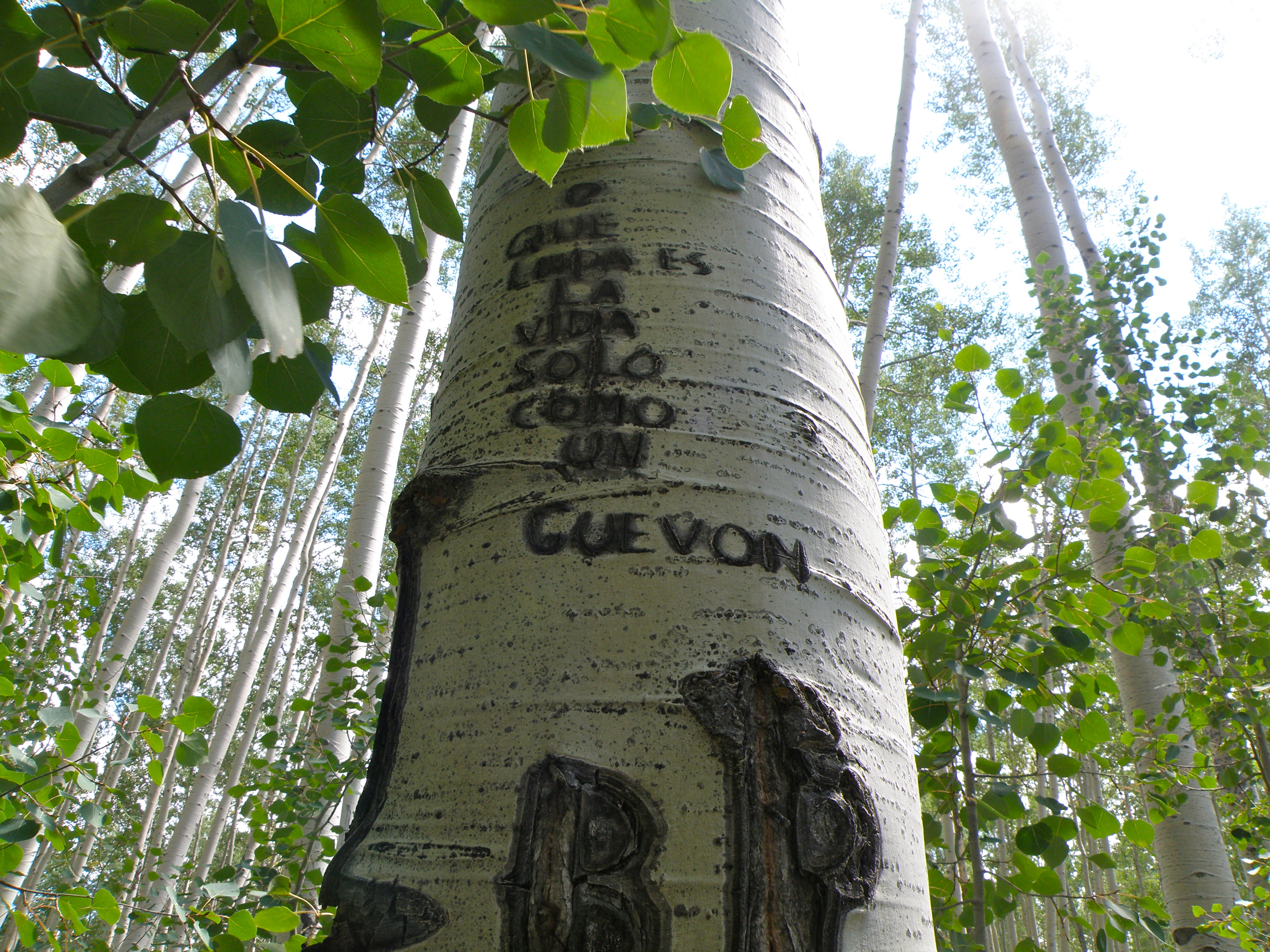
I went by myself on this trip, and my mom and Stanley were excellent tour guides.  I’d mention something I’d like to see and they’d make it happen.  We tromped through the remote territory above Steamboat Lake, near the Wyoming border, where my step-dad’s father lived as a young boy.  They drove me to Dinosaur National Monument where we viewed petroglyphs that looked like aliens and picked grapes that have gone wild at the old homestead site of Josie Bassett.  They took me to their cabin and pointed me in the direction of a trail that harbored messages engraved on aspen trees by lonely Peruvian sheepherders.

The whole time I was in Colorado ordinary things seemed extraordinary: The smell of ozone during a lightning storm.  That damp, earthy odor of beaver dams and aspen trees.  The way the wind kicks up dust in the evenings when a storm is blowing in.  Tumble weed, antelope, deer.  Mourning doves perched on power lines.  Fresh cut hay and sheep on a hillside.  Stars up close through a dry sky.  Ranch houses, cows, birds of prey.  Dinners of elk steak, sliced tomatoes, ripe peaches.  Rabbit brush in yellow, spindly juniper trees, sagebrush.  Grazing horses and sheep dogs keeping watch.  Back roads in all directions, blue heron fishing on bends in rivers.  And every once in a while, a cleansing shower that quells the dust.

One definition of nostalgia is the pleasure and sadness that is caused by remembering something from the past and wishing you could experience it again.  So even though the word ‘nostalgia’ kept going through my mind when I was back in Colorado, I suspect it was something different that I was experiencing.  Is there a word for appreciating things you couldn’t appreciate when you were younger?

I left Colorado for Montana when I was twenty-one years old.  Then I went back for seven months a couple years later, but that time it was with one foot already firmly out the door and headed toward my new life in Alaska.  I go back there now and I see things I’ve seen a hundred times, but it’s as though everything is in sharper focus.

And so now I’m back in Alaska and I’m thinking about the notion of home.  As is usually the case, I have more questions than I have answers.  What is it that makes a place a home, really?  Is it familiarity?  Is it where the jobs are or where the beauty takes your breath away?  Or is it simply where you put your energy into fostering love and comfort and friendship?  Does it change over a lifetime?  I’ve heard it said that home is where you make it, but then what do you call that place your senses yearn for?

For me, for now, I’m thinking of a place with plenty of open spaces and mountains, where summer afternoons are hot, but mornings and evenings are cool.  There, you might have winter days that dip below zero or storms that dump a lot of snow, but the sun, it still manages to shine most days, and it has the potential to warm your skin any time of the year—sometimes even in February.


Bravery Practice

It’s already well into August and I’m looking at the date of the last time I posted here. Where has my time gone?  In June it went to Montana for twelve days.  For a good portion of July it went to the University of Anchorage for my third MFA residency.  As it goes with employment, plenty of my summer time has been spent at the library.

Thankfully, some of my summer has involved soaking up much-needed sunshine and hanging out with friends and family.  Some of my time was even spent running, after a very long (read twenty-some years) hiatus.  Nearly all of my summer was spent mentally and emotionally preparing myself for my daughter’s departure to school on the East Coast.  And almost constantly, my time was spent thinking about writing, which is what I do when I’m not writing.

The high summer days are gone now and it’s time for me to get some words written down instead of letting them swim around in my brain.  It’s getting dark again at night and the rainy season is back.  Adella left a few days ago.  Time isn’t as elusive as it has been, and yet I’m finding it hard to know where to begin.

I’ll guess I’ll start with an admission:  I’ve spent a lot of time over the past few months questioning myself mercilessly about my reasons for continuing to write here on this blog.  I’ve thought about bringing it to an end.  I’ve wondered if I should change it up, make it into something more professional or more in tune with marketing myself, which seems to be the whole point of having a blog according to the million or so writers’ advice articles I’ve read on the subject.  I’ve fretted over what I named it, after all if a person doesn’t know the story behind the name, it does sound a little egotistical.  Worrying, fretting, second-guessing myself:  apparently I have those parts of being a writer figured out.

Then I thought about the things this blog has done for me since I started it nearly five years ago.  It may need some updating as far as formatting is concerned.  It may seem to have no identifiable theme, (which is another certain no-no in the blogging world.)  It may have no predictable schedule for new posts.  Clearly, it is an imperfect blog and being that I’m an MFA student entering my thesis year, I should spend my limited writing time working on my critical essay or on fiction.

But through questioning my motives and wondering if I should continue here, I’ve realized that this blog has been, and can continue to be, an important part of my becoming a writer.  It gives me a small but diverse audience.  It gives me a chance to write something besides fiction.  It challenges me to write with precision.  It does all of those things, but it does something even more important. Let me explain:

I think the best writers, whether they’re writing fiction or poetry or nonfiction, are those who are honest—honest with the story they are telling or poem they are creating, honest with those who will read their work, but most importantly, honest with themselves.  And honesty is hard.  It means putting yourself out there, opening up, making yourself vulnerable.  And could anything be scarier?

Last October, I posted a very personal story on this blog in reaction to something that happened in my town.  I had never told a soul that particular story and yet I wrote it on here for all to see.  I hit the publish button and started shaking.  I shook for almost a week afterwards as it was passed around the web through personal emails and Facebook.  I shook as friends and acquaintances stopped me in town to talk with me about it.  I took a huge risk.  It was terrifying.  But it ended up being a connecting experience.  People shared their own stories.  People expressed to me their gratitude for having spoken up.

It was hard to share that story and even as I was doing it I questioned my motives for doing so.  I wondered what it meant that I could tell such a secret publicly.  But then I remembered that I’m an aspiring writer and writers are supposed to tell stories.  We’re supposed to write about what it means to be alive even if it’s hard and, sometimes, even if it’s personal.  If nobody wrote the hard things, I think we’d all feel alone.

And so Lofty Minded in Alaska is not about marketing myself or about selling anything.  It’s not about perfection or keeping up with trends.  This blog is about connecting with other people.  As long as it seems to be doing that, I’ll keep at it.  Also, there are things I want to write about that are even harder than what I’ve written so far.  Some of it will best be written about in the form of fiction, but some of it needs to be the straight up truth.  And since I still hold back, I think I’ll keep this blog as a place to practice being brave.  If I’ve learned anything from keeping this blog it’s that writing fearlessly takes practice.

A Violent Wind

Farmer and his brother making music.
Farmer and his brother making music.  Russell Lee *


I heard my Granddad tell the story four separate times.

One evening when he was sixteen years old my Granddad, Clarence Acree, (nicknamed Sonny at the time) was at his Uncle Bill’s house in Sayre, Oklahoma.   It was late in the day, well after supper, and they were sitting in the main room playing fiddle and guitar.  Maybe it was the music that kept them from hearing the twister approach, or maybe the storm just moved so fast that they wouldn’t have heard it coming even if the house had been silent.  Either way, they had no warning.  In an instant it sounded like a freight train was upon them, and while they sat there, instruments in hand, the roof of the house was pulled clean away.  Just like that.

Everyone at Uncle Bill’s house was okay, but the storm moved on and they could hear its continued destruction.  After it passed they went out to assess the damage.

Here’s an article from the Sayre, Oklahoma Daily dated October 16th, 1933 about the incident:

AGED COUPLE AND LITTLE BOY DIE IN VIOLENT WIND

“A freak cyclone covering more than one mile in length approxamately 100 yards in width struck south and four miles east of the city after 10 ‘clock (pm) Saturday left death and destruction in its wake.  The dead are:

Frank Yandell 77, Mrs. Frank Yandell  72, Luther Lowrence 8 .

A fourth person Nadene Lowrence age 7, with the victims of the violent wind, escaped death.  Except for shock she is not thought to be seriously injured. The two youths are the great grandchildren of Mr and Mrs Yandell.  They were spending the night at the Yandell home. Mr and Mrs Lowrence live near the cyclone swept area.

Preceding a heavy rain, the storm swept down on the Willis Hawkins farm tearing the roof and porch off the Hawkins home and razzing a windmill.   The storm then gained in velocity and traveled in a northeasterly direction  hitting the Yandell farm and the spent itself as it the struck the John Edwards farm one mile away. The Yandell home and all the outbuildings were completely demolished.  A barn and garage at the John Edwards farm was leveled.

The bodies of the dead were found 175 yards from the wrecked home by Clarence Acree and Willis Hawkins, nearby neighbors.

Seeing the residence demolished they shouted but received no replies..  Checking with nearby neighbors 1/4 mile away they were assured the Landells or the Lowrence children had not escaped.

Walking back in the dark to the demolished residence the boys shouted again and the little girl called to them from a field.  An ambulance was summoned and the four were brought to Sayre.  The dead were taken to the local mortuary and the little girl was rushed to Tistial Hospital for treatment and examination.  She told them Mr Yandell and her brother had gone to bed and she and her great grandmother were getting ready to retire when the cyclone hit the house.  She could not remember anything after that.

The bodies of the deal were badly crushed and mutilated. And lacerated.  They appeared to have died instantly.”

* * *

It’s funny how we hear stories in the context of our own lives.  We grab hold of different parts.  We notice different things.

The first time I heard my granddad’s story, it was all about the violent storm, such force I could scarcely imagine.  He told about the bald chickens running around the farm the next day, the force of the wind had plucked them clean.  He said a nearby bridge had been impaled by a piece of straw.

The second time I heard the story, I thought more about the little girl.  My Granddad said they’d given up hope of finding anyone alive and were headed back to Uncle Bill’s house when they heard her.  She’d been carried nearly a hundred yards from her great-grandparent’s home, her nightgown had been pulled off in the storm, but she was uninjured.  I wondered, how was it to live a life as the one who had been spared?  Could she recall my grandfather finding her or was her shock too great to remember that detail?  Did she move away from tornado country the way my Granddad did?

The third time I heard the story I fixated on the time in history in which the storm took place.  A time when families sat down to play music together instead of huddling in front of a television, a time before tornado warnings and forecasts.  I thought about my own family history of fiddle players and Okies.  I tried to tie who I am today with the people I came from.

The last time my granddad told me the tornado story he was ninety-one years old.  I was back in Colorado for a visit and I asked him to tell me the tale one more time because I knew the time for hearing his stories was running out.  Always before when he’d told me the story, he was very matter-of-fact about it—first this and then that.  But this time it was different.  It was like he was there.  He was sixteen again, in rural Oklahoma, with his Uncle Bill.  He was walking through the rubble, trying to make sense of the destruction that came through in an instant and changed everything.  “We thought they were all dead,” he said.  “And then I heard her call out. ‘Sonny,’ she said. ‘What are you doing out here?’”   Then he couldn’t tell any more.  His blue eyes, still brilliant and as sharp as ever, watered up. He turned his head to the side.

That fourth time, the story was about my Granddad—about the man he was and the boy he’d carried around inside of him for all of those years.  It was about time and distance being erased for a while and being young and being old all at the same time.  It was about transcendence and remembering and living again and again.


*The vintage photo was taken by Russell Lee, you can learn more about him here.  (It’s not actually my granddad in the picture.)

                              ** Also, thanks to Helen McPherson for passing along the newspaper article and for reminding me of a few details of the story.