Carrying On

When I studied fiction writing, I learned the term simultaneity. It’s a state of existing with more than one thing happening at the same time. Within a scene, a family might be playing a card game, having a difficult conversation, and managing their unruly dogs all at the same time. It’s a state that’s reflective of the real world, as nothing actually occurs in a vacuum, but it takes some skill to write a scene that portrays many things happening at the same time.

I was reminded of the term recently when I was thinking about how weird it is to be going about my normal day-to-day life while our country and its processes are being degraded at such a rapid pace. I check the headlines on my phone while I’m cooking dinner and see that an Iranian woman who’s lived in the United States for decades was targeted and swept away by armed masked men while working in her garden. While Dean and I are planning a small building project to support our small business, the Trump administration is planning to build more prisons to hold more people who are being taken off the streets and away from their families, due process be damned. While I’m at my library job checking out books to kids, education systems at all levels are being targeted, research grants are being pulled, and agencies across the federal government are being purged of professionals and replaced with unqualified Trump loyalists.

I carry on with my normal life the way so many Germans must have carried on with their normal lives as government sanctioned police rounded up people and sent them away to concentration camps, all under terms that were deemed legal. Chances are some of those German citizens were horrified but felt powerless to do anything to stop the machine. But we know now that a lot of them went along with the scheme because they’d been subjected to propaganda that made them fearful of anyone unlike themselves. They’d been programmed to view their Jewish neighbors as monsters and criminals. Purging the country of them, many German citizens agreed, was a way to make their country great.

And yes, I realize that what happened in Germany during Hitler’s reign isn’t happening to the same extent here, but I see signs that are pointing in a direction that’s not so different, and they’re making my inner alarm bells ring at a volume I can’t ignore. For me personally, to stay quiet or to pretend that all is well is not an option. Speaking out is inconvenient. It comes with a risk of alienating people or putting people on the defensive and that is not something I enjoy. But sometimes circumstances require that we move beyond what makes us feel comfortable.

I’m choosing to write this because I don’t have the ability to stop the unbelievable amount of money that the United States Congress just authorized to send to the the U.S. Immigration and Customs Enforcement Agency and I don’t have the ability to change Stephen Miller’s heart or Donald Trump’s priorities. I can’t close the doors of the despicable Alligator Alcatraz and I can’t stop the flow of news that somehow makes many of my fellow citizens think that all of this is okay.

What I can do is state for the record that I don’t believe our country is okay. I believe the cruelty being perpetuated by ICE in the name of public safety is unacceptable. I believe the profiteering that our president engages in is unethical. I believe Donald Trump’s love for power exceeds his desire to serve. I believe that for the richest nation in the world to prioritize the financial well being of its wealthiest while undermining the needs of its working class is immoral. I believe that dismantling environmental regulations and disregarding the realities of climate change is harmful to future generations. I believe that blaming all of the troubles of our country on Trans people and immigrants and those who stand up for them is discriminatory and dehumanizing.

I am not naive enough to believe that I can change anyone’s mind, but I know from personal experience that minds and hearts are capable of changing, which is another reason why I am writing here today, to kindly ask those of you who are cheering this administration and its tactics to deeply examine your choice.

If you think that Trump’s tactics are okay, if you think that what ICE is doing and how they’re treating people is in any way making America great, I’d like to encourage you to diversify your news sources. I watched an interview recently in which Adam Kinzinger, former U.S. congressman from Illinois, spoke with Rich Logis, who started an organization called Leaving MAGA. Asked what made him start questioning the MAGA movement and Donald Trump in particular, he answered that his views began to shift when he began to diversify his news sources.

For every news story there are many different angles to consider, and our biases sometimes close us off from hearing a perspective that doesn’t match the story we want to believe. Even more troubling is the fact that certain news organizations are reluctant to report on certain stories. They may not be lying outright but they are not always telling the whole story. I recommend Ground News. They describe themselves as “a platform that makes it easy to compare news sources, read between the lines of media bias and break free from algorithms.” I appreciate the section they call Blindspot, which highlights stories that both left and right leaning media are not reporting on.

This is deeper than news though. It’s about our hearts. It’s about our Faith. It’s about our children and our grandchildren and the people who will be here long after all of us are gone. Do we want this country, the supposed Land of the Free, which already has one of the highest incarceration rates in the world, to become even more of a police state? Do we want to continue to ignore the laws of nature in order to bolster the profits of corporations? Do we want to continue to reward a small handful of billionaires with policies that hurt the vast majority of our population? Do we want to ignore the teachings that so many of us grew up with, that instruct us to love one another?

I know there are plenty of Trump voters who don’t call themselves Christian, but most of the Trump voters I know would say that their Christianity is more important than their politics. But Jesus didn’t want people to be treated cruelly. He didn’t want his followers to make other people suffer. He didn’t want to humiliate people or cause harm. He did not scapegoat people who were different from him. Jesus instructed his followers to care for the poor, the sick, the weak, and the children. He did not encourage his followers to rise up politically in order to force his teachings onto anyone.

Jesus was here to bring healing to a broken world and those who feel called to follow his example should want to do the same. But the current administration is implementing policies and engaging in operations that cause human suffering. They even seem to be reveling in it. For as long as this is the case, greatness for the Unites States is an impossibility. All that will come from treating humans with cruelty is long-term resentment, the fomentation of hatred, the stoking of violence, the perpetuation of fear, and generational trauma.

Politics, like war, has a way of narrowing everything down to winning and losing, and for many Trump supporters, the way he’s moved into power since his inauguration feels like retribution for the ways they felt victimized by the last administration. But my hope is that the anger they feel over what they perceived as dangerous from the Biden presidency does not blind them to the dangers that are unfolding right now. If a short-term political battle is won but the ability to discern right from wrong is lost, we’re bound to end up on the wrong side of history.

I don’t want that to happen, so today, before I head out into my garden I’m putting this out into the world. The outcome is beyond my control, but I can rest easier knowing that I’ve done what my heart has compelled me to do.

Carrying On

When I studied fiction writing, I learned the term simultaneity. It’s a state of existing with more than one thing happening at the same time. Within a scene, a family might be playing a card game, having a difficult conversation, and managing their unruly dogs all at the same time. It’s a state that’s reflective of the real world, as nothing actually occurs in a vacuum, but it takes some skill to write a scene that portrays many things happening at the same time.

I was reminded of the term recently when I was thinking about how weird it is to be going about my normal day-to-day life while our country and its processes are being degraded at such a rapid pace. I check the headlines on my phone while I’m cooking dinner and see that an Iranian woman who’s lived in the United States for decades was targeted and swept away by armed masked men while working in her garden. While Dean and I are planning a small building project to support our small business, the Trump administration is planning to build more prisons to hold more people who are being taken off the streets and away from their families, due process be damned. While I’m at my library job checking out books to kids, education systems at all levels are being targeted, research grants are being pulled, and agencies across the federal government are being purged of professionals and replaced with unqualified Trump loyalists.

I carry on with my normal life the way so many Germans must have carried on with their normal lives as government sanctioned police rounded up people and sent them away to concentration camps, all under terms that were deemed legal. Chances are some of those German citizens were horrified but felt powerless to do anything to stop the machine. But we know now that a lot of them went along with the scheme because they’d been subjected to propaganda that made them fearful of anyone unlike themselves. They’d been programmed to view their Jewish neighbors as monsters and criminals. Purging the country of them, many German citizens agreed, was a way to make their country great.

And yes, I realize that what happened in Germany during Hitler’s reign isn’t happening to the same extent here, but I see signs that are pointing in a direction that’s not so different, and they’re making my inner alarm bells ring at a volume I can’t ignore. For me personally, to stay quiet or to pretend that all is well is not an option. Speaking out is inconvenient. It comes with a risk of alienating people or putting people on the defensive and that is not something I enjoy. But sometimes circumstances require that we move beyond what makes us feel comfortable.

I’m choosing to write this because I don’t have the ability to stop the unbelievable amount of money that the United States Congress just authorized to send to the the U.S. Immigration and Customs Enforcement Agency and I don’t have the ability to change Stephen Miller’s heart or Donald Trump’s priorities. I can’t close the doors of the despicable Alligator Alcatraz and I can’t stop the flow of news that somehow makes many of my fellow citizens think that all of this is okay.

What I can do is state for the record that I don’t believe our country is okay. I believe the cruelty being perpetuated by ICE in the name of public safety is unacceptable. I believe the profiteering that our president engages in is unethical. I believe Donald Trump’s love for power exceeds his desire to serve. I believe that for the richest nation in the world to prioritize the financial well being of its wealthiest while undermining the needs of its working class is immoral. I believe that dismantling environmental regulations and disregarding the realities of climate change is harmful to future generations. I believe that blaming all of the troubles of our country on Trans people and immigrants and those who stand up for them is discriminatory and dehumanizing.

I am not naive enough to believe that I can change anyone’s mind, but I know from personal experience that minds and hearts are capable of changing, which is another reason why I am writing here today, to kindly ask those of you who are cheering this administration and its tactics to deeply examine your choice.

If you think that Trump’s tactics are okay, if you think that what ICE is doing and how they’re treating people is in any way making America great, I’d like to encourage you to diversify your news sources. I watched an interview recently in which Adam Kinzinger, former U.S. congressman from Illinois, spoke with Rich Logis, who started an organization called Leaving MAGA. Asked what made him start questioning the MAGA movement and Donald Trump in particular, he answered that his views began to shift when he began to diversify his news sources.

For every news story there are many different angles to consider, and our biases sometimes close us off from hearing a perspective that doesn’t match the story we want to believe. Even more troubling is the fact that certain news organizations are reluctant to report on certain stories. They may not be lying outright but they are not always telling the whole story. I recommend Ground News. They describe themselves as “a platform that makes it easy to compare news sources, read between the lines of media bias and break free from algorithms.” I appreciate the section they call Blindspot, which highlights stories that both left and right leaning media are not reporting on.

This is deeper than news though. It’s about our hearts. It’s about our Faith. It’s about our children and our grandchildren and the people who will be here long after all of us are gone. Do we want this country, the supposed Land of the Free, which already has one of the highest incarceration rates in the world, to become even more of a police state? Do we want to continue to ignore the laws of nature in order to bolster the profits of corporations? Do we want to continue to reward a small handful of billionaires with policies that hurt the vast majority of our population? Do we want to ignore the teachings that so many of us grew up with, that instruct us to love one another?

I know there are plenty of Trump voters who don’t call themselves Christian, but most of the Trump voters I know would say that their Christianity is more important than their politics. But Jesus didn’t want people to be treated cruelly. He didn’t want his followers to make other people suffer. He didn’t want to humiliate people or cause harm. He did not scapegoat people who were different from him. Jesus instructed his followers to care for the poor, the sick, the weak, and the children. He did not encourage his followers to rise up politically in order to force his teachings onto anyone.

Jesus was here to bring healing to a broken world and those who feel called to follow his example should want to do the same. But the current administration is implementing policies and engaging in operations that cause human suffering. They even seem to be reveling in it. For as long as this is the case, greatness for the Unites States is an impossibility. All that will come from treating humans with cruelty is long-term resentment, the fomentation of hatred, the stoking of violence, the perpetuation of fear, and generational trauma.

Politics, like war, has a way of narrowing everything down to winning and losing, and for many Trump supporters, the way he’s moved into power since his inauguration feels like retribution for the ways they felt victimized by the last administration. But my hope is that the anger they feel over what they perceived as dangerous from the Biden presidency does not blind them to the dangers that are unfolding right now. If a short-term political battle is won but the ability to discern right from wrong is lost, we’re bound to end up on the wrong side of history.

I don’t want that to happen, so today, before I head out into my garden I’m putting this out into the world. The outcome is beyond my control, but I can rest easier knowing that I’ve done what my heart has compelled me to do.

Nothing Great

I’ve felt my fair share of righteous anger lately, and plenty of dismay, but today I’m sad. Incredibly sad. Was it the video of Kristi Noem looking cute and wearing a $30,000+ Rolex standing in front of caged humans that caused me to feel this way? Was it the video of masked men in plain clothes detaining Tufts University Ph.D. student Rumeysa Ozturk, even though she’d done nothing wrong? Is it the fact that the things that make life a little better for the citizens of this country are being made out to be handouts and a waste of money? Is it that decisions that impact the lives of working people are being made by a billionaire who cares not one iota about our well-being? Is it that the earth itself is seen as just a resource to be used for building wealth, with no consideration for the living beings who will inhabit this planet far into the future?

I realize that my personal sadness could go two different ways. I could wallow in it, shake my head and wish for better days, or I can try to put it to use somehow and be a part of the solution to the problem of the cruelty that’s being perpetuated in the name of making our country great.

But here’s the simple truth. Nothing great comes from cruelty. Nothing great comes from destroying the ecosystems that life depends on. Nothing great comes from causing others to suffer. Nothing great comes from scapegoating. Nothing great comes from a platform that’s been built on lies. Nothing great comes from pretending that this country hasn’t inflicted great harm both within and beyond our borders. And nothing great will ever come from valuing money and power over all else.

If being great means being oppressive, if it means having no regard for peoples’ ability to have a good life, if it means forgetting what it means to be good, then I don’t want any part of it.

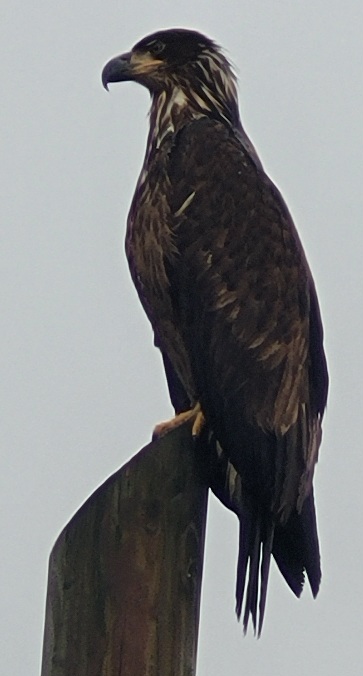
Immature bald eagle

Nameless

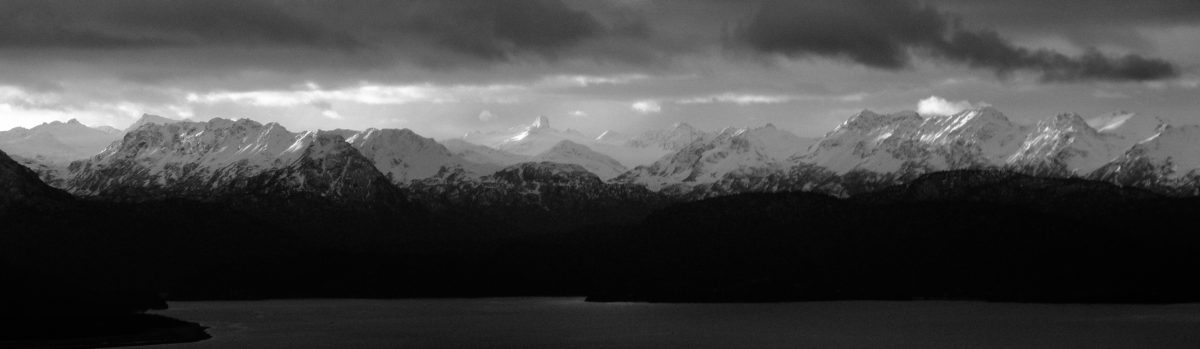
There is a mass of land north of where I live that bulges toward the heavens. It’s been measured by humans and thus determined to be the highest reaching land mass on the continent. People pilgrimage to this great land mass. Sometimes they stay in its proximity for days just to catch a glimpse.

Something so grand, so awe-inspiring, so beyond anything else, becomes revered; not because it demands reverence, but because reverence for it is inevitable. And to see it, to be near it, to feel its presence inspires us to use it as a reference. There are other land masses that protrude from this continent and each of them are unique and beautiful, but only one is The Great One.

What is the purpose of a name? I’ve had friends who’ve changed their names because they were never comfortable with the ones that had been chosen for them. I changed my name as well after I got married, like my mother did, and her mother before her, and hers before her as far back as the genealogical history on both sides of my family goes. Does my married name make me who I am any more than my maiden name did before that?

In a society that demands identification, would I cease to exist if I didn’t have a name? Without a name, how would I be known? By my appearance, my attributes, my essence? Would I be known by the evidence of my existence?

What evidence is there of my existence? There is my physical flesh and blood, although that will cease to exist one day. What about the children who were born from my body and the children they may have one day? Had I not chosen to have children though, I would still exist.

Would the words I write or the things I make with my hands act to prove my existence? Would they, even without a name to attach to them?

A name then, is a convenience. A name is something we attach to something that exists. But a name is not proof of existence.

A name gives us something to call each other.

A name gives us a sound, a visual to attach to ourselves and our surroundings, and when a name is agreed upon, it gives us something in common. When I say I live in Alaska, you recognize that name. You may not think of Alaska the same way I think of Alaska, but we have a common reference point from which we can launch our conversation.

As for me and for you, if the name that’s been attached to us were to be stripped away, what would we be left with? It depends on who’s asking. I am someone different to my spouse, to my kids, to my coworkers. We are seen from a different perspective from everyone we encounter, but does that change who we are fundamentally?

A name then, is a simplification. Who we are in our true essence is much more complicated than what a name could possibly contain. We, at our core, are nuanced beings who can move through the world and adapt to the environments in which we find ourselves.

I have different roles at home than I have at work. Roles then, are not unlike names.

I am the lady behind the circulation desk at the library. I am a Cook. Spouse. Friend. Writer. Musician. Beach wanderer. Sun seeker. Reader. Vacuum operator. Gardener. Tea maker. Sister. Mother. Animal caretaker. Neighbor. Driver. Television watcher. Internet scroller. Philosopher. Mystic.

Strip away any of these. Strip away all of these. Who am I?

We know each other by our names. We know each other by our associations.

I don’t know your name, but you sat in front of me at the basketball game.”

I’ve never met _____, but I’ve read an article they’ve written.”

______ is a talented artist, and from what they’ve made I imagine they’d be interesting to talk to.”

I’ve heard that name before, but I can’t recall where I’d know them from.”

We only know a person from the perspective from which we’ve interacted or been introduced. We can never know another person as well as we can know ourselves. And a name is never able to encompass the full story of whatever it is we are attempting to name.

If I use the word God, what does it mean? It will mean something different to you than it does to me because we only have our own perspective from which to give it meaning. We may have a guide that informs our ideas in the form of a text. We may have had experiences that add to our perspective of whatever it is we think about when we hear the word God.

A belief in God is not required in order to try to describe what is meant by the word God. What comes to mind when you hear the word God? What feeling is evoked? How would you describe whatever you think others might mean when they use the term God?

We each have an understanding of what we’re trying to describe, but my description will always be different than your description. No one perspective is complete.

What is it that we’re trying to name when we use the word God? The force that pulls us all together? All there is and all there ever will be? The endless cycle of being? That which gives us life?

We use the word God because an adequate description of what we’re trying to name will always fall short. The term God then is inadequate. It is a limitation, an approximation, a shortcut.

Could any name, could any book, could any religion or tradition claim to know all there is to know about God? No. It is an impossibility. All we can do is try to understand what is meant when we use the term God, and there is no end to such an exploration.

Could any name adequately encompass the grandness of the tallest mountain in North America? No, but the people who lived in its shadow, who lived with it as their continual reference point, described it as Denali – The Great One – so I will refer to it as that. No matter what any human calls it or names it though, the truth of the mountain’s existence, the truth of the mountain’s essence, the truth of the mountain’s grandeur is incapable of being diminished.

Remember, this is also true of you.

Uncomplicated

Sometimes the universe gives us gifts and last Friday I was given a row of three seats to myself on the first leg of my journey home from Georgia. I was grateful for the space for all the obvious reasons, but also because it was at 30,000+ feet in the air somewhere between Atlanta and Seattle that it hit me that my dog Ripple wouldn’t be there to greet me when I got home.

I left for Atlanta to visit our daughter a week prior, knowing there was a good chance that Ripple would die while I was gone. She’d been winding down for the past month, eating less, growing weaker, sleeping more. I said my goodbyes to her over the course of a five day weekend at home before I left, lying on the floor with her at times, telling her what a good dog she’d been, and thanking her for all she’d given our family, which is more than she could possibly have known.

I left on a Wednesday and she died at home late in the day the following Friday with Dean and Dillon beside her.

It was 2008. Adella was a sixth grader and Dillon was a freshman in high school when Ripple joined our family. One Friday afternoon, in the spring of the year, a young woman in Dillon’s math class picked a black curly-tailed puppy with a white patch on her chest out of a litter that was being given away in front of Safeway. Dillon’s well-meaning friend thought the puppy would cheer up her mom who was going through a divorce at the time but, as you might imagine, as sweet as the girl’s intentions were, the mom didn’t have the bandwidth for a puppy. Her answer to keeping the dog was a clear no, with instructions to deliver her to the animal shelter immediately. Dillon witnessed the whole exchange between the mom and the daughter and couldn’t bear the thought of the puppy staying at the shelter over the weekend, so he hid her inside his coat, smuggled her onto the school bus, and brought her home.

Our lives were pretty chaotic, so it’s questionable whether or not we were ready to add a rambunctious puppy into our mix of chickens and dogs and adolescent children. But it only took a few days for us to see that this quirky pup brought something to our family that we hadn’t even realized had been missing.

Family life is hard sometimes, and complicated, even when there’s plenty of love to go around. There are personality conflicts, and guesswork, and lots of trial and error. There are hurt feelings and frustrations and overwhelm. All of this can lead to a pretty serious existence.

Laughter is what our family needed when Ripple came to us. She brought us lightheartedness, and with her goofy antics she brought us together when it would have been easier for us to retreat from one another. She didn’t have to try, she just had to be her authentic self and she would crack us up. She provided us with comic relief that we desperately needed and offered us a common place to direct our love and attention. With Ripple nothing was complicated. We just loved her.

What can I tell you about this dog? Besides being ridiculously cute, she took her role as a companion seriously. Early on, on a road trip to McCarthy, she decided that I was her primary person, and from then on, whether it was down the hall to the bathroom or outside in a blizzard to feed the chickens, she would follow me. If I wasn’t home she’d just as readily follow someone else. She loved tromping around the yard and garden and trails with us and always kept an eye out for anything that didn’t seem quite right, which is how she became to be known as the property manager.

Every morning sometime between 3:00 and 5:00am she’d jump up on the bed and curl up against my legs. I was never sure if it was out of affection or her need to monitor my movement as breakfast time approached, but her warm body curled up against my legs every morning might be the thing I’ll miss most now that she’s gone.

One of Ripple’s rare and most puzzling traits is what came to be known as her “water noise.” Consistent throughout her life, before taking a drink of water she’d let out a noise. Sometimes it was a quiet whine and other times it a full blown spectacle of song, some combination of a howl and cry that’s nearly impossible to describe with words. It made us laugh every single time we heard it. The water noise was proportionately louder and longer the happier and more excited she was, and since she was always excited for breakfast her water noise was often the first thing we’d hear in the morning.

***

On the last day of my visit to Georgia, Adella and Ally took me to Atlanta’s historic Oakland Cemetery to stroll among the flowering trees and headstones. Other than a few gardeners and maintenance folks, we were alone.

Some of the gravestones were of those who’d lived full lives, like Mrs. Talitha Dison who was born on Feb 16, 1864 and died on Oct 29, 1937. Others were monuments to young men whose lives were cut short by war. On one family’s plot the two most elaborate monuments memorialized two children, a beloved son who died at age three and a daughter who died at age five. The siblings’ lives did not overlap, but followed one after the other. Four more siblings who went on to live long lives were born after the first two lived and died. Their headstones were modest in comparison.

As we walked the brick pathways between family burial plots it seemed natural to talk about those we’d known and loved who’d gone before us, grandparents, parents, friends, beloved pets. From there it was an easy segue to the subject of our own inevitable departures.

When we brought Ripple into our family we weren’t thinking about how we’d have to say goodbye to her one day, even though we knew it was part of the deal. Dogs go from playful puppies to aged elders in what seems like a few short years and watching their lives unfold reminds us that none of us are immune. We’re all the same in that way. Here for just a while.

Dean’s Aunt Kathy, who passed on just last year, told us one time that she believed our purpose for living was to learn how to love. I’ve thought about that so much and I’ve come to agree with her. Through this lens everything and everyone becomes a teacher. Good teachers don’t bring new things into existence as much as they help us see what’s already there, they give us a deeper understanding. Ripple was with us for sixteen years and our love for her was as pure as love can be. It was uncomplicated and unconditional, and even though she wasn’t always the easiest dog, loving her was the easiest thing ever. For our family, she brought to the surface what was there all along.

In McCarthy, 2008

Waltzing through time: One two three, one two three…

12/31/23

Yesterday we drove our daughter and daughter-in-law to the airport in Kenai where they boarded a small plane to start them on their journey back to Atlanta. They were here for two weeks and during that time we shared space the way I always imagine people should share space. We chatted over morning coffee, took turns cooking and doing chores, schemed about new projects, went for walks, huddled around the wood stove, and sipped chai each evening from spices that had been simmering all day. We also gave each other space when it was needed, and did our own thing on occasion.

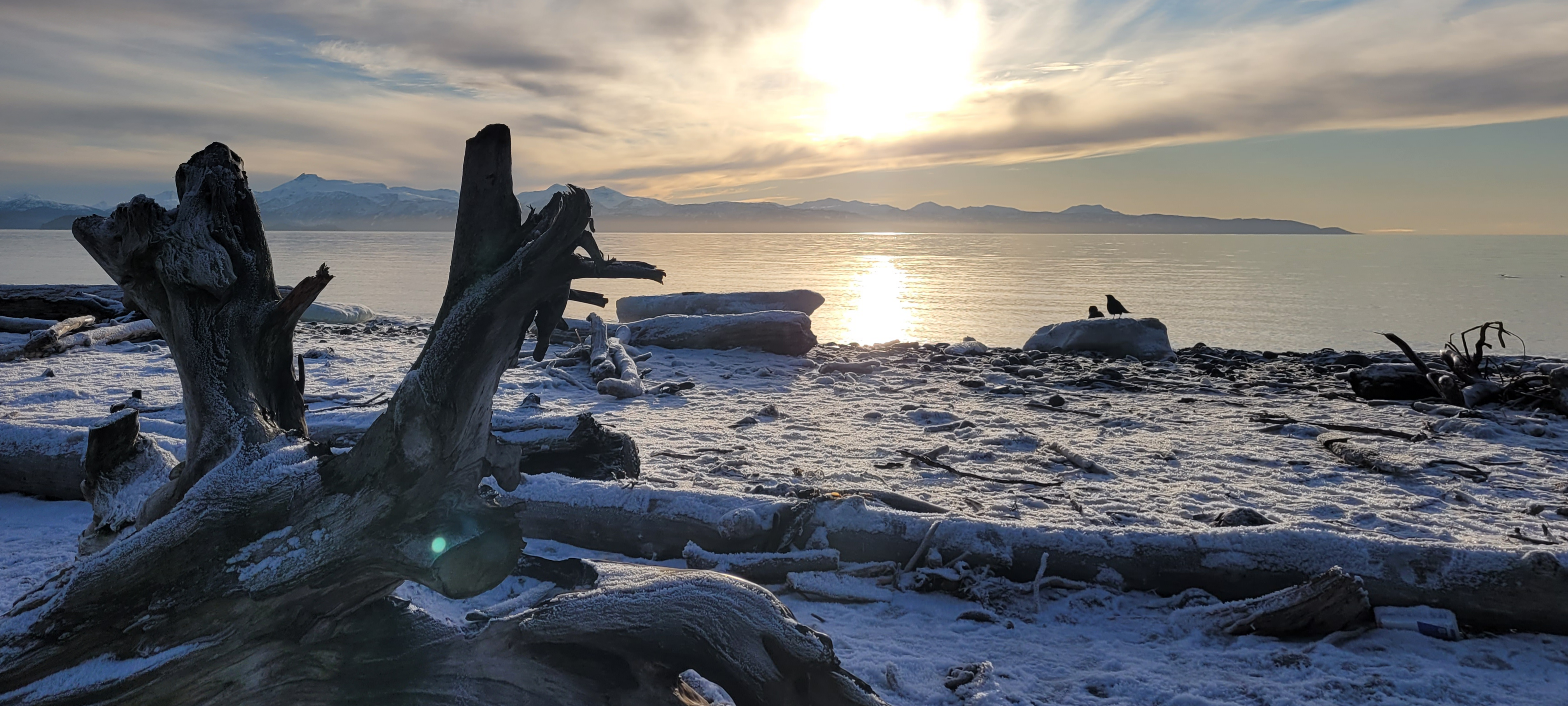
One day I had to make an early morning run to town for a couple of errands. I hadn’t planned on going to the beach but when I got to the stoplight at the intersection that leads there, I found myself turning. I’ve lived in Homer for going on 30 years now, but just in the last two years I’ve developed a kind of relationship with Bishop’s Beach. When I’m there, the mental chatter in my brain is paused. I don’t make lists or try to solve any problems. I don’t think about politics or the state of the world or the things I wish were different. When I’m there I am fully present with the rocks and the sand, the vast ocean, the driftwood, the wind, the salty air, the sunlight, the streams of water as they flow from the bluffs down into the sea, the birds, the ever-changing landscape that the perpetual tides create. There, I’m playful. I stack rocks. I leap over puddles. I talk to the crows. I experiment with photography. I sing.

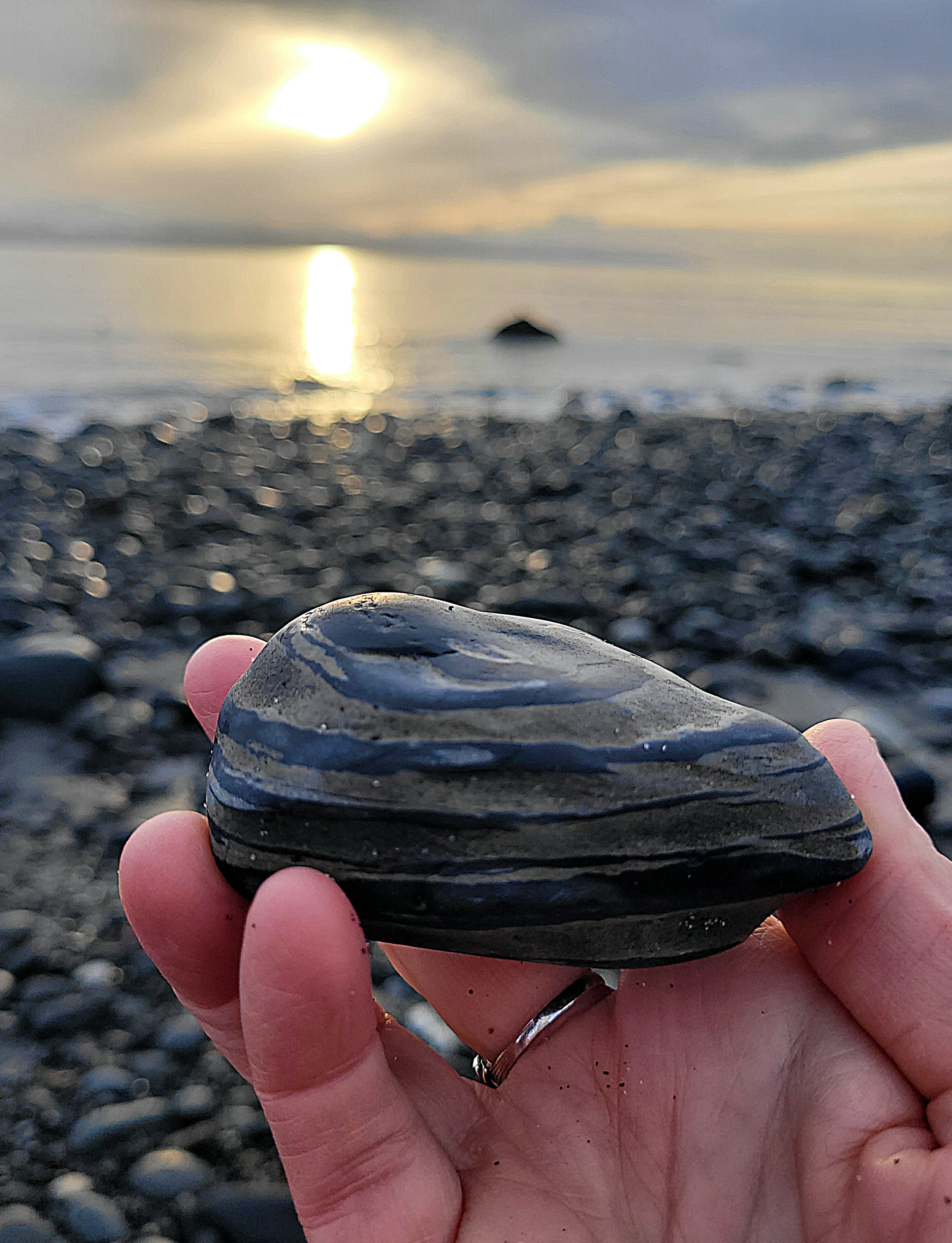
My childhood was not especially conducive to playfulness and so I have a lot to learn in that regard. I was at the beach on my lunch break a few weeks ago and I got so caught up in taking photos of rocks that I had to run back to my car in order to make it back to work on time. I made it, but by the time I got there I was sweating and my hair was windblown. My face was flushed and I’d completely forgotten to eat. There at the library circulation desk where I was trying to smooth down my hair and catch my breath and figure out how I was going to make it without eating for the next few hours, I felt like a kid who’d been called away from playing outdoors to do homework or chores. At the beach I’d lost myself, with no agenda, and had experienced a kind of freedom that I suspect is what playing is all about.

On the particular morning last week that I had to run errands in town, the sky was just beginning to lighten in the east and there wasn’t a cloud in sight. The trickle of daybreak and the waning gibbous moon made it possible for me to navigate the beach terrain without a headlamp, so I headed west into the moonlight, slowly at first to keep from twisting an ankle or slipping on the frozen rocks. Then I got to the sandy expanse where the walking was easy. I walked beside the water’s edge until the the tide began to roll back in. I took the tide’s turning as my cue to turn back as well, and headed back toward my car and the silhouetted mountains.

I drove back home with the car heater on full blast feeling like I had climbed a mountain, or glimpsed some piece of heaven. I’d been restored to myself and my place in the world again. I hadn’t known I’d needed that time at the beach, but I was glad I’d answered its call. Once I was home I sat with my daughter and her wife and we drank coffee and talked about herbs and music and books. We planned our next meal and figured out our day. Nothing was extraordinary about it, but at the same time everything about it was extraordinary.

Yesterday we watched the small commuter plane take off from Kenai and take them away. Then we drove back home. The night before, a thick fog from Cook Inlet had come inland and the moisture froze itself to every tree, plant, and street sign in its path. Sometimes, when everything is so beautiful there’s a tinge of pain that comes along with it. It’s true even when you haven’t just said goodbye to people you love. But the combination of the hoarfrost, the low angle light, and the sadness over parting ways brought me back to a familiar kind of longing.

I felt it for years when I was a child and I had to say goodbye to my mom every other weekend. During every car ride when she drove me and my sisters back to Grand Junction after spending a weekend with her in Craig, a kind of sadness fell over me that I began to associate with the scenery. I still can’t make the drive between the two towns without that sadness sneaking in.

We all have our different kinds of longing, but yesterday I identified my own unique brand of it. I feel it still when my mom’s summers in Alaska come to a close and she heads back to Colorado. I’ve felt it every time I’ve taken my son or daughter to an airport. I feel it whenever I’m in piñon pine country and have to leave. The longing dissipates with time, but for a while it takes up all the space in my heart.

Today the clouds have rolled in and the stretch of clear cold days that we had when our house was full has come to an end. The intense beauty of the blue sky days and big moon nights has mellowed and there’s a new year to ring in. Like we’ve done in recent years since our kids have been grown, we’ll have a fire in the wood stove, we’ll light a few candles, and with our old dogs curled up beside us we’ll debate over whether it’s worth it to stay up until midnight.

Chances are we won’t. That’s partly because we’ll be tired and partly because we’ve got tomorrow to look forward to. The forecast looks good for the morning, and our plan is to bundle up and greet the day outside with coffee and a fire. It’ll be quiet and calm and maybe by then this longing I feel will have dissipated back into the contentment that’s my more normal state of being these days.

It’s taken some work to get here, to this place of contentment. And it will take some work to stay here too, and so here are my hopes as I move forward: to take life as it comes, to want less, to live in constant gratitude, to see the extraordinary in the ordinary, to learn to love more and love better, to allow space for playfulness and freedom, to listen to my body and my soul’s longings, to strive less and let things unfold as they’re meant to, to heal the parts of myself that still need healing and to take part in a greater kind of healing beyond myself, to know when to take action and when to be still, to mourn and recover as many times as life requires, to rest, to forgive, to cultivate joy, and to use discernment when making choices. Ultimately, my hope is for peace – for you, for me, for all the animals, both wild and domestic, for the planet that sustains us, for everyone. Everywhere. No exceptions.

May we remember that our capacity to love is as infinite as time and as vast as the universe, and that’s what we’re here to do. My heartfelt best wishes to you all for the new year.

Illuminate: A ten-day journal series

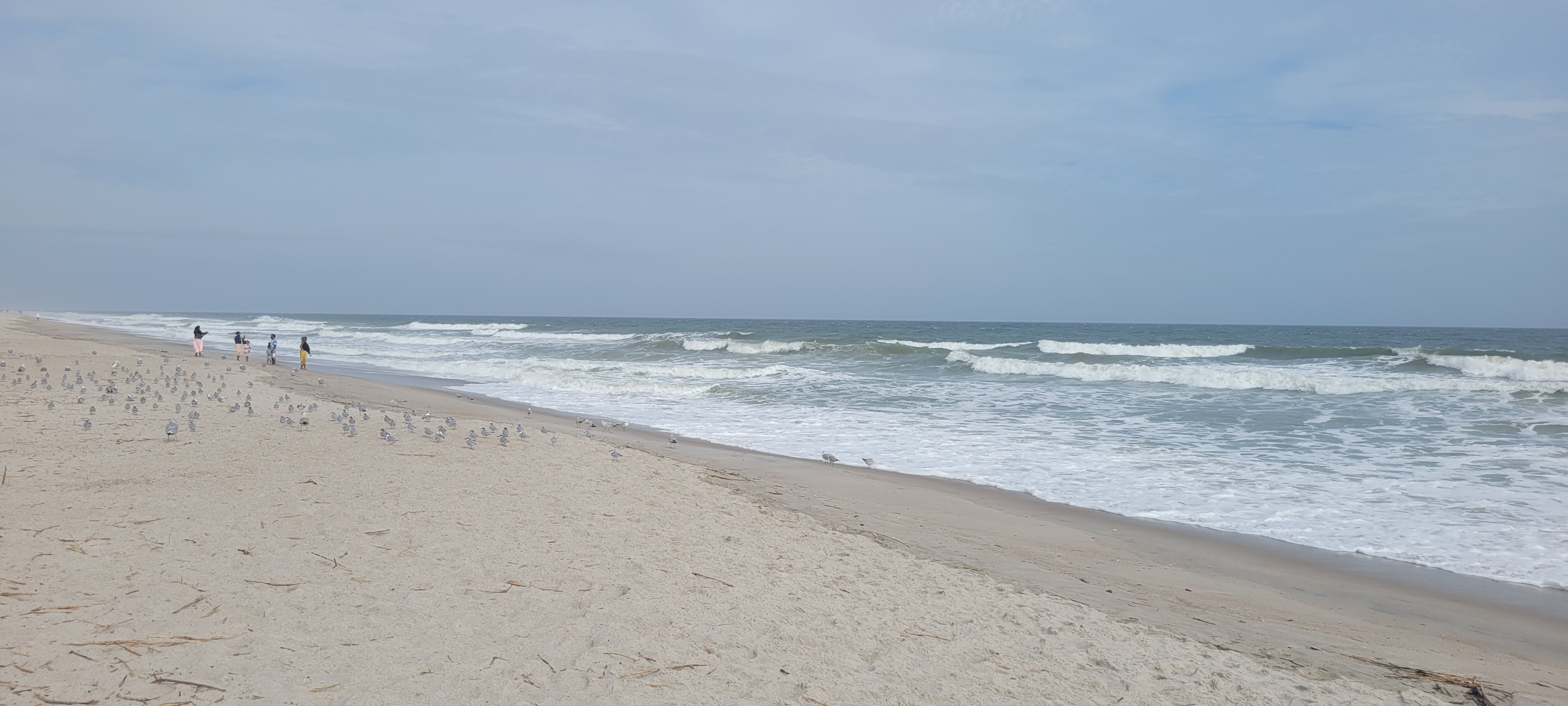
I count myself lucky to work in a place that’s a three minute drive to the beach. Often on my lunch break I pull on the mud boots I stash under my desk, grab my sack lunch, and head down to the shore. Most days I eat in the car and then head out walking. As soon as my feet hit the sand I feel like I’ve entered a different realm.

A person might go to the beach for any number of reasons. Sometimes after a big storm people drive out and fill their truck beds with coal for burning. Between September and April people might show up with buckets to collect seaweed for their garden beds. Friends of mine go to the beach once a month to plunge into the cold ocean. I say I want to join them, but haven’t mustered up the will quite yet. I usually go to the beach just to wander, and see what I might find.

Each beach excursion is different. There might be a calm drizzle or a raging wind, brilliant sun reflecting off the water or dense fog. The tide is either high or low or somewhere in the middle. Some days I might only have a few minutes, other days I might have a good long time. One day the beach will be crowded with people and dogs, other times it’s nearly empty.

It’s often cool and breezy and I find it tempting to stay in the car to keep myself separate from the elements, but always, even on the rough weather days, once I’m out there I don’t regret my choice to feel the ocean’s influence on my body and soul, even if it’s only for a moment. That’s because the beach is a place for receiving gifts. Some of them are physical, but more often I come away with something that’s much more difficult to articulate. How do you describe the effect of fresh salt air, the sound of waves on rocks, the company of birds, the long expanses, the being near something so vast and alive as the ocean?

When I go back to work after spending time at the beach, I’ve brought some of its offerings with me. I breathe easier. I’m better able to focus. I have fresh ideas and a new perspective. I’ve got color in my cheeks and a sense of calm and connection.

What do I feel connected to? Myself, I suppose, but also something beyond myself. I’m not just a person who goes here and there and exists on the planet alongside everyone else, I’m a part of the whole big system, and for me, puzzling about the whole big system—what it is and what my role in it might be—is the stuff that makes life interesting. It’s the driving force behind my writing.

And that brings me to my journal.

I do a lot of writing, and I share a small percentage of it here, but I consider the writing I do in my journal as the real writing. It’s the place where the inner work is done. It’s where I suss out questions and consider multiple answers. It’s where I question my beliefs and test the soundness of my opinions. It’s where I vent my frustrations and scheme about new ideas and imagine a brighter future. It’s where I give myself pep-talks and muster up the courage to do the things that are required to live the kind of life I want to live. It’s where I toss around new business ideas and evaluate their pros and cons. It’s where I’ve found empathy and ultimately forgiveness for the people I’ve needed to forgive, including myself.

On the pages of my journals are prayers for the people I know and love. Prayers for the whole of humanity, for the state of the world and for the planet that supports our existence. There are to-do lists, recipes I don’t want to forget, and anecdotes and snippets of conversations I’ve overheard. There are poorly written song lyrics and descriptions of places I wish I could teleport back to. On the pages of my journal I’ve imagined conversations with my dad and my grandparents who’ve been gone from my life now for a good many years. These conversations are made up, but often they bring back memories that are real, the sound of a voice, a specific gesture, a funny trait, a remembrance of what it felt like to be in their presence.

What I’ve discovered is that the way I feel after writing in my journal isn’t so different than the way I feel after I’ve spent some time at the beach. Each day the writing is different, but always when I’m done I feel a sense of calm. I feel connected. And often I’ve been given a memory or an idea or a vision of the future that feels very much like a gift. Where does that gift come from? What is it I feel connected to? Well, those are the kinds of questions I love asking on the pages of my journal.

For me journal writing has become a practice, and without hesitation I can say that it’s made my life better. I could continue to go on about it, but what I really want is for you to try it for yourself, or maybe get back into the habit. I want you to experience the way writing can change the way you see the world, the way it can open your heart and inspire your attention, even if you never share a word of it with anyone else.

I’d like to invite you to join me for ten days of journal writing, starting on the first day of November. Early each day I’ll send an email that will include some writing prompts along with a bit of encouragement, and then you’ll take it from there. That’s all there is to it.

If you’d like to participate in this ten day journaling series, let me know you’re interested by sending an email to tsundmark@protonmail.com and I’ll add your name to the list and send you a quick confirmation. Then you’ll hear from me again just before we get started. It’s free to join and there are no strings attached. At the end of the series there will an opportunity to offer a gift payment if you’ve found the experience meaningful, but absolutely nothing is required. For me this is about connection, and I’d love to have you join me.

An Empire of Earthworms

If you were to come visit us right now, you might feel a little overwhelmed by the nature of our house. Quite literally, we’ve brought nature inside. In our entryway we’ve got a good sized chrysanthemum plant that we’re going to try to winter over in case the ones we planted outside don’t make it. In our living space there’s a crock of sauerkraut burping away and four baskets of mint and marjoram waiting for a turn in the food dehydrator in the next room over. Near our wood stove we’ve got a good haul of onions draped over a clothes drying rack before we put them into deeper storage, and in our pantry we’ve got about a hundred garlic bulbs curing. I hate to admit it, but I’m kind of glad our potato harvest wasn’t terribly impressive this year.

As I was digging our few potatoes last weekend I witnessed something I’d never seen before, which was an earthworm producing an egg sac. What caught my attention about this particular worm was the white ring around its mid-section. It looked as though it had slithered into a small plastic ring or bead, and I watched the worm work to push the ring off its body, going long and skinny and then short and plump until eventually a little pale orb fell off of its body into the dirt. I’ve since learned that the ring was picking up sperm off of the worm’s body as it squirmed it off of itself, and once the sac was deposited onto the soil it contained scores of fertilized eggs. It was something to behold.

Peeking into the soil and seeing a healthy bunch of earthworms wriggling around is deeply satisfying but I’d never given much thought to earthworm reproduction. Anything I might have learned about them in my high school biology class had long since left my brain, so I took a short dive down that wormhole by reading the fifth chapter of Secrets of the Soil, a book about biodynamic agriculture by Peter Tompkins and Christopher Bird.

The chapter was packed with facts about earthworms and historical anecdotes. Turns out Cleopatra understood the Egyptian valley’s fertility depended upon earthworms and she decreed that they be revered and protected as a sacred animal. Aristotle called them the “Guts of the Soil” and Charles Darwin considered the earthworm to be the “greatest plowman, an animal of greater value than the horse, relatively more powerful than the African elephant, and more important to man than even the cow.”

And did you know that earthworms excrete a kind of mucus that helps them wriggle through hard ground, and that same mucus acts to cement the walls of their pathways, which in turn creates soil structure that’s perfect for retaining water and making space for the roots of plants? Or that earthworms have a gizzard that allows them to digest both organic matter and raw earth, and what comes out as worm castings on the other end is nearly perfect humus that’s loaded with microbes, giving plants what they need structurally, nutritionally and with the right pH?

These powerful, unassuming creatures go about their lives creating the fertile ground that allows us to grow gardens and feed ourselves. They mix organic matter and minerals around and up and down, gradually deepening the topsoil layer and distributing nutrients to where plant roots can reach them. In fact one earthworm can produce its weight in castings each day and can move a stone that’s fifty times its weight. What this means is that if the earthworm population is happy, no rototiller is needed. And that is why when I finished digging potatoes last weekend I covered the ground with grass clippings, nettle, dandelion leaves, comfrey and a bunch of beet greens and cabbage leaves. Then I added a layer of meadow straw that Dean had the foresight to rake and set aside back in May, before everything greened up, knowing that we’d need it now when it’s time to tuck our garden and our soil and all those hungry earthworms in for the winter.

This year’s garden is just about wrapped up. The garlic has been planted and all that’s left in the ground are carrots, parsnips and some kale. Over the next few weekends we’ll get the rest of the beds put away for winter. We’ll add a little compost and a layer of green. We’ll cover them all up with leaves and straw, and then we’ll walk away. In our absence, the earthworms and their microbial cohort will be mixing and churning. When the ground freezes they’ll go down deep. When it starts to thaw they’ll move up again toward the surface, and they’ll bring some of that deep earth goodness with them. In the spring when we peel that layer of straw off the garden bed we’ll find that somehow, even in the cold, the earthworms will have done what earthworms are meant to do and the soil will be ready for the seeds and the plants that will eventually grow into the food that feeds us. No matter how many times I see it or how many gardens I tend, I’ll never stop marveling over the way of it all.

I find that it’s easier to write about the changing seasons and growing a garden than it is to write about God. And I don’t mean God as a bearded fellow ruling the universe, I mean God as The Way Things Work. I mean God as the continuous cycle of death and renewal. I mean God as the all-encompassing glue that makes everything touch everything else. I mean God as that nameless energy that keeps the world spinning and the oceans churning and the earthworms tilling up the ground so that we can grow snap peas and sweet carrots and potatoes and the like. It’s much easier to stick to the facts but I can’t stop thinking about how within the workings of the natural world there’s something supernatural going on. Something so simple, so perfect, so sustainable. Something so honest, so straightforward, so real.

I don’t claim to understand how it all works, or why. I just know that in a world where it’s easy to be distracted by billionaires and politicians and the near-constant barrage of information and opinion, there is something bigger that is worthy of our attention, and that there is nothing to lose and everything to gain by reorienting our existence toward whatever that bigger thing is. To do so we might put our hands in the dirt and our feet on the ground. We might turn off the lights and look up at the night sky. We might notice how we change as the seasons change. We might learn the ways of plants and animals and fungi and each other. With practice we might remember the truth of who we really are.

And who are we, really? We’re humans with physical, temporary bodies that require nourishment and clean air and pure water. We have big brains that allow us to learn from the past and imagine the future. We’re as natural as the earthworms that are digging and tilling away in my garden and yet we have this incredible capacity to give and receive love. Where did that come from, I wonder. And how can we put it to use? There must be 8.1 billion different ways.

***

*** If you’d like to join me for a ten day journaling practice starting on Nov. 1, please send me an email at tsundmark@protonmail.com. Every day for ten days I’ll send out a few journal prompts that will get you started, and then you’ll take it from there. It’s free to join and I’d love to have your company. I promise I won’t share your email with anyone else. Feel free to share with anyone else who might be interested and let me know if you have any questions. — Teresa

Pointing Toward Winter

It’s fall equinox this weekend and this morning a light frost had settled outside, giving a gray hue to the kale and cabbage that’s still in the garden. This week we’ve draped row covers over the peas and chamomile each evening as the forecast calls for the temperatures to dip down to freezing, hoping to buy them a little more time. There’s a lot to do in the garden this time of year with harvesting and processing, planting next year’s garlic, and tucking in all the garden beds for winter. It’s a bit of a push when our energy is waning and our pull is toward slowing down and settling in.

I’m staring out at the landscape a lot these days, and in particular I find myself gazing out the window at our back garden. The fireweed back there didn’t bloom spectacularly this year like it normally does, but now it’s a mix of maroon and orange and red. The cottonwood and birch have turned yellow. The cow parsnip is fading and the alders are browning. A few of our flowers are hanging on, blue borage, purple comfrey, gold and yellow calendula, a couple of deep red poppies for punctuation. I’m enthralled with the colors themselves, but also with the depth of perspective they provide. Suddenly with a change in color it’s as if I can see more. More plants, more variety, more contours, more perspective.

A couple years ago I watched a video of a young man with colorblindness putting on a pair of glasses that allowed him to see colors he’d never seen before. I expected him to be wowed to see certain colors for the first time, and happy to have the visual experience most everyone else has. His reaction though, was one of overwhelm. He immediately burst into tears because it was all so much. He physically didn’t know how to respond to the sensory input he was suddenly tasked with processing.

I’ve also heard stories about people seeing colors they’ve never seen before while on psychedelics or during near death experiences. After the experience is over it’s impossible for them to describe the new colors because there are no words in our shared language for such things, but they have a memory, and an understanding that there’s more out there beyond our perception.

There is a book called Old Ireland in Colour by John Breslin and Sarah-Anne Buckley that features colorized versions of historical black-and-white photos. The book is beautiful and it became a bestseller in Ireland in 2020. But would the book have been a bestseller if it had just featured the black-and-white photos? Or was it hugely popular because of the added color? Does the addition of color allow people to feel a connection to the subjects of the photos – the children, the elders, the landscapes – that’s more profound?

What is it about color that changes our emotional response to a thing? How is it that we’re wired to respond to a smattering of wildflowers against a meadow of green, to alpenglow, to a sunrise? Why do these autumn colors compel me to think deep thoughts and ask so many questions?

Last week sandhill cranes flew overhead in huge noisy flocks, heading east over Kachemak Bay to begin their journey south for the winter. Now the squirrels are dropping spruce cones from the tops of trees in an effort to build their middens. Even my parents who spend their summers in Homer are starting their long drive back to Colorado on Monday morning.

Once again, like every year, everything is pointing toward winter. While I’d like to sit and write all day, the garden and all the bounty it’s offered us still need my attention. There are roots and herbs to dry, cabbage to ferment, and even a few berries still to pick. I know there will be time for more writing and reading soon enough.

While I’m out there I’ll take in all the colors and I’ll breathe in the cool fall air. I’ll work with my hands and let my mind roam free. I’ll feel the changing season and let myself change with it. I’ll feel the longing that seems to go hand in hand with the fall equinox. I’ll keep working, knowing that I’ll never really be done with all the tasks at hand, and I’ll keep coming up with questions I may never be able to answer. By the end of the day I’ll have added a few new things to my to-do list, and technically I won’t be any further ahead than when I started out, but I’ll be glad for how I passed my time.

***

On a different but not entirely unrelated note, three years ago, starting on the Autumn Equinox, I offered a twelve day journaling challenge. I invited people to sign up to receive an email a day for twelve consecutive days with a few prompts to get them going with their own writing. I put the idea out there without knowing what to expect but with hopes that people would discover a few things about journaling that I’ve discovered over the years, which is that it’s an amazing tool that lends itself to self-discovery and personal growth. It’s fun. It’s a way to jump-start a writing project or any creative endeavor. It can help a person work through a few things in their life that might need some attention and it almost always uncovers surprising insights and ideas.

Here’s the invitation I sent out three years ago: https://loftyminded.com/2020/09/16/lost-words-found-meaning-and-an-autumn-equinox-journal-series/

Around forty people signed up and for twelve days we journaled together. Many of the participants let me know that it was a mix of challenging, meaningful, fun, and inspiring. For me personally, it was the highlight of my year. I loved everything about it and I’ve been excited to do it again.

Finally I’ve settled on a start date for my next one. This time the start date will be November 1, 2023 and it will go for ten days.

I’ll send out a more formal invitation as Nov. 1 approaches, but I want to start getting the word out so that everyone who wishes to participate can start thinking about it and looking for that perfect journal. Please send me an email at tsundmark@protonmail.com if you’d like to sign up or if you have any questions, and I’d love it if you spread the word to anyone else you think might be interested.

Like last time, I’ll be offering this as a gift because I want to make it available to everyone who’d like to participate regardless of their financial situation. When it’s all said and done if anyone wants to and is able to offer a gift payment in exchange for participation in the series, there will be a way to do so. It’s 100% free to sign up and participate though, and I hope you will!

Ben and Beyond

I’ve just come inside from harvesting strawberries in the back yard and all the time I was filling my bucket I wished I could write and work in the garden at the same time. Out there the air is charged with motion and life. Out there the wind is gusting and the fledgling eagles are screeching for their parents. Out there the onion bulbs are swelling and garlic scapes are curling and the scent of chamomile lingers in the air. Out there everything I wish to articulate in my writing comes to me clearly, easily, in an instant, and I always wish I could capture it.

Today if I could have written while I was picking berries I would have written about my friend Ben who died in July just short of his 42nd birthday. Ben was in my cohort in graduate school and the nature of the program, which brought us all together on campus for four summers in a row, allowed a few of us to form fast and lasting friendships.

Unlikely friendships are often the ones that give us a window into sides of ourselves that would likely have gone unknown. Those of us in the fiction cohort challenged each other in our thinking and our writing, and we got to know each other outside of our day to day lives. With Ben and Dan and Nick I was just Teresa. Not the person who worked at the Homer library, or Dean’s spouse, or Dillon and Adella’s mom. It was refreshing to be known differently like that, and it changed the way I defined myself.

When I first met Ben he was becoming a Catholic. One night over dorm room beers Dan and I tried to get Ben to explain why he felt compelled to convert, especially in light of the abuse within the church, and Ben couldn’t really give an answer. He said something about ritual and beauty. He mentioned his dad, who’d also been Catholic. Really though, he didn’t know why he needed to become a Catholic, it was just the way he needed to go.

Since that dorm room conversation over a decade ago, my own ideas about God have evolved. Before when I looked for some kind of evidence of the Divine, I couldn’t see it. Now I see evidence everywhere. That change didn’t happen overnight and it’s not something that can easily be explained. I guess that might have been the way Ben felt when he tried to explain his reasons for converting to Catholicism. It was personal.

The day before I found out Ben was in the hospital, I felt that it was important for me to call him. I was busy though, with all of my work, and I didn’t follow through. It nagged at me in a way that felt urgent, and now, in hindsight, I know that day was the day Ben reached his lowest point. Up until then he put people off when they asked him to seek help. He thought he had a handle on his situation. But on that Thursday Ben knew it was time. Maybe even past time. He told me later that he stopped off at confession that same day.

I’ve lost people I’ve cared about, but something about Ben’s death feels different. His death was tragic, but also not entirely unexpected. I grieve for his sons who will go through life with just a memory of their father. I grieve for the fact that he’ll never come down for a weekend stay in our yurt again. I grieve for the books and short stories and blog posts he won’t write. And I grieve for Alive Ben, whose life was heavy in ways and for reasons I’ll never fully understand. But alongside the grief I have over Ben’s death, there’s a sliver of relief that he’s not carrying the weight of it all any longer. It wasn’t easy being Ben.

As I’m writing this I’m looking out the window at the weather to see if I should get back out there to resume all the chores I hoped to get done this weekend. The way the rain starts and stops, the way the clouds roll overhead exposing patches of blue, the way that summer’s on its way out even as it just now feels like it’s getting started, I find that this grief is always in motion. It’s mixed in with other losses, some more personal than this one, some that came before and some that have come after. It’s a small grief within the bigger Grief that’s been with us and will always be with us.

Every day there is more to grieve. This week a long-anticipated visit from a friend fell through when her travel visa was canceled abruptly before she boarded the plane to Alaska. For a neighbor it’s the loss of a much-loved birch tree that her children used to climb. And then there’s Lahaina. So many lives lost and so much history destroyed.

There’s also preemptive grief, like knowing our old dog Ripple is reaching the end of her life span, like knowing an undeveloped piece of land is about to be developed.

Sometimes beauty alone is cause for grief because it’s all fleeting. We grow old. Cities burn. Civilizations come and go. Species go extinct. It’s a lot to carry.

It’s tempting to try to avoid grief by limiting how much we love, by closing our hearts, by becoming cynical and jaded. Or we numb ourselves. Those seem like viable options given how much life hurts sometimes, and every person has to make their own choice as how they’re going to keep going, or whether they’re going to keep going.

Out in the strawberry patch I thought about how grief feels lighter when I put it in the perspective of infinity, when I imagine that this life is a part of something far beyond anything I can truly conceptualize. So vast, so eternal that every experience belongs and is held without judgment, where there’s enough time and enough space for all of our burdens, our quirks, our mistakes.

Within infinity everything is dispersed through time and space, making it all small, nearly weightless. And what is the manifestation of Love if not the lightening of our loads, both individually and collectively?

Who really knows? All I know is that each year the seasons come and go and I’m only here for a limited number of them. Right now it’s the season for harvesting and I should get back out to the garden. This year the strawberries are plump from the early rains and sweet from the late summer sun. It would be a shame to miss them.